





When planning for college, Room and Board is the second biggest expense after tuition. Many freshmen assume that living in a dormitory is the only option, or perhaps the cheapest one. However, with the rising costs of university fees in 2025, this is often no longer the case. To help you make a financially smart decision, we have broken down the true costs of on-campus “Room and Board” versus the freedom and potential savings of off-campus housing.
What is Included in “Room and Board”?
To compare costs effectively, you first need to understand what you are paying for. “Room and Board” is a bundled fee charged by universities that covers two things:
Room: Your sleeping quarters (often a shared dorm room with communal bathrooms).
Board: Your food (the Meal Plan).
The “Meal Plan” Trap
The “Board” part is often where students lose the most money. Most colleges require on-campus students to purchase a mandatory meal plan.
High Cost Per Meal: If you break down the semester fee, you are often paying $10-15 per meal for cafeteria food, regardless of whether you eat it or not.
Lack of Choice: Missed the cafeteria hours? You pay twice: once for the missed swipe, and again for the pizza you order late at night.
Unused Credits: At the end of the semester, unused meal swipes often expire. That is money straight down the drain.
The Hidden Costs of On-Campus Living
The sticker price of a dorm room might look comparable to an apartment at first glance, but hidden inconveniences can quickly inflate the cost.
The “Kick-Out” Policy: Most on-campus housing contracts close during winter and summer breaks. If you want to stay during vacation, you often have to pay extra fees or find temporary hotels.
Zero Privacy: Some domitories are compact with a bad effect of soundproofing. This can impact your studies and living experience.
Storage Fees: Because dorms are tiny, many students end up paying for external storage units during the summer break to hold their belongings.
Top 5 US Colleges with Highest Room and Board Fees
Official figures for the 2025-2026 academic year show that on-campus living expenses at top universities have broken new records. If you are applying to these schools, be prepared for the bill, or consider moving off-campus to save thousands.
1. University of California, Berkeley
Room & Board (2025-26): ~$22,000 – $24,500
Reality: Despite being a public university, Berkeley’s housing crisis drives costs up. You are paying a premium for a cramped dorm.
Smart Move: Search for student housing in Berkeley early. Off-campus apartments in the Bay Area often offer better value and locked-in rates.
2. University of Southern California (USC)
Room & Board (2025-26): ~$21,508 – $22,266
Reality: Living at the “USC Village” is convenient but comes with a luxury price tag and mandatory meal plans.
Smart Move: Many Trojans move to North University Park. Check student apartments near USC to find modern units with pools for a fraction of the cost.
3. New York University (NYU)
Room & Board (2025-26): ~$21,354
Reality: You are paying Manhattan prices for a shared room.
Smart Move: Commuting from Brooklyn or Jersey City is the #1 way NYU students save money. Explore student housing in New York to see how far your budget can go off-campus.
4. Northeastern University
Room & Board (2025-26): ~$20,260
Reality: Boston’s housing market is competitive, and universities pass that cost on to you.
Smart Move: Secure a student flat in Boston (Mission Hill or Fenway areas) to avoid the annual “dorm rent hike.”
5. Boston University (BU)
Room & Board (2025-26): ~$19,970
Reality: Breaking the $20k threshold, BU’s mandatory dining plans inflate the cost significantly.
Smart Move: Ditch the meal plan. Renting off-campus housing near BU allows you to cook for yourself and cut your monthly expenses by hundreds.
Why Off-Campus Housing Might Be a Better Deal?
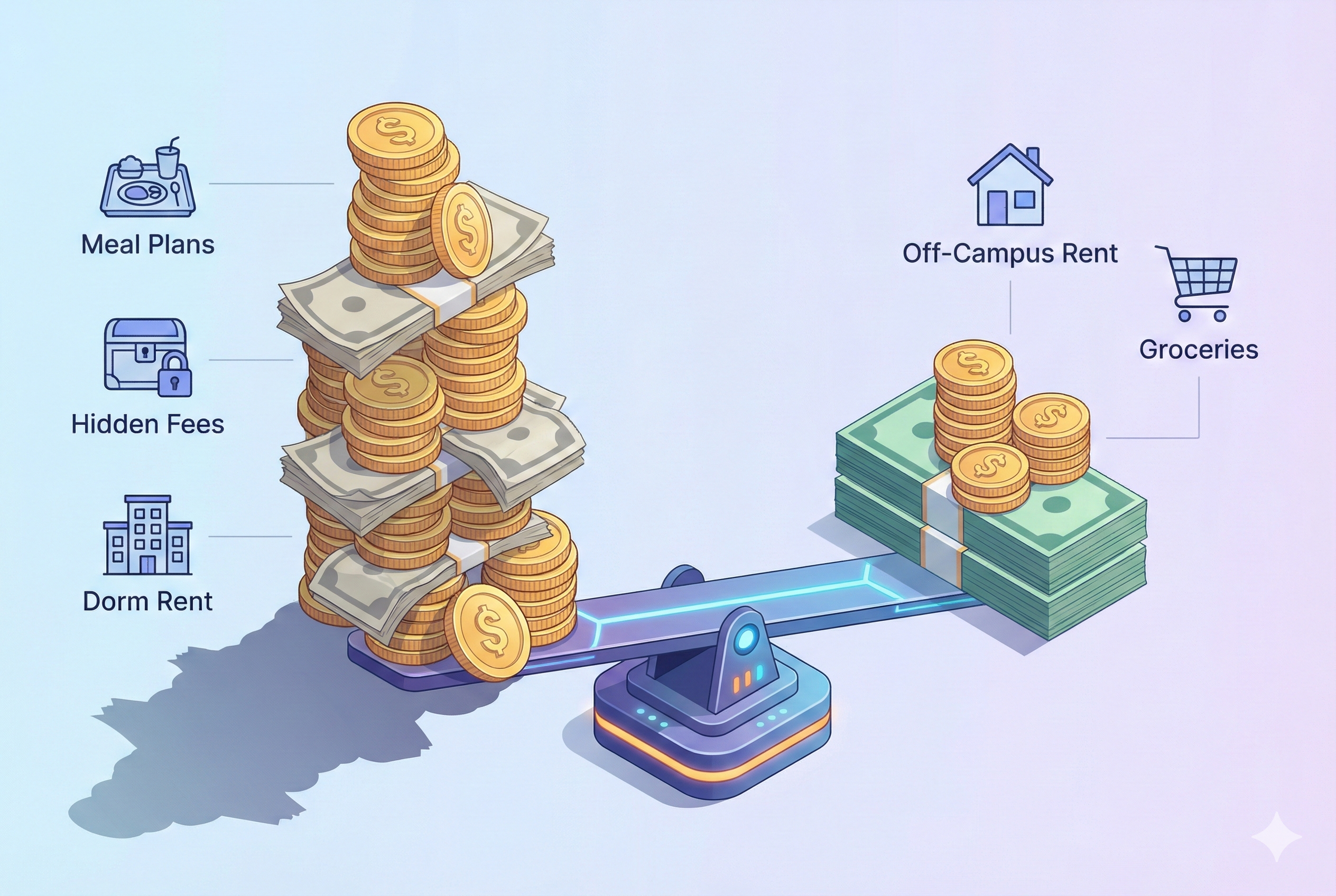
Moving off-campus is often the “hack” to saving money while upgrading your lifestyle. Here is why switching to a private student apartment usually offers better value:
1. No Mandatory Meal Plans (Big Savings)
When you live off-campus, you control your food budget. Cooking your own meals is significantly cheaper than a university meal plan. Even with occasional dining out, most students save $1,000+ per semester just by ditching the meal plan.
2. More Space & Privacy
For the same price (or less) than a shared dorm room, you can often find a private bedroom with an en-suite bathroom in an off-campus apartment.
3. Year-Round Access
Off-campus leases typically run for 12 months. This means you have a home during Winter Break, Spring Break, and Summer. No moving out, no storage fees, and no stress.
4. Better Amenities
Modern off-campus student housing, like that listed on uhomes.com, often includes luxury amenities like 24/7 gyms, swimming pools, and study lounges—all included in your rent.
Room and Board Fees vs. Off-Campus Housing
Below is a typical cost breakdown for a student in a major US city (e.g., Boston or NYC).
| Expense Category | On-Campus (Dorm + Meal Plan) | Off-Campus (uhomes Apartment) |
|---|---|---|
| Housing Cost | $1,200 – $1,800 / month (approx.) | $900 – $1,500 / month |
| Food (Board) | $600 – $800 / month (Mandatory) | $300 – $500 / month (Groceries) |
| Privacy | Low (Shared Room/Bathroom) | High (Private Room/En-suite) |
| Amenities | Basic | Gym, Pool, Rooftop, etc. |
| Summer Stay | Not Included (Extra Cost) | Included in 12-month lease |
| TOTAL Monthly | ~$2,200+ | ~$1,500+ |
Note: By cooking for yourself and finding a competitively priced apartment, you could save $500-700/month.
Average Student Rent in Top US Cities
Ready to see how far your budget goes? Rents vary significantly by location. Here is what you can expect in popular student hubs.
New York City (NYC):
Housing in the Big Apple is competitive. To beat the high prices of NYU or Columbia dorms, check out affordable student housing in New York. Look for options in Brooklyn or Queens for the best deals.Boston:
Home to over 35 colleges, Boston’s room and board fees are among the highest in the country. You can find better value by searching for student apartments in Boston, particularly in areas like Allston or Brighton.Los Angeles:
Don’t let USC or UCLA housing fees eat up your budget. Explore modern student living in Los Angeles that offers pools and air conditioning, essentials for the California climate.Chicago:
Compared to the coasts, Chicago offers great value. Student accommodation in Chicago often provides spacious high-rise living for a fraction of the cost of a cramped dorm.
Conclusion
While “Room and Board” offers the convenience of proximity, it often comes at a premium price with restricted freedom. By opting for off-campus housing, you not only save money on food and rent but also gain the independence of having your own space.
Don’t wait until the dorms are full. Browse uhomes.com today to compare thousands of verified student apartments near your university and secure the best rates for 2025.
FAQ
How much do room and board fees average around?
According to the statistics from the College Board, in 2024-2025, average room and board costs are $15,250 at private colleges, higher than $13,310 at public colleges. Below are the information on average room and board costs for college.
Is tuitoin included on room and board
No.
Tuition is not included on room and board. Both of them are essential components of college budget for students. Tuition is the primary cost paying for being taught in a college, while room and board fees refer to the cost of housing and food student spending at a college.
Does the term room and board include food?
Yes.
The term room and board include food. Room and board fees usually cover the cost of housing (room) and the cost of food (board). They vary depending on what kind of rooms and meal plans student choose.