


For international students, it is crucial to know about the types of student accommodation. If you are about to start a study journey in a foreign country, you must be excited and inevitably a little nervous. What you choose is not only a place to sleep, but a home in a foreign country. A good choice for different types of accommodation for students can help you settle down quickly and immerse you in a new environment. Next, we will introduce you to four types of student accommodation and their cons and pros, and tips for finding the right accommodation. Let’s have a look and find your perfect home!
Four Different Types of Accommodations for Students
Understanding these different types of accommodation for students is the first step in finding the ideal residence, as each option has its unique advantages. The following mainly introduces four mainstream types of student accommodations, classified by the operating entities, for your reference. You can learn in detail about the advantages and disadvantages of different types of rooms.
1. University Accommodation
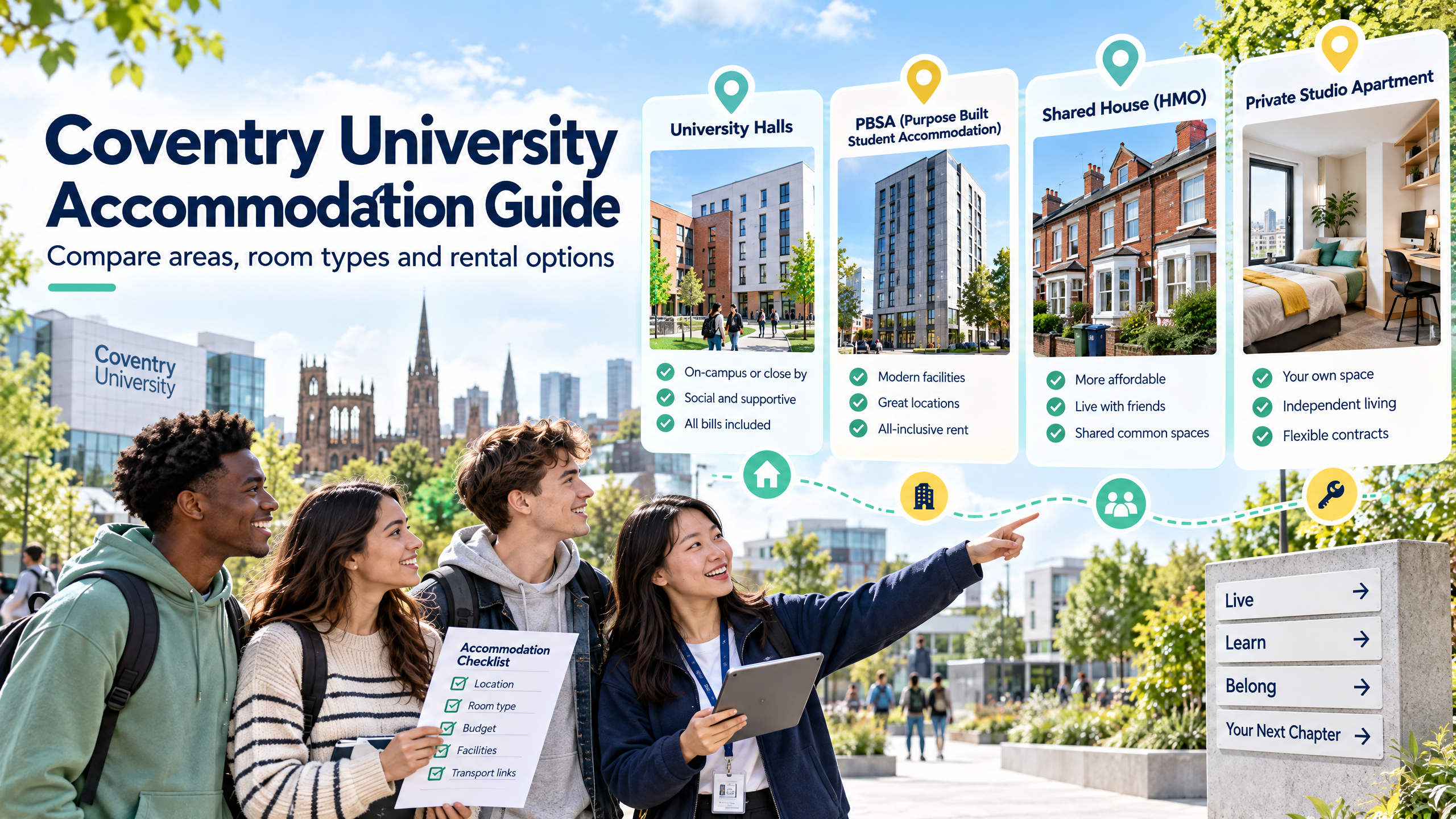
University Accommodation, as one of the most common types of student accommodation, is mainly open to first-year undergraduates. Its main advantages lie in its unbeatable locations. University accommodation is mostly located within or adjacent to campus, providing the ultimate in commuting convenience.
In terms of living experience, it randomly assigns roommates. You will share kitchen and bathroom facilities with 3 to 10 people. This shared space creates an excellent opportunity to make friends for you, but also may lead to interpersonal conflicts due to different habits of life habits.
In terms of price, University accommodation rents mainly include water, electricity and miscellaneous fees, but there will be differences depending on the city and degree of newness of the accommodation. Compared with Purpose-built Student Accommodation, University accommodation pays more attention to providing practical living guarantees, which makes it an ideal choice for freshmen during the transition period.
Main Room Types:
- Shared Rooms
Sharing a bedroom and all its facilities with others is the most cost-effective and social option. Weekly rent reference: Non-London £100 – £120 / London £140–£180
- Single Rooms
Have an independent bedroom, but share the bathroom and kitchen to strike a balance between privacy and social interaction. Weekly rent reference: Non-London £130 – £150 / London £170–£210
- En-suite Rooms (Single Room with Independent Bathroom)
The most mainstream choice at present is to equip a single room with a private bathroom and only share a kitchen. Weekly rent reference: Non-London £160 – £185 / London £210–£260
- Studio Apartments
It offers an independent kitchen and bathroom, with a completely private space, suitable for students who pursue an independent life and have a sufficient budget. Weekly rent reference: Non-London £200–£230 / London £260–£340
- Themed Specialised Housing
Accommodation is allocated based on specific interests or academic topics to facilitate the establishment of communities among like-minded students. Weekly rent reference: Non-London £150–£180 / London £200–£250

2. Purpose-built Student Accommodation (PBSA)
Different types of accommodations for students have different advantages. Purpose-built Student Accommodation is a high-end accommodation option tailored for students. Through professional platforms like uhomes.com, students can flexibly choose to rent a single room or share a room with others based on their needs. They can enjoy the privacy of living alone or live with friends.
This type of accommodation enjoys a significant geographical advantage. For instance, most of the student accommodations in London, UK, from the brand are located in core areas such as King’s Cross and Canary Wharf, and it is easy to walk or take the subway to reach prestigious universities like the London School of Economics and Political Science and Imperial College London. Its most distinctive feature lies in the complete supporting facilities, ranging from basic gyms and self-study rooms.
In terms of security, PBSA generally adopts access control systems, round-the-clock monitoring and 24-hour property management. Although the rent is slightly higher than that of traditional dormitories, the cost usually includes water, electricity and Internet. Overall, this is a choice that can make the life of studying abroad more worry-free and comfortable.
Main Room Types:
- En-suite Room: The most famous room type, equipped with privacy and sociability. Weekly rent reference: Non-London £155–£200 / London £250–£300
- Studio Apartment: Hold an independent kitchen and bathroom, you can enjoy a totally private space. Weekly rent reference: Non-London £200–£250 / London £340–£400+
- Shared Apartment: Renting a shared apartment with your friends, you need to share the kitchen and the living room. Weekly rent reference: Non-London £180–£250 (per person) / London £280–£380 (per person)
3. Private Rented Housing
Among the different types of accommodations for students, Private Rental Housing is ordinary residential properties directly rented through intermediaries or landlords, offering the greatest degree of freedom and local living experience. The most common form is a shared residence for multiple people, and an entire apartment can also be rented.
This is the most cost-effective choice, with more living space, but you need to handle trivial matters such as water and electricity bills and municipal tax exemptions by yourself. The lease contract is complex and may involve disputes over agency fees and deposits. Old facilities and untimely maintenance are also common problems.
Main Room Types:
- Shared House (including HMO): The most common form of private rental is sharing a house with multiple people. Weekly rent reference: Non-London £100–£150 / London £200–£300
- Self-Contained Flat/Apartment(including BTR): Rent a complete apartment with an independent kitchen and bathroom, which is suitable for those who pursue complete independence. Weekly rent reference: Non-London £200–£450 / London £350–£800+
4. Other Options: Homestay, Fraternity & Sorority Housing
In addition to the above three types of accommodation for students, some international students may also consider Homestay and Fraternity & Sorority Housing. These options are generally considered non-mainstream in the UK student housing market, serving only niche needs.
- Homestay
Homestay, a unique option among different types of accommodations for students, offers international students the opportunity to live with a local family. The primary value of Homestay is deep linguistic and cultural immersion. You can learn about local people’s life habits and experience their culture. You need to communicate with family members, so the improvement of your language ability is an advantage. This kind of accommodation typically provides all-inclusive service, including daily food. Weekly rent reference: Non-London £100–£160 / London £150–£250
- Fraternity & Sorority Housing
It is crucial to note that this type of student accommodation is almost exclusively found within the U.S. university system and is renowned for its unique community culture. By organising various social activities and establishing a close network of members, students are provided with a strong sense of belonging, but at the same time, they are also required to actively participate in organisational affairs and abide by group norms. Weekly rent reference: US Market (Approximate Weekly Cost): $200–$400+
| Student accommodation | |||
|---|---|---|---|
| Accommodation Type | Pros | Cons | |
University Accommodation |
• Short walk to campus, very convenient commute. • Great for socializing, easy to make friends quickly. • All-inclusive bills, no separate utility payments. • Good security and support, with on-site staff. |
• Low privacy, often sharing rooms and facilities. • Strict dormitory rules with many restrictions. • Facilities can be outdated and basic. • Fierce competition for applications, limited room type options. |
|
Purpose-Built Student Accommodation (PBSA) |
• Modern facilities (gym, cinema, study rooms). • Prime locations, close to university and city life. • Flexible lease lengths and various room types. • Professional management, quick maintenance. |
• Expensive rent, poor cost effectiveness. • Can feel impersonal, less community atmosphere. • Rooms can be small with limited space. • Requires booking months in advance, limited options. |
|
Private Rented Housing |
• Often cheaper, especially when shared (good value). • Freedom to choose housemates, location, and type of house. • More living space and a homely feel. • Flexible contracts, can often match your needs. |
• Responsible for utility bills and council tax. • Slow maintenance, many quality issues. • Need to independently evaluate safety. • Potential for issues like deposit disputes. |
|
Homestay, Fraternity & Sorority Housing |
• Immersive cultural and language experience. • Meals usually provided, no need to cook. • Safe and supportive home environment. • Lower cost, budget-friendly. |
• Less privacy, must follow family rules. • Need to adapt to the host family’s lifestyle. • Low freedom, strict visitor restrictions. • Commute may be longer to campus. |
|
Market Dynamics and Affordability Insights Across Types of Student Accommodation
“According to data from the National Student Accommodation Survey 2024 (NSAS 2024), student rents have increased for the fifth consecutive year, highlighting the critical importance of planning accommodation budgets in advance. This trend confirms the growing pressure on student finances, especially in core cities.”
- University Accommodation
While University Accommodation remains a more affordable option in cities like London (with an average weekly rent of approximately £232 for 2024/25), rent increases have been significant. Due to soaring operating costs, rents in this sector have seen a dramatic rise of 31% over the past three years, placing substantial financial strain on students. - Purpose-Built Student Accommodation (PBSA)
PBSA dominates the UK student accommodation market, holding over 56% of the total market value. Despite strong investment, there is a severe national shortfall of over 370,000 dedicated beds. This scarcity means that in major cities, approximately 2.7 students are competing for every one dedicated bed, rapidly driving up rental costs. - Private Rented Housing
Private Rented Housing (or HMOs) is still the most common choice for UK students. However, factors like a dwindling housing supply and rising market prices have made private renting extremely expensive in cities like London. Crucially, average weekly rents for shared private housing in key cities typically do not include utility bills, adding significant extra cost to students’ budgets. - Other Options (Homestay, Fraternity & Sorority Housing)
These options offer highly variable rates, with no reliable national average due to their localized nature. Homestay can be a lower-cost alternative, especially when meals are included. However, the wider issue of affordability remains: the maximum student maintenance loan for 2024/25 is now less than the average annual rent for private PBSA (approximately £13,595), forcing many students towards these non-standard options out of necessity.
| Student accommodation | ||||
|---|---|---|---|---|
| Accommodation Type | City | Average Weekly Rent Range / Median (GBP £) | Average Weekly Rent Range / Median (USD $) | Data Explanation |
| University Accommodation | London | £232 (Average) | $280 – $350 (Estimated) | Typically single rooms or shared facilities, with shorter contract periods (approx. 40-41 weeks). |
| New York (NYC) | £245 – £460 (Converted from monthly rent $1,200 – $2,250) |
$300 – $550 (Converted from monthly rent $1,200 – $2,250) |
Often shared bedrooms, contract aligns with the academic term, mostly on-campus or university-managed. |
|
| PBSA (Purpose-Built Student Accommodation) |
London | £295 – £395 (Average Range) | $350 – $480 (Estimated) | The PBSA average is £295. Premium/privately-run PBSA can reach £395 or more, typically all-inclusive of bills. |
| New York (NYC) | £300 – £600+ (Converted from monthly rent $1,500 – $3,000+) |
$370 – $750+ (Converted from monthly rent $1,500 – $3,000+) |
High-end student residences/private halls. Rent varies widely by location and facilities, often partially inclusive of bills. |
|
| Private Rented Housing | London | £150 – £400 (Range) | $180 – $480 (Estimated) | Renting a room in a shared flat/house (HMO). Prices highly volatile and usually exclude utility bills. |
| New York (NYC) | £400 – £700+ (Converted from monthly rent $1,900 – $3,500+) |
$500 – $850+ (Converted from monthly rent $1,900 – $3,500+) |
Renting a room in a shared apartment. Extremely high prices in popular areas and usually exclude bills. |
|
| Other Options (Homestay Fraternity & Sorority Housing) |
London/NYC | Highly variable, no reliable average | Highly variable, no reliable average | Homestay: Often lower cost, potentially £150 – £250 / $180 – $300 including meals. Fraternity/Sorority Housing: Costs are complex (dues, meals included) . |

A Guide to Choosing Different Types of Accommodation for Student
Securing the right types of student accommodation requires early planning and informed decision-making. Many students may be missing desirable properties due to a lack of preparation. The following five steps can help you perfectly complete the choice of accommodation.
Step 1: Start early (4-6 months ahead)
It is recommended to start preparing four to six months before the enrollment season. You will have more property selections and can enjoy an early bird discount.
Step 2: Create your shortlist
Firstly, you need to clarify your core demands, such as budget, commuting time, and necessary facilities. Then, select five to eight eligible listings from a professional student accommodation platform such as uhomes.com. Finally, you can evaluate the cost-effectiveness of each option.
Step 3: Virtual/actual viewings
When going through an online platform for a virtual viewing or site visit, you need to carefully examine the room layout, the surrounding environment, and the living facility.
Step 4: Understanding contracts
Please carefully read the contract, pay more attention to details, including the rent period, payment method, and conditions for deposit refund.
Step 5: Move-in preparation
Before moving in, take photos of the current state of the house, save the emergency contact information, and understand the repair reporting process. Joining the accommodation community helps to integrate into the new environment quickly and makes the transition period smoother.
Conclusion about Types of Student Accommodation
Looking at all types of student accommodation, from university accommodation to homestay, each option represents a different lifestyle. You need to clarify your focus and achieve the best combination among budget, geographical location, social needs and personal privacy. A desirable type of accommodation for students can fulfil your basic life demands and support your academic development. It is hoped that this guide can help you clarify each option and make a choice that makes you feel at ease and satisfied.
FAQs bout Types of Student Accommodation
What are the different types of accommodation for students?
There are four types of student accommodation, including University Accommodation, Purpose-built Student Accommodation, Private Rented Housing, Homestay, Fraternity & Sorority Housing. University Accommodation is suitable for freshmen who want to quickly integrate into campus life. Purpose-built Student Accommodation offers modern living facilities and all include bills. Private Rented Housing can fulfil your need for independent living. And a Homestay can make you deeply feel the local family culture. In addition, the fraternity/sorority dormitories pay attention to community building. You can select suitable accommodation according to your demands.
What types of accommodation in UK for international students?
For international students in the UK, the main types of accommodation are university accommodation, specially built student accommodation (PBSA), private rental housing and other options such as homestays. Your choice depends on the priority of your budget, privacy demands, and social life. Comparing different types of accommodation is necessary. Besides, many students find that field visits can help them make better decisions.
What types of accommodations for students with disabilities?
There are mainly four different types of accommodation for students with disability, including: Accessible University Housing, Specialised Purpose-Built Student Accommodation (PBSA), Adapted Private Rentals, and Assisted Living or Supported Housing.
- Accessible University Housing
Key Features:
Specially designed on-campus accommodation
Equipped with wheelchair accessible layouts
Emergency call buttons installed in rooms
Provides maximum convenience for students with disabilities
Direct access to university support services
- Specialised Purpose-Built Student Accommodation (PBSA)
Key Features:
Privately operated accommodations with modern designs
Features include widened doors and accessible routes
Emergency alert systems throughout the building
Located close to campus with good transport links
Assistance animals are generally welcome
- Adapted Private Rentals
Key Features:
Modified properties from private landlords
Requires early searching and negotiation
Students can use disability allowances for funding
Necessary adjustments can be arranged
Offers more independence and flexibility
- Assisted Living or Supported Housing
Key Features:
Designed for those requiring daily assistance
Combines housing with on-site care
Provides medical support services
Features specially tailored facilities
Suitable for students with higher support needs
What are the three main types of accommodation for students in Nottingham?
The three main types of student accommodation in Nottingham are university halls, private halls, and private shared housing.
- University Halls
Key Features:
Priority for first-year undergraduates
Located on campus or within walking distance
All-inclusive bills (water, electricity, Wi-Fi)
Social events and academic community building
- Private Halls (Purpose-Built Student Accommodation)
Key Features:
Modern high-rise buildings in the city centre
Premium amenities: gyms, cinema rooms, study spaces
All-inclusive bills and contents insurance
Secure access systems and 24/7 staff
A mix of domestic and international students
- Private Shared Housing
Key Features:
Traditional Victorian/Edwardian houses in student areas
Tenants are responsible for setting up bills
More privacy and independence
Often cheaper per person than halls
Gardens and larger living spaces
What types of accommodation in London?
Here are two types of accommodation in London for different visitors.
For Tourists & General Visitors
- Hotels
The most common options range from global luxury chains and boutique hotels with unique character to budget-friendly options. Amenities often include restaurants, concierge services, and fitness centres.
- Serviced Apartments & Self-Catering
Ideal for longer stays or families, providing a home-like environment with kitchen facilities. This category includes serviced apartments and vacation rentals (e.g., through platforms like Airbnb).
- Bed and Breakfasts (B&Bs) & Pub Accommodation
Offers a more intimate, often family-run experience. This includes traditional B&Bs and rooms located above pubs, providing a classic British feel.
For Students
- University Halls of Residence
University-managed accommodation, typically for first-year students. It’s a convenient and social option, often located near campus. Examples include halls from the University of London.
- Private Halls of Residence (PBSA)
Modern, purpose-built student accommodation operated by private companies. They offer high-end amenities like gyms and cinema rooms, and are popular for their all-inclusive bills and security.
- Private Rental
Renting a room in a shared house or a full apartment. This offers maximum independence and is common for students after their first year, though it requires managing bills and a tenancy agreement.
- Alternative Options
Homestay: Living with a local family, ideal for cultural immersion and language practice.
Studios: Self-contained units with a private kitchen and bathroom, offering a balance of independence and convenience.