





Average bills per month in the UK may seem easy to work out at first. In reality, the final amount can change quickly once you add everything up. The budget can become even harder to estimate when some bills are included in rent and others are not. This guide breaks down average household bills in the UK by bill type, household size and property size, so you can get a clearer idea of what you may actually pay each month.
Average Bills per Month UK
Generally, if we use current figures, the average household bill per month UK is around £255–£270 per month on core bills before council tax, or around £450–£470 per month when council tax is included. The real average utility payment per month can be lower or higher, of course. It depends on your home, your region, your usage and whether some bills are already included in your rent.
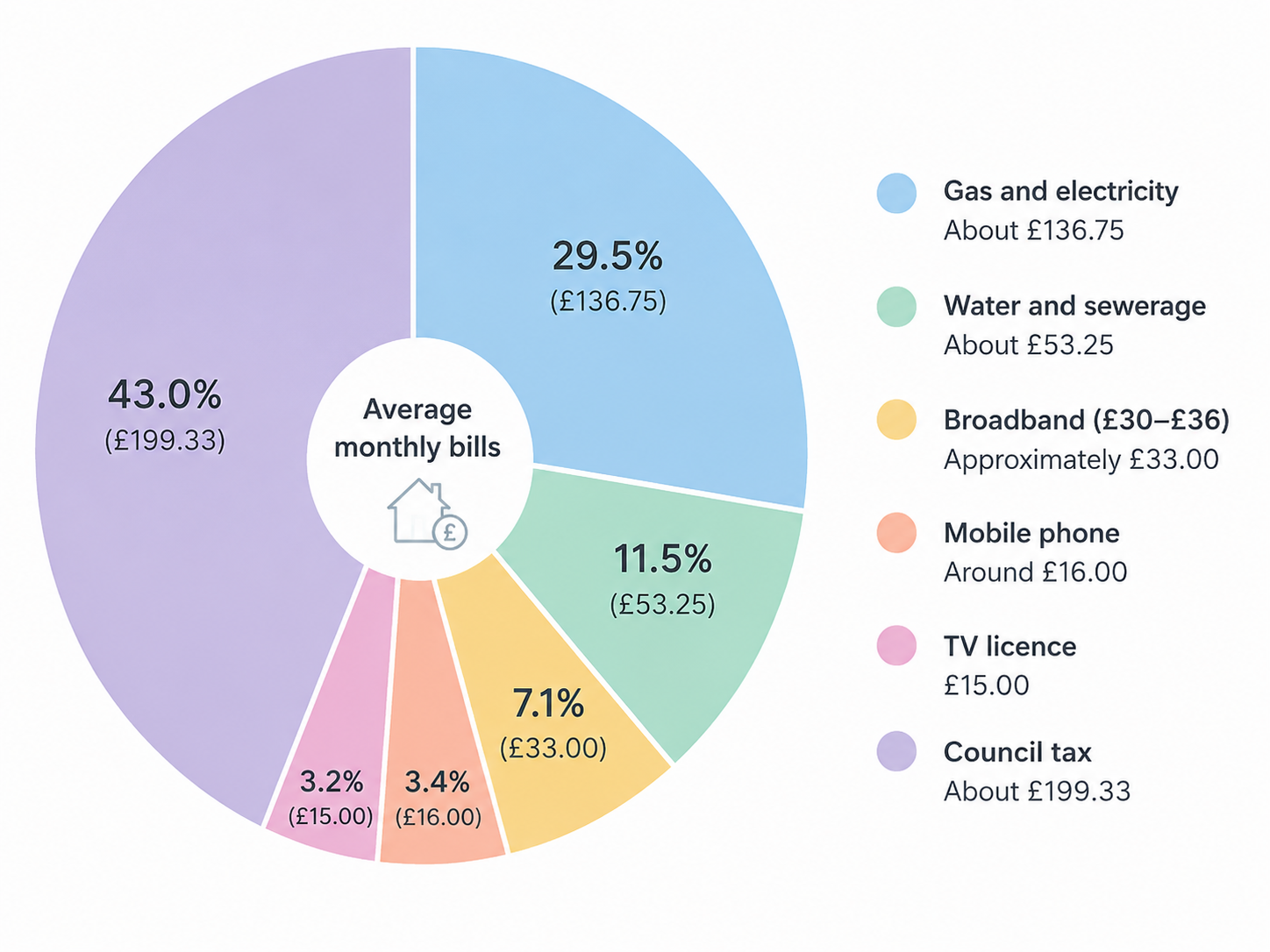
These numbers are useful, but they are not perfect. So, use them as a planning guide rather than a fixed answer.
What Does Average Bills per Month Cover?
List of Household Bills UK
The list of household bills UK can be short or long, depending on your living setup. But for most renters, these are the bills to check before signing anything:
| Household bill | Usually paid by |
|---|---|
| Gas and electricity | Tenant or homeowner, unless included in rent |
| Water and sewerage | Tenant, homeowner or landlord depending on contract |
| Broadband | Tenant or homeowner |
| Mobile phone | Individual |
| TV Licence | Household, if needed |
| Council tax | Household, unless exempt |
| Contents insurance | Tenant or homeowner |
This is why two households can both say they pay “bills,” but mean very different things. One person may include council tax and broadband. Another may only mean electricity, gas and water. So before comparing your monthly bills with anyone else’s, check what is actually included.
What Counts as a Utility Bill in UK?
The average UK bills per month usually means a bill for an essential home service, mainly electricity, gas and water. Broadband is often counted in everyday conversation too, even though it is technically more of a communications service.
The simple way to think about it is this: electricity, gas and water are the core utility bills. Broadband, phone, TV Licence and council tax are household bills, but not always “utility bills” in the strict sense.
What Bills Do You Pay When You Rent?
What bills you pay when you rent UK depends on your tenancy agreement. This sounds obvious, but it is the bit people often forget to check. In a private rental, you may need to pay for electricity, gas, water, broadband, council tax, TV Licence and your own phone bill separately. Some bills may be included, but you should never assume.
For students, this is also where bills-included accommodation can feel easier. Instead of guessing separate utility costs every month, you can see more of the real monthly cost before you move in. On uhomes.com, you can easily filter the properties you like with all bills included options. Students can compare student accommodation in UK, including studios, shared apartments and other bills-included options where bills may already be included in the rent. It is not just about saving money. It is also about having fewer things to worry about after moving in. When electricity, water, heating or WiFi are already covered, students can spend less time chasing bills and more time settling into their new city, studying and enjoying student life.
Council tax is another cost students should check carefully. If everyone in the household is a full-time student, the household is usually exempt from council tax. Student halls are also generally exempt. But if you live with someone who is not a full-time student, the rules can change. So the exemption comes from your student status and household situation, not simply from booking through a platform.
Average Utility Bill UK per Month by Bill Type
Average utility bills in the UK are made up of several regular household costs. Energy usually takes up the largest share of monthly bills, but smaller services can also increase the total cost when added together. The sections below break down the average cost of each main bill type to help you understand where your money is likely to go.
Average Electricity Monthly Bill in UK
The average electricity bill per month is about £72.91 for a medium-use household in UK. If you live alone in a flat, it may be closer to £54.41. If you live in a larger home with more people, it may be around £101.69.
| Usage level | Average electricity usage annually UK | Average electricity usage per month UK | Estimated monthly electricity bill |
|---|---|---|---|
| Low | 1,800 kWh | 150 kWh | About £54.41 |
| Medium | 2,700 kWh | 225 kWh | About £72.91 |
| High | 4,100 kWh | About 342 kWh | About £101.69 |
This is why the same “electricity bill” can look very different from one home to another. A person using a laptop, lights and a small fridge is not the same as a household using electric showers, a tumble dryer, multiple screens and work-from-home equipment every day.
Besides, the average monthly electric bill with solar panels UK may lower for homeowners, but they are not a normal monthly bill estimate for most renters or students. If you rent, you usually cannot install solar panels yourself. So for this guide, it makes more sense to focus on normal electricity usage and unit rates.
How Much Is Electricity per Kwh UK?
Electricity costs about 24.67p per kWh under the Ofgem April–June 2026 average Direct Debit price cap. There is also a daily standing charge of 57.21p, so your bill is not just usage. You pay a fixed daily cost too.
A rough way to think about it since appliances may vary:
| Appliance example | Approximate kWh use | Cost at 24.67p/kWh | Estimated monthly electricity bill |
|---|---|---|---|
| 100W lightbulb for 10 hours | 1 kWh | About 25p | About £54.41 |
| Electric oven for 30 minutes | Around 2 kWh | About 49p | About £72.91 |
| Tumble dryer cycle | Around 4.5 kWh | About £1.11 | About £101.69 |
Average Gas Bill UK per Month in UK
The average monthly gas bill UK is about £63.86 for a medium-use household. For a low-use flat, it may be closer to £44.72. For a high-use larger home, it can be about £90.16.
| Usage level | Annual gas use | Monthly gas use | Estimated monthly gas bill |
|---|---|---|---|
| Low | 7,500 kWh | 625 kWh | About £44.72 |
| Medium | 11,500 kWh | 958 kWh | About £63.86 |
| High | 17,000 kWh | 1,417 kWh | About £90.16 |
Average Water Bill in UK Monthly
The average water bill UK monthly is about £53.25, based on the average combined water and sewerage bill in England and Wales. This includes both water supply and sewerage charges, so it is not just the water you use from the tap.
The average monthly water bill UK can still vary by region. It also depends on whether your home has a water meter. A metered home is charged more directly by usage, while an unmetered home is charged in a different way.
| Water bill type | Annual average | Monthly average |
|---|---|---|
| Water only | £309 | About £25.75 |
| Sewerage only | £330 | About £27.50 |
| Combined water and sewerage | £639 | About £53.25 |
Average Phone Bill per Month in UK
The average phone bill per month UK is around £16 for many mid-range SIM-only users, but it can be higher if you pay for a handset contract. This makes it one of the smaller monthly bills, but it still matters when you calculate your average bills per month UK.
Your actual phone bill depends on your data allowance, provider, contract type and whether you are still paying for a phone. SIM-only plans are usually cheaper, while handset contracts can cost much more. It is also worth checking old out-of-contract plans, because people sometimes overpay without noticing.
| Phone bill type | Monthly cost guide |
|---|---|
| Low-cost SIM-only | Under £10 possible |
| Mid-range SIM-only | Around £16 |
| Phone contract with handset | Often much higher |
| Out-of-contract old plan | Can be poor value |
This is a bill where small overpayments often go unnoticed. A few extra pounds each month may seem minor, but over a year they can add up significantly
Average Broadband Bill UK per Month
The average broadband bill UK per month is often around £30–£36 for many standard home packages, but the cost depends on provider, speed, contract status and whether you are on a promotional deal. Faster full-fibre plans can cost more, while basic or promotional deals may cost less. Ofcom’s pricing report also notes that in-contract broadband customers usually pay less than out-of-contract customers.
| Broadband situation | Monthly cost guide |
|---|---|
| Basic or promotional deal | Around £20–£30 |
| Common home broadband | Around £30–£36 |
| Faster full-fibre package | Around £35–£50+ |
| Out-of-contract broadband | Often higher |
So if your broadband bill suddenly feels silly, check your contract end date first. Sometimes the easiest saving is asking your current provider for a new deal, instead of switching provider.
Average Bills per Month UK by Household Size and Property Size
Average bills per month UK change a lot depending on how many people live in the home and what type of property it is. A single person in a studio will not use energy in the same way as a family in a 3 bed house. That sounds obvious, but it is exactly why one “average bill” number can feel a bit misleading.
Some bills also behave differently. Broadband and TV Licence can usually be shared by the whole household. Phone bills are personal. Energy and water usually rise when more people live in the home, but they do not always rise evenly.
Average Bills per Month in UK by Household Size
Here is a simple way to estimate average bills per month UK by household size. Theses figures include gas, electricity, water, broadband, phone bills and TV Licence. Council tax is shown separately because students may be exempt, and council tax also changes by property band and local area.
| Household size | Estimated monthly bills before council tax | Estimated monthly bills with council tax |
|---|---|---|
| Average monthly bills UK for 1 person | About £216 | About £365 with single-person council tax discount |
| Average monthly bills UK for 2 person | About £270 | About £469 with average Band D council tax |
| Average monthly bills UK for a family of 4 | About £357 | About £556 with average Band D council tax |
Average Bills per Month in UK by Property Size
Property size also changes the average bills per month UK. A flat usually costs less to heat than a house. But it is not always that simple. A badly insulated 1 bed flat can still be expensive, while a newer 2 bed flat may be easier to run.
| Property size | Estimated monthly bills before council tax | Estimated monthly bills with council tax |
|---|---|---|
| Average bills per month UK 1 bed flat | About £216 | About £365 with single-person council tax discount |
| Average bills per month UK 2 bed flat | About £254–£270 | About £453–£469 with average Band D council tax |
| Average bills per month UK 2 bed house | About £270–£300 | About £469–£499 with average Band D council tax |
| Average bills per month UK 3 bed house | About £314–£357 | About £513–£556 with average Band D council tax |
Overall, the main point is not that one property type is always cheaper than another. It is more about control. A shared flat or 2 bed house may reduce the cost per person, but the final bill can still change because of other people’s habits. Someone may use more heating, take longer showers or choose a more expensive broadband plan. The point is not just to find the lowest headline rent. It is to understand the real monthly cost before you move in.
How To Save on Utility Bills in UK
How to save on utility bills UK is not always about making big changes. Sometimes it is more about noticing where money quietly goes each month. So before you panic about high costs, it helps to start with the parts you can actually control.
Why Average Bills per Month in UK Can Change?
Average bills per month UK do not change for just one reason. Property size matters, but it is not the whole story. Two people can live in similar homes and still pay different bills because of heating habits, appliance use, tariff rates, water usage and local charges. So after looking at household size and property size, it also helps to understand what actually pushes the bill up or down.
How to Reduce Average Energy Bills UK?
To lower average energy bills in the UK, focus on your usage first, not the tariff. Many people rush to switch suppliers, but it’s usually your daily habits that have the biggest impact on the bill.
Here are a few simple things to try:
Lower your heating by 1°C: Heating is one of the biggest energy costs in a UK home. Even a small change can help over the month.
Use your washing machine or dishwasher with a full load: Half-loads feel convenient, but they can mean more cycles, more electricity and more hot water.
Avoid the tumble dryer when you can: A tumble dryer cycle can use around 4.5 kWh, so using it often can quietly push your electricity bill up.
Submit meter readings regularly: This helps you avoid estimated bills. Estimated bills can be too high or too low, and both are annoying in different ways.
Check your tariff end date: If your fixed tariff ends, you may be moved to a different rate. It is worth checking before the bill suddenly changes.
Improve insulation if you are allowed to: For homeowners, this could mean loft insulation or draught-proofing. For renters, it may be smaller things like using draught excluders or thermal curtains.
Renting usually means you can’t upgrade the boiler, windows, or insulation. So concentrate on what you can control: heating habits, meter readings, appliance use, and choosing properties with transparent bills.
Tips To Track Household Bills in UK:
Tracking household bills UK does not need to be complicated. Honestly, a simple note on your phone is already better than guessing every month.
Here is what to track:
Write down every monthly bill: Include electricity, gas, water, broadband, phone, TV Licence, council tax and subscriptions.
Record the amount and due date: This helps you avoid late payments, especially if several bills come out at different times.
Keep meter readings: Take a photo or write them down once a month. This is useful if your supplier sends an estimated bill.
Save contract end dates: Broadband, phone and energy contracts can become more expensive after the deal ends.
Track shared house payments: If you live with housemates, write down who paid and who still owes money. It feels awkward, but it avoids arguments later.
Check what is included in your rent: Some student accommodation includes electricity, water, heating and WiFi. Some does not. Always check the property details before booking.
Keep screenshots or copies of bills: This is useful if there is a dispute, or if you need proof of address later.
Conclusion
Average bills per month UK are useful as a starting point, not a final answer. A typical household may spend around £255–£270 per month before council tax, and closer to £450–£470 per month with council tax included. But the real number depends on your home, usage, location and whether some bills are already included in rent.
The safest way to budget is simple: check what your rent includes, estimate energy from the property size, add water, broadband and phone, then check council tax rules. It is not exciting, but it can save you from nasty surprises later.
FAQ
What is a utility bill?
A utility bill in the UK is usually a bill for essential home services, mainly electricity, gas and water. Broadband is often grouped with utility bills in everyday conversation, because it is also a regular household cost. But strictly speaking, broadband is more of a communications bill. For renters, this is something worth checking before moving in. Some homes include electricity, water, heating or WiFi in the rent. Others do not. So the safest thing is to look at your tenancy agreement or property details page before you budget.
How much is water a gallon in UK?
The average water bill per month UK is about £53.25, based on the average combined water and sewerage bill of £639 per year in England and Wales. This includes both clean water and wastewater charges, so it is more than just the water you use from the tap. Your actual water bill can still be different. It depends on your region, supplier and whether your home has a water meter.
Is electricity cheaper than gas in UK?
No, electricity is not cheaper than gas in the UK when you compare the price per kWh. Under the April–June 2026 Ofgem price cap, electricity is about 24.67p per kWh, while gas is about 5.74p per kWh. That is why electric heating can feel expensive, especially in winter. But the final bill still depends on the home itself. Insulation, heating habits, boiler efficiency and daily usage all make a difference.
Is broadband a utility bill?
Broadband is often treated as a utility bill in the UK, although it is more accurately a communications bill. People usually include it in household bills because most homes pay for it every month, just like energy and water.
Is WIFI a utility bill?
WiFi itself is not a utility bill; broadband is the bill you actually pay for. WiFi is just the wireless connection inside your home. People say “WiFi bill” because it sounds natural, but the monthly charge is usually for broadband or internet service. So when you calculate average bills per month UK, count broadband as the cost, not WiFi as a separate bill.
Is TV License a utility bill?
A TV Licence is not usually classed as a utility bill in the UK, but it can still be part of your monthly household bills. It is not the same as electricity, gas or water. It is more of a media-related household cost. From April 2026, a colour TV Licence costs £180 per year, which works out at £15 per month. You only need one if you watch or record live TV, or use BBC iPlayer. If you do not use those services, this cost may not apply to you.
Can you live on £1000 a month in the UK?
Yes, you can live on £1000 a month in the UK, but it is much easier if your rent is low, your bills are included, or you live outside expensive cities like London. If rent takes up most of your budget, £1000 can feel very tight after food, transport, phone bills and daily spending. For students, it may be more manageable if you live in bills-included student accommodation and do not need to pay council tax as a full-time student. So, £1000 can work in some cases, but it is not a comfortable budget for everyone.