


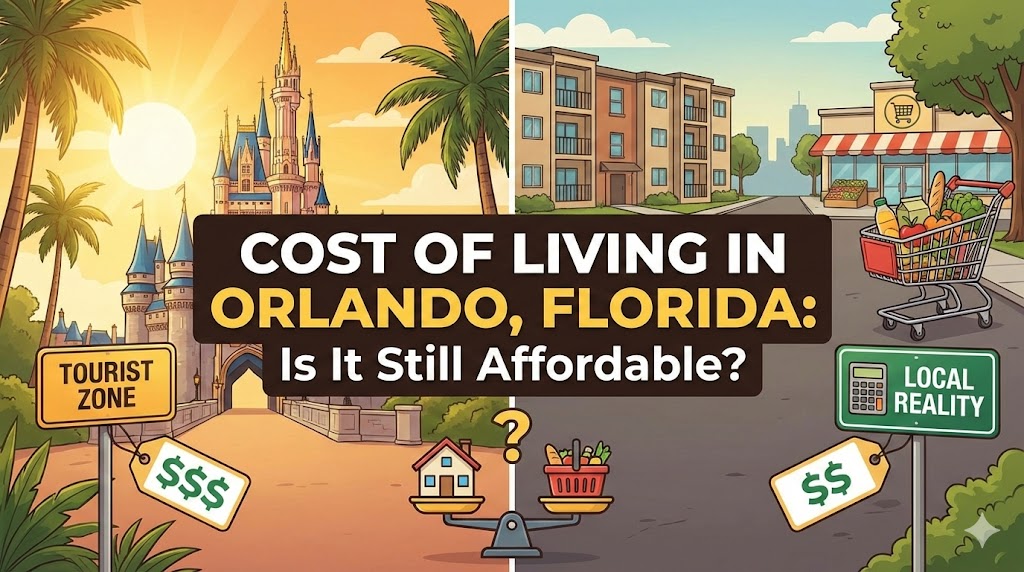
Are you considering a move to the City Beautiful? While Orlando is world-famous for its theme parks, its real appeal in 2026 lies in its balanced economy. Currently, the cost of living in Orlando, Florida, is about 8% lower than the national average, making it one of the most financially attractive metropolitan areas in the Southeast.
Driven largely by a favorable real estate market, the housing costs are 20% below the U.S. norm. While utilities are 3% cheaper than average, residents should budget for groceries that trend 5% higher. For a single individual, the average monthly expense is roughly $1,210 (excluding rent), making the “City Beautiful” one of the most balanced metropolitan areas in the Sunshine State.
Cost of Living in Orlando, Florida vs. National Average
Getting a clear picture of Central Florida’s economy means looking past the tourism hype and at the actual numbers. In 2026, the living expenses in Orlando, Florida, remains a major draw for newcomers, offering a solid mix of low overhead and high quality of life. While you’ll likely save big on housing and power bills, some daily costs have ticked up as the city continues to expand. To see how your budget might shift, check out the breakdown below comparing Orlando’s core expenses to the national average.
| Category | Orlando Cost of Living | Comparison to National Avg. |
|---|---|---|
| Housing | $1,300-$1,840 | 8% lower |
| Groceries | $300-$400 | 5% higher |
| Utilities | $150-$250 | 3% lower |
| Healthcare | $150-$300 | 6% lower |
| Transportation | $50-$150 | 4% lower |
| Goods & Services | $200-$250 | 4% lower |
Orlando Housing Cost: Rent vs. Buy
When discussing the cost of living in Orlando, FL, housing is the most significant factor for most budgets. While local house prices are currently 20% lower than the national average, the rental market has seen a different trend with average rents rising by 4.8% over the past year. This means whether it’s better to buy or rent really comes down to how long you plan to stay in the area.
House Price
When calculating the cost of living, the average cost of an apartment in Orlando, Florida, will always be your biggest line item. But here is the good news: while most major U.S. cities feel increasingly out of reach, Orlando’s median home price of $427,058 offers a breath of fresh air. This price point sits 20% below the national average, giving buyers a rare chance to enter the Florida market without the “Miami price tag.”
To keep your finances healthy, we stick to the “30% Rule.” This means your total housing costs—mortgage, taxes, and that all-important Florida home insurance—shouldn’t eat up more than 30% of your gross income. Whether you’re hunting for a downtown condo or a backyard in the suburbs, checking the price per square foot is the smartest way to see exactly what your money buys you here.
| Apartment | Price |
|---|---|
| Price per Square Feet to Buy Apartment in City Centre | $217.39-$304.72 |
| Price per Square Feet to Buy Apartment Outside of Centre | $227.98-$274.06 |
Housing for Rent
For most newcomers to Orlando, renting a house is the most direct way to experience the cost of life in different communities. Currently, the median rent is $1,282 per month. Although this figure seems very attractive, due to Orlando’s scattered layout, there is a significant price difference between high-end apartments in the city center and multi-family houses in the suburbs.
When formulating the budget, in addition to the basic rent, you also need to set aside funds to cover common amenities fees common in Florida communities and, possibly, parking fees. To assist you in making a more accurate assessment, we have compiled the rental reference data for different core areas:
| Apartment | Price |
|---|---|
| 1 Bedroom Apartment in City Centre | $1,500-$2.200/month |
| 1 Bedroom Apartment Outside of City Centre | $1,200-$1,950/month |
| 3 Bedroom Apartment in City Centre | $2,500-$4,000/month |
| 3 Bedroom Apartment Outside of City Centre | $2,070-$3,500/month |
Student Housing in Orlando, FL
If you’re heading to UCF, Rollins College, or Full Sail University, finding a spot that’s both close to campus and easy on the wallet is usually the top priority. Moving to a new city is stressful enough, which is why platforms like uhomes.com are a total game-changer for anyone hunting for student housing in Orlando, FL. Instead of scrolling through endless, sketchy ads, you get access to verified listings—giving you much-needed peace of mind if you’re booking from out of state or overseas. What really sets them apart is the 1-on-1 professional support; they actually walk you through the fine print of your lease. Plus, with a price-match guarantee and exclusive offers, you’re much more likely to snag a high-quality apartment that won’t blow your budget, letting you focus on your classes rather than your rent.
| Student Housing | Price |
|---|---|
| Single Room | $996.50/month |
| Studio | $1,239/month |
| 1B apartment | $1,683/month |
| 2B apartment | $1,899/month |
| 3B apartment | $2,215/month |
| 4B apartment | $1,018/month |
| 5B+ apartment | $1,114/month |
Average Utilities Cost in Orlando, Florida
Budgeting for a move to Central Florida comes with a small but helpful financial break: utility prices in Orlando are 3% lower than the national average. This discount is a vital part of keeping the overall Orlando cost of living manageable, especially when offsetting other rising costs. While the local heat means your air conditioning will work overtime during the summer months, the base rates for power and water remain surprisingly competitive compared to other major U.S. hubs. To help you plan your monthly outgoings, the table below outlines what you can expect to pay for essential services, including energy, water, and digital connectivity.
| Utilities | Price |
|---|---|
| Basic Utilities for 915 Square Feet Apartment (Electricity, Heating, Cooling, Water, Garbage) | $150-$280/month |
| Mobile Phone Plan (Monthly, with Calls and 10GB+ Data) | $31-$100/month |
| Broadband Internet (Unlimited Data, 60 Mbps or Higher) | $50-$100/month |
Grocery Prices & Dining Out
Filling up your fridge in Orlando might be a bit more expensive than you’d expect. Despite the local citrus groves and farms, grocery prices here are roughly 5% higher than the national average. This small premium is a crucial detail for your Orlando cost of living budget, especially since it eats into the savings you might get from lower utility bills. Whether you’re a local or just moving in, you’ll want to be strategic about where you shop. Here is a quick look at what basic staples will cost you at the store right now:
| Markets | Price |
|---|---|
| Milk (Regular, 1 Liter) | $0.79-$1.59 |
| Fresh White Bread (1 lb Loaf) | $1.89-$6.05 |
| Eggs (12, Large Size) | $2.00-$8.00 |
| Local Cheese (1 lb) | $3.00-$6.00 |
| Chicken Fillets (1 lb) | $3.00-$8.16 |
| Apples (1 lb) | $1.13-$4.00 |
| Tomatoes (1 lb) | $1.00-$4.00 |
| Potatoes (1 lb) | $0.46-$2.00 |
| Lettuce (1 Head) | $1.97-$4.00 |
| Bottle of Wine (Mid-Range) | $9.00-$20.00 |
| Domestic Beer (16.9 oz Bottle) | $1.80-$4.64 |
Average Transportation and Commuting Costs
Navigating the metro area is actually one of the few places your budget gets a break, with transportation costs running 4% below the national average. However, that figure comes with a caveat: the cost of living in Orlando FL almost always requires owning a car. The city is famous for its sprawl, and while you’ll save on gas and maintenance compared to other states, you’ll likely spend more time behind the wheel. If you’re lucky enough to live near a SunRail station, you can skip the daily nightmare of I-4 traffic for your commute, and the LYNX bus network offers a budget-friendly backup for getting around. Still, for most, a reliable vehicle remains a non-negotiable expense. To see how these costs stack up, check out the breakdown below for everything from fuel prices to the cost of a new sedan.
| Transportation | Price |
|---|---|
| One-Way Ticket (Local Transport) | $2.00-$4.50 |
| Monthly Public Transport Pass (Regular Price) | $50.00 |
| Taxi Start (Standard Tariff) | $2.90-$3.50 |
| Taxi 1 mile (Standard Tariff) | $3.06 |
| Taxi 1 Hour Waiting (Standard Tariff) | $35 |
| Gasoline (1 Liter) | $0.79-$0.99 |
| Volkswagen Golf 1.5 (or Equivalent New Compact Car) | $36,000.00-$37,241.00 |
| Toyota Corolla Sedan 1.6 (or Equivalent New Mid-Size Car) | $25,142.63-$26,628.00 |
Average Healthcare and Medical Costs
Keeping up with your health in Central Florida is actually more affordable than in many other major hubs, with medical expenses sitting about 6% below the national average. This gap gives you some much-needed breathing room when navigating the cost of living in Orlando, Florida. If you’re a student or a young professional, it’s smart to set aside $400 to $600 a month to cover your premiums and those unexpected out-of-pocket costs. For those supporting a family, you’re looking at a monthly commitment closer to $1,200. Luckily, with heavyweights like AdventHealth and Orlando Health dominating the local landscape, finding high-quality care is rarely a struggle. To give you a better idea of what to expect, the table below breaks down the typical costs for everything from a quick dentist visit to picking up a pack of Ibuprofen.
| Healthcare | Price |
|---|---|
| Doctor Visit | $131.00 |
| Dentist Visit | $98.76 |
| Optometrist Visit | $96.24 |
| Prescription Drug | $18.05 |
| Ibuprofen | $11.86 |
Average Goods and Services
When you look past the big-ticket bills like rent, you’ll find that everyday essentials in Central Florida are surprisingly affordable. In fact, prices for general goods and services in Orlando sit about 6% below the national average, providing a much-needed buffer for your overall living expenses in Orlando, Florida. For most people, these routine expenses—everything from your gym dues to basic hygiene products—usually run between $150 and $250 a month. While tourists might pay a premium nearby, your day-to-day “maintenance” costs are much easier to handle. To help you fine-tune your budget, the table below breaks down what you’ll actually pay for common items, from a basic tube of toothpaste to a bottle of shampoo.
| Service | Price |
|---|---|
| Toothpaste | $4.02 |
| Shampoo | $1.71 |
| Dry Cleaning | $18.57 |
| Women Slacks | $37.01 |
| Washer Repair | $71.21 |
| Movie | $15.38 |
| Yoga | $15.52 |
| Tennis Balls | $3.82 |
| Haircut | $22.04 |
Comparison with Other Cities in Florida
On the Florida pricing spectrum, the living expenses in Orlando, Florida, land right in that “sweet spot” between affordability and big-city opportunity. With a cost index of 102.3, you’re paying just a fraction more than the national average, but you’re getting a lot of bang for your buck. If you’re eyeing Miami, be prepared for a reality check—their index sits in the 118–120 range, making Orlando feel like a total bargain. On the flip side, if you’re strictly chasing the lowest possible bills, Tampa (95–97) and Jacksonville (92–94) are still technically cheaper on paper. However, for most people, Orlando is the winner because it balances those slightly higher costs with a powerhouse job market and perks that smaller Florida towns just can’t pull off.
| City | Cost of Living Index |
|---|---|
| Orlando | 102.3 |
| Miami | 118–120 |
| Tampa | 95–97 |
| Jacksonville | 92–94 |
| Tallahassee | 90–92 |
| Gainesville | 91–93 |
Conclusion
So, is the Orlando cost of living actually manageable? The short answer is: yes, but it requires a strategy. Orlando isn’t the cheapest city in the Sunshine State, but it’s arguably the one that offers the most “bang for your buck.” While you’ll need to account for a 5% premium on groceries and a car-dependent lifestyle, these are often offset by a 20% discount on housing compared to other major U.S. hubs. The real win here is the balance—you’re getting big-city amenities and a massive job market without the crushing price tags of Miami or the West Coast.
For students and young professionals, the secret is to leverage the lower utility costs and look for housing just outside the main tourist corridors. For families, the stability of the local healthcare system and the consistent value of the real estate market make it a solid long-term bet. Ultimately, moving to Orlando isn’t just about finding a cheaper place to live; it’s about trading the “national average” for a lifestyle that actually feels like a permanent vacation.
FAQ
Is Orlando expensive to live in?
The overall cost of living in Orlando is generally regarded as moderate, being approximately 4.5% lower than the national average. Compared to many major cities in the United States, the cost of living here is lower, and it is 24% lower than that of Miami. However, with the increase in housing prices, the cost of living here is no longer as low as it was a few years ago.
Can you live comfortably on $50,000 a year in Florida?
Yes, in Florida, a person with an annual income of $50,000 can still lead a relatively comfortable life, but this requires careful budget planning, especially in high-consumption areas such as Miami or Tampa.
What is the cost of living in Florida for a single person?
In Florida, a single person typically needs an annual income of around $46,645 to $57,064 to meet basic living needs, which amounts to approximately $3,900 to $5,000 per month.
Can I retire in Florida on $3,000 a month?
Yes, it is entirely feasible to retire with only $3,000 per month in Florida, especially in some more affordable inland cities or northern cities such as Tallahassee, Pensacola, Panama City or Jacksonville.