

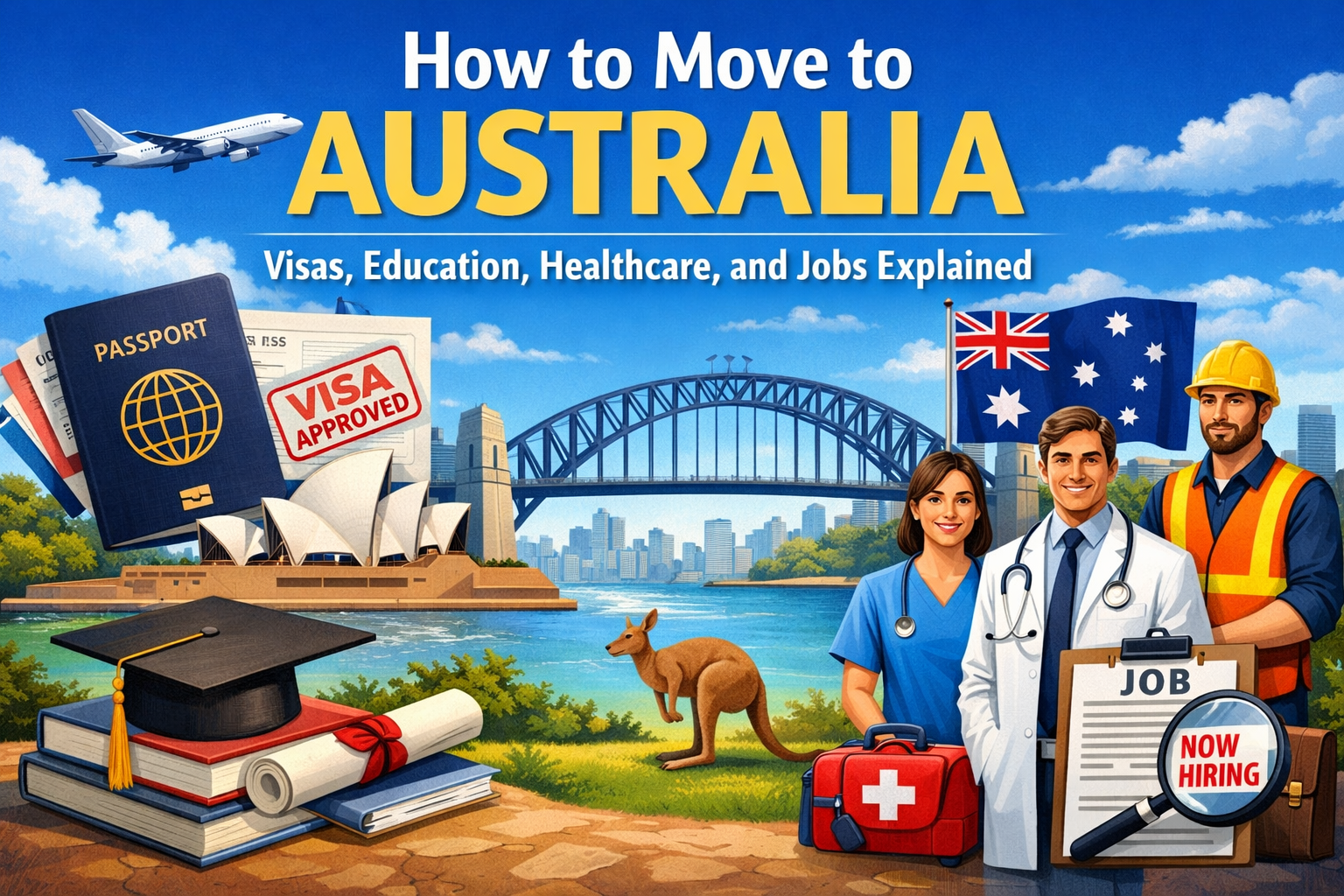
If you are wondering how to move to Australia, stop staring at the postcards and start bracing for the paperwork. Moving to the “Great Southern Land” is a massive life pivot that involves a gruelling grind through visa subclasses and points tests. To succeed, you must cut through the noise and face the cold logic of the Australian immigration requirements. Whether you’re targeting a Subclass 189 or 190, you need a fluff-free roadmap through the Home Affairs system. Stop scrolling through travel brochures and start auditing your points; it’s time to turn a logistical headache into a home.
Why People Choose to Move To Australia?
Australia’s appeal as a top-tier destination stems from its rare ability to balance economic resilience with a genuine focus on well-being. Beyond the competitive salaries and robust job market for specialists, the country offers a lifestyle that prioritizes the outdoors—supported by a foundation of public safety, world-class healthcare, and a prestigious education system, prompting many to explore how to migrate to Australia.
- Superior Livability and Public Safety
Australia consistently secures its spot atop global livability rankings, offering a stable environment where public safety and high standards are the daily norm.
- Economic Resilience and Work-Life Balance
A robust job market provides competitive salaries alongside a deep cultural respect for personal time and professional boundaries.
- Premier Climate and Natural Landscapes
The country’s year-round sunshine and vast, pristine ecosystems offer an unparalleled outdoor lifestyle for those escaping harsher northern climates.
- Excellence in Healthcare and Education
Residents benefit from a sophisticated dual public-private healthcare model and a university system that ranks among the world’s elite.
- A Global Model for Multiculturalism
With nearly half the population having international roots, Australia stands as a welcoming, diverse society that prioritises social inclusion.
- An Ideal Setting for Family Growth
The combination of safe, community-focused neighborhoods and an active lifestyle makes the country a gold standard for raising the next generation.
Visas Option for Expats Moving to Australia
Before you start packing and booking your flight, it’s important to make sure you have the correct visa for Australia. Knowing the Australian migration requirements and the different visa options in advance can help you avoid delays or complications during the application process of immigrating to Australia.
| Subclass | Visa Type | Residency Status | Cost (AUD) | Age Limit |
|---|---|---|---|---|
| 189 | Skilled Independent Visa | Permanent | 4,000 – 5,000 | Under 45 |
| 190 | Skilled Nominated Visa | Permanent | 4,000 – 5,000 | Under 45 |
| 491 | Skilled Work Regional Visa | Provisional (5 years) | 4,000 – 5,000 | None |
| 482 | Temporary Skill Shortage Visa | Temporary (2–4 years) | 3,000 – 4,000 | None |
| 500 | Student Visa | Up to 5 years | 454 | None |
| 820 / 801 | Partner Visa | Temporary to Permanent | 8,000 – 9,000 | None |
- Skilled Independent Visa (Subclass 189)
A permanent visa for skilled professionals who qualify through the points system and do not need sponsorship from an employer or government. - Skilled Nominated Visa (Subclass 190)
A permanent residency visa for skilled workers who are selected and nominated by an Australian state or territory. - Skilled Work Regional (Provisional) Visa (Subclass 491)
A temporary visa that allows skilled workers to live and work in designated regional areas of Australia, with a pathway to permanent residence. - Temporary Skill Shortage Visa (Subclass 482)
An employer-sponsored temporary visa that enables skilled workers to fill labour shortages and may lead to permanent residency later on. - Partner Visa (Subclasses 820/801)
A visa for people in a genuine relationship with an Australian citizen or permanent resident, starting with a temporary stay and progressing to permanent residency. - Student Visa (Subclass 500)
- Working Holiday Visa (Subclasses 417/462)
A short-term visa that lets eligible young people travel around Australia while working to support their stay.
Visa for Green Card holders
You’re free to pursue any Australian visa you qualify for, regardless of your US Green Card. Just keep in mind that moving abroad can be a bit of a balancing act regarding your US permanent residency requirements; you don’t want to jeopardize your status by staying away too long. For “mixed-status” couples, the Partner visa remains the go-to pathway for making the jump to Australia.

Requirements for Move to Australia
Immigrating to Australia is a fairly structured process, requirments usually around health, character, and age, usually requiring applicants to be under 45. Most people navigate through skilled or sponsored visa tracks. The skilled route is particularly specific—you’ll need 65 points minimum, a job that matches the national occupation list, a formal skills assessment, and a submitted EOI to get started.
- Valid Visa: The first practical hurdle in learning how to move to Australia is identifying the Visa Type that aligns with your specific goals, whether that involves Skilled Migration, Employer Sponsorship, or a Partner/Family visa.
- Age Limit: For the majority of skilled pathways, you must be under 45 years old at the moment you receive your official invitation to apply.
- Skills Validation: You must secure a positive Skills Assessment from the relevant authority assigned to your nominated occupation.
- Point Tests: To be eligible for a skilled visa, you must reach a minimum of 65 points. This Points Test score is calculated based on variables such as your age, work history, education, and language skills.
- English Fluency: You’ll need to provide verified test results (like IELTS or PTE) to prove you meet the mandatory English Language Ability levels required for your specific visa subclass.
- Medical Clearances: Australia maintains strict Health Criteria. All applicants are required to undergo medical examinations by approved physicians to ensure they don’t pose a significant health cost or risk.
- Background and Character Checks: The applicants must provide Police Clearance Certificates from every country where they have resided for 12 months or more over the last decade to satisfy the Character Check.
- The SkillSelect Entry: Before an invitation is issued, you must lodge an Expression of Interest (EOI) through the SkillSelect portal. This is the formal way for anyone figuring out how to migrate to Australia through the skilled workforce program, signaling your intent to the Department of Home Affairs.
Best Neighborhoods for Expats in Australia
The actual process of immigrating to australia often leads culture-seekers toward Melbourne, where neighborhoods like South Yarra and Fitzroy dominate the conversation thanks to their incredible arts and food scenes. For those who prefer a more sun-drenched, laid-back pace, Perth and Brisbane provide a warmer climate and welcoming expat communities that make the transition feel remarkably smooth. Below is the detailed information on each recommended area in popular cities of Australia to consider.
| City | Neighborhoods | Key Characteristics |
|---|---|---|
| Sydney | Bondi & Manly | Top choices for beach culture with a high concentration of expats |
| Paddington & Rose Bay | Prestigious and central areas, often favored by expats | |
| Mosman & Lane Cove | Highly popular with families, offering safety and excellent schools | |
| Surry Hills & Darlinghurst | Ideal for young professionals seeking cafes, restaurants, and nightlife | |
| Melbourne | South Yarra & Toorak | Upscale neighborhoods with great connectivity |
| Fitzroy | Known for a vibrant, bohemian, and diverse atmosphere | |
| Port Melbourne & St Kilda | Popular for beach proximity and diverse communities | |
| Elwood & Moonee Ponds | Sought-after residential areas for newcomers | |
| Perth | Cottesloe & Subiaco | Known for a strong British expat presence and a relaxed coastal lifestyle |
| Brisbane | New Farm & West End | Offers cosmopolitan, riverside living with an active and welcoming vibe |
| Canberra | Kingston & Barton | Popular with professionals and expats, close to government offices and amenities |
| Belconnen & Gungahlin | Family-friendly areas with modern housing, good schools, and convenient transport |
Australian Educational System
1. The Three-Tiered Structure
- Primary (Ages 5-12): Focuses on holistic development.
- Secondary (Years 7-12): Leads to the Senior Secondary Certificate of Education (e.g., HSC/VCE).
- Tertiary (Higher Ed & VET): This is the most critical stage for those looking at how to immigrate to Australia, as specific qualifications can unlock various visa pathways.
2. Diverse Schooling Models
- Public Schools: Government-funded.
- Private/Independent: Specialized facilities.
- Faith-based: Religious-centered learning.
- Note: All must adhere to the same National Curriculum.
3. The AQF: Your Path to Residency
- Skill Recognition: The AQF ensures your studies align with national migration skill assessments.
- Flexibility: You can start with a practical VET diploma and bridge into a University degree.
- Outcome-Driven: Completing certain AQF levels (like Bachelors or Masters) often provides a direct advantage in the points-based immigration system.
Australian Healthcare System

1. Medicare & the PBS: The Essentials
Unlike systems that rely solely on employment-based insurance, Australia’s model is tax-funded and remarkably straightforward. It covers the essentials: free treatment in public wards and subsidized GP visits.
While Medicare is the foundation, a significant chunk of the population tops it up with Private Health Insurance. It’s not about basic survival—it’s about choice. Private cover lets you skip the long public waiting lists for elective surgeries and pick your own specialists. It’s the “fast track” option that bridges the gap between public accessibility and personal convenience.
- The “Gap” Fee: Even with Medicare, some specialists charge more than the rebate, leading to unexpected out-of-pocket costs.
- The Rural Divide: If you’re looking at how to migrate to Australia via a regional visa, keep in mind that healthcare specialists are concentrated in the cities. Choosing a regional path often means weighing immigration points against the proximity of major medical hubs.
- Indigenous Health: There remains a significant, ongoing effort to close the gap in health outcomes for First Nations Australians.
The system operates on a dual-engine: the Commonwealth Government pulls the financial levers, while individual States and Territories actually run the hospitals. It’s a complex federalist dance that keeps the nation’s health gears turning.
Job Opportunities in Australia

- Key Roles: Fruit picking, farm laboring, and livestock management.
- Why it works: Regional labor gaps make immigrating to Australia from the USA via the 482 or 494 visa streams more accessible in these zones.
- Key Roles: Meat packers, warehouse operators, and production line workers.
- Sponsorship Potential: These industries frequently utilize Labor Agreements, allowing them to sponsor workers even for roles that aren’t on the standard skilled occupation lists.
- Key Roles: Baristas, kitchen hands, waitstaff, and cleaning supervisors.
- Strategic Entry: Urban hospitality groups often provide a “foot in the door” for those looking at how to immigrate to australia while gaining local experience.
- Key Roles: Forklift drivers, warehouse assistants, and freight handlers.
- Pathway: These roles are critical for supply chain integrity, making them stable options for those through employer-nominated schemes.
How can uhomes.com help you?
uhomes.com is the trusted platform for you to find ideal student accommodation in Australia and in specific cities like Sydney, Melbourne, Perth, Canberra, and the Gold Coast. Our student apartments are usually close to University of Sydney,University of Technology Sydney, the University of Melbourne, and Australian National University (ANU). Students just need to take a 10-15 minute stroll to the campus. We provide these properties that come with various room options like studios, en-suites, and shared rooms, among others. Plus, the student housing is equipped with many modern amenities like well-equipped gyms, study rooms, on-site laundry, bike storage, and others. To book your best student accommodaiton with us today!
Conclusion
Migrating to Australia isn’t exactly a walk in the park—the rules shift, points targets jump around, and the paperwork can honestly feel like a second job. But whether you’re holding out for a skilled independent visa or taking the regional “scenic route” on a skilled work regional visa, the trick is to stay nimble and just keep pushing. The moment you’re finally settled, morning coffee in hand with the Pacific breeze hitting your face, the stress of the application will be a distant memory. Pick your path, get those skills assessed, and take the leap. The answer to how to move to Australia for a lifestyle upgrade is worth every bit of the hustle.
FAQ
Australia’s immigration process is famously rigorous, primarily because the points-based system is geared toward attracting top-tier talent in specific, high-demand industries. It’s a marathon, not a sprint—requiring significant financial investment, patience, and meticulous paperwork, including health and character clearances. However, for those who bring the right qualifications and a bit of persistence, the path to a visa is entirely navigable.
While Australia often carries a higher price tag for urban rent and a night out, the US can be surprisingly expensive in other areas, like the grocery aisle or the doctor’s office. Australia’s Medicare system does a lot of the heavy lifting to offset those costs, making the day-to-day more manageable.
U.S. citizens need an Electronic Travel Authority (ETA) to enter Australia for tourism or business. This subclass 601 permit allows you to stay for up to 90 days per visit. Since it’s digitally tied to your passport, there’s no physical paperwork to worry about—just download the Australian ETA app to get it sorted.
Buying property in Australia as an American is doable, but it’s not a free-for-all. You’re generally required to stick to new dwellings or land for development, and FIRB approval is a must. Established homes are typically off-limits to non-residents, though temporary residents can often buy one existing property—provided it hits the market again when they head home.
Moving from the Philippines to Australia involves selecting an appropriate visa, such as a skilled, student, or partner visa, and submitting an application through ImmiAccount. Applicants may need a positive skills assessment, meet English language requirements, and complete health, character, and biometric checks.
Americans are allowed to settle permanently in Australia, but they must first obtain a permanent residency visa. This is usually done through skilled migration, employer sponsorship, or a family or partner visa. Most pathways involve a points-based assessment as well as health and character checks. Common options include the Skilled Independent visa (subclass 189) and partner visas.
One of the quirks of being a U.S. person abroad is that your tax obligations follow you. Whether you’re a citizen or a green card holder, you’re still on the hook for filing U.S. taxes and reporting your worldwide income, even if you’re fully settled in Australia.
“If you’re looking at a skilled visa for Australia—like the 189 or 190—you really need to watch the clock. The cutoff age is 44, meaning you have to get your application in before you hit the big 4-5. Once you turn 45, most of these permanent residency paths unfortunately close off.