


Syracuse University’s acceptance rate is approximately 46%, meaning that out of every 100 applicants, about 46 are admitted. From a statistical standpoint, this places Syracuse in the moderately selective range. However, the Syracuse University admit rate represents an aggregate probability across the entire applicant pool, not the likelihood for any individual student. Because admissions decisions are based on a holistic evaluation, applicants can meaningfully increase their personal probability of acceptance by strengthening key variables in their profile—such as academic performance, course rigour, extracurricular involvement, and application essays—rather than relying on the overall acceptance rate alone. This blog breaks down Syracuse University’s acceptance rate and admissions process, and provides a practical step-by-step guide to help students apply with confidence.
What Is Syracuse University Acceptance Rate?
Syracuse University’s acceptance rate sits around 46%—a number that tells you one thing and one thing only: Syracuse is not a school that admits everyone, and it is not a school that admits only the flawless. It is selective enough to demand competence, yet open enough to recognize potential.
Founded in 1870, Syracuse University has grown into a nationally respected private research university, known for its strong professional programs, investment in innovation, and unmistakable campus identity. From communications and public affairs to business, architecture, and information studies, Syracuse attracts students who are not merely looking for a degree, but for preparation for real influence beyond campus. Its location in New York State, combined with a powerful alumni network—especially in New York City—only amplifies that appeal. This is why tens of thousands of students apply each year: Syracuse offers both academic credibility and a clear path to professional opportunity.
How Selective Is Syracuse University?
Syracuse University’s acceptance rate is roughly 46%, the college is moderately selective. When students ask about the Syracuse acceptance rate, they’re usually trying to understand how competitive the school really is. A high school GPA around 3.5 or above is common among successful applicants. They reflect what Syracuse expects: students capable of handling rigour, pursuing ambition, and turning opportunity into results.
| Metric | Syracuse University |
|---|---|
| Overall Acceptance Rate | ~42%–46% |
| Selectivity Level | Moderately selective |
| Test-Optional Policy | Test-optional for Spring 2026, Fall 2026, Spring 2027 |
| SAT Middle 50% | ~1290–1420 |
| ACT Middle 50% | ~29–32 |
| What Admissions Values | Strong coursework, senior-year rigor, essays, recommendations, activities |
| Key Note | Your application is reviewed holistically (not just test scores) |
The Syracuse University admit rate shows the university is selective, but still very achievable — if you have strong grades, solid coursework, and a compelling story, you have a real chance of getting in.
Where is Syracuse University located?
Syracuse University is located in Syracuse, New York, in Central New York, with a main campus set on a hill overlooking the city. It’s not a huge metro like NYC, but it’s more active than a typical small college town. The area has a true four-season climate: winters are long, cold, and snowy, while fall is crisp and scenic, and spring and summer are mild and comfortable. Syracuse also maintains a New York City presence through the Joseph I. Lubin House on East 61st Street in Manhattan, which hosts events and supports alumni and academic programming. The region is also close to the Finger Lakes, the Adirondacks, and Lake Ontario, making nature getaways easy during breaks.
Syracuse University Acceptance Rate: Early Decision
If Syracuse University is your first choice, consider applying for Early Decision I or Early Decision II. To give applicants a clearer understanding of recent admission trends for Syracuse University’s Early Decision (ED I + ED II) programs, the table below summarizes the ED acceptance rates for different graduating classes. Overall, Syracuse University’s ED acceptance rate is relatively favorable, generally remaining between 56% and 66% in recent years.
| Syracuse University Class Year | Early Decision (I + II) Acceptance Rate |
|---|---|
| Class of 2030 | Not Yet Published |
| Class of 2029 | Not Yet Published |
| Class of 2028 | Not Yet Published |
| Class of 2027 | 65.95% |
| Class of 2026 | 59.95% |
| Class of 2025 | 61.87% |
| Class of 2024 | 56.19% |
| Class of 2023 | 60.24% |
| Class of 2022 | 58.23% |
Key Early Decision Deadlines (Undergraduate):
- Early Decision I (ED I): November 15.
- Early Decision II (ED II): January 5.
Why Early Decision?
For the past several years, the Syracuse ED acceptance rate has consistently remained above 50%, which is higher than regular decision. This suggests that if you are very certain about the university and have prepared your application materials thoroughly, choosing Early Decision is often more advantageous than applying in the regular admission round.
Syracuse University Acceptance Rate: Transfer
The transfer acceptance rate at Syracuse University is about 40%–50%. Compared to many top private universities—where transfer acceptance rates are often below 20%—Syracuse is relatively open to students with a strong college track record. For example, the Whitman School of Management typically admits up to 30 transfer students annually, making it one of the more transfer-friendly professional schools on campus.
About 15% of incoming undergraduate students each year are transfer students, showing that Syracuse actively welcomes transfers across a wide range of academic programs. Syracuse also has a flexible transfer policy. If you’ve completed 12 or more college credits as a degree-seeking student, you’ll be classified as a transfer applicant. If you’ll have fewer than 12 credits at the time of enrollment, you should apply as a first-year student instead.
Transfer students come from a mix of community colleges and four-year universities, especially from New York State and the Northeast. Many students transfer to Syracuse in search of stronger programs, better resources, or a better overall fit.
Syracuse University Transfer Admissions — Key Metrics
Best Majors at Syracuse University
Syracuse University offers nearly 600 undergraduate, graduate and certificate programs within our 13 schools and colleges. Its public administration program is ranked first in the nation, and several other disciplines are ranked among the top ten in the US. Its School of Information Studies, College of Engineering and Computer Science, Maxwell School of Citizenship and Public Affairs, Newhouse School of Public Communications, College of Visual and Performing Arts, School of Architecture, and School of Education are all highly regarded in the United States, achieving remarkable success and making a significant impact in their respective fields.
Newhouse School of Public Communications (Top Strengths)
Public Relations
Advertising
Broadcast Journalism
➡️ These are some of Syracuse’s most nationally recognized and “signature” majors.
Newhouse is Syracuse’s most famous and competitive school. The three majors consistently ranks among the best in the country. Admission to Newhouse is selective. Most incoming students have strong academic records, with an average GPA close to 3.9 and SAT scores typically around the 1300+ range. The acceptance rate at Syracuse Newhouse is often reported at 8%–20%, and many transfer students apply each year as well.
Public Affairs & Policy (Maxwell School)
Public Affairs
➡️ Syracuse’s Maxwell School is extremely well-known in the U.S., especially for public policy and government-related fields.
School of Information Studies (iSchool) (Very Strong)
Information Technology Management
Digital Librarianship
Information Systems
General Information Science
➡️ These are highly competitive programs at Syracuse, especially for students interested in IT, data, systems, and information management.
STEM / Forensic Science / Biotechnology
Forensic Science and Technology
Biotechnology
➡️ These are distinctive, high-value science programs that Syracuse is also known for.
Arts, Design & Creative Industries
Music Management
Fashion Design
➡️ These programs are popular for students who want creative careers with strong industry connections.
Syracuse University Admissions
For students considering applying to the school, understanding the Syracuse acceptance rate isn’t enough; learning about the academic profile of admitted students is also an important first step. One common question is the average GPA, ACT and SAT scores at Syracuse and how competitive applicants typically are, especially for those planning their final semesters of high school.
The Syracuse University admission rate and requirements suggest that the university considers more than just test scores. Syracuse closely examines your academic preparation (especially senior-year coursework), school context, recommendations, extracurriculars, and personal character—along with any special talents required for certain programs. The university is also test-optional for Spring 2026, Fall 2026, and Spring 2027, and students who don’t submit scores are not disadvantaged or excluded from merit scholarships.
Average GPA, ACT& SAT of Admitted Students
Syracuse University — Admissions Snapshot
GPA and test scores are only part of the picture. Students with a GPA below the average may still be admitted, especially with strong extracurriculars, standout essays, and compelling recommendation letters.
Syracuse University Application Deadlines
Understanding the Syracuse University admissions and application deadlines can help applicants prepare more strategically.
Early Decision I (First-Year Only)
Not available for Acting & Musical Theater
Early Decision II (First-Year Only)
Not available for Acting & Musical Theater
Regular Decision
July 1 (Transfer)
Acting & Musical Theater prescreen: December 1
Spring Admission
Syracuse Tuition
2025–26 Costs for Undergraduate Students
| Expense Category | Living On‑Campus | Living Off‑Campus |
|---|---|---|
| Tuition | $66,580 | $66,580 |
| Housing & Food (average) | $19,756 | $18,249 |
| Miscellaneous Fees * | $1,849 | $1,389 |
| Books, Course Materials, Supplies & Equipment | $1,799 | $1,799 |
| Transportation | $817 | $817 |
| Personal Expenses | $1,260 | $1,260 |
| Loan Fees (if applicable) | $67 | $67 |
| Total Cost of Attendance (without health insurance) | $92,128 | $90,161 |
| Health Insurance ** | $2,664 | $2,664 |
| Total Cost of Attendance (with health insurance) | $94,792 | $92,825 |
2025–26 Costs for Graduate Students
| Expense Category | Fall + Spring (18 credits) | 12-Month Program (24 credits) |
|---|---|---|
| Tuition (per credit: $2,015) | $36,270 | $48,360 (est.) |
| Housing & Food | $16,338 | $21,784 |
| Miscellaneous Fees | $1,010 | $1,010 |
| Books & Supplies | $1,098 | $1,464 |
| Transportation | $1,839 | $1,839 |
| Personal Expenses | $2,388 | $3,184 |
| Health Insurance* | $2,664 | $2,664 |
| Total Cost of Attendance | $61,607 | $77,890 |
Note:
Health insurance is mandatory but may be waived with proof of adequate private coverage.
When considering the cost, Syracuse University’s tuition is often weighed alongside long-term career prospects. And honestly, that’s a wise choice. According to Syracuse University’s official Degree Outcomes data, 93% of undergraduates who enter the workforce are employed in roles related to their career goals within six months of graduation. That’s a strong indicator that Syracuse doesn’t just help you earn a degree — it helps you transform it into a real career.
This is why students look at tuition and immediately examine career results: placement rates, starting salaries, and who actually recruits on campus. Syracuse graduates go on to work at major companies like Amazon, Deloitte, IBM, and The Walt Disney Company. The university’s strength in fields like communications, business, and engineering makes the investment worthwhile for many students—because it’s not just education, it’s a pathway to internships, connections, and a job you’re genuinely enthusiastic about.
How uhomes.com can Help Syracuse Students?
Based on the cost breakdown above, living off campus can be slightly more affordable at Syracuse University because the biggest variable is housing and food. On-campus housing typically comes as a bundled package with a required meal plan, which is convenient but often priced at a premium. Off-campus living gives students more control over their monthly budget—especially if you cook at home, share an apartment with roommates, or choose a unit that matches your lifestyle instead of paying for a one-size-fits-all campus plan. Over a full academic year, that flexibility can add up.
If you’re considering off-campus housing, uhomes.com can make the process much easier. We offer cheap Syracuse University off campus housing from $450/month, that are fully furnished, move-in ready, and located within walking distance of campus. You can filter by budget, room type, and amenities, and our team can help you compare options and book safely. We also offer exclusive discounts, cashback, and a lowest-price guarantee—if you find a better deal, we’ll match the price and cover the difference. Start early, lock in a good rate, and make your Syracuse housing plan stress-free. Here are some purpose-built student accommodations within walking distance of the campus and daily essentials.
- Park Point, Syracuse: 4-minute walk to campus, offers fully furnished apartments & private bedrooms designed for students.
- U Point, Syracuse: 4-minutes walk, a modern living spaces with options like 1-4 bedroom floor plans.
- Campus West, Syracuse:3-minutes walk to Syracuse University
- The Laurel Syracuse: Brand new apartments with modern amenities like a fitness centre, gaming areas, coffee bar.
- 505 on Walnut, Syracuse: A variety of studio to 4-bedroom options makes it easy to live solo or with friends.
- The Coda, Syracuse: A newer upscale community with all utilities included — simplifies budgeting.
Financial Aid and Scholarships
| Type of Aid | Description |
|---|---|
| Scholarships | Awarded based on merit or academic achievement; do not need to be repaid. All applicants are considered, and decisions are made at admission. |
| Grants | Need-based gift aid that does not have to be repaid; eligibility is based on FAFSA/CSS Profile information. |
| Loans | Borrowed funds that must be repaid, often with federal terms; available to students who qualify. |
| Student Employment | Work-study and other campus job opportunities allow students to earn income while studying. |
| Special Programs | Includes programs like the Federal Direct Parent PLUS Loan and Yellow Ribbon Program for veterans. |
| Summer Aid | Financial support available to students enrolled in summer study or study abroad programs. |
| Graduate Student Aid | Scholarships and tuition support for graduate students, often requiring satisfactory academic progress. |
Financial Aid at a Glance
81% of Syracuse University students receive some form of financial aid, reflecting the university’s strong commitment to affordability and access.
The average financial aid package is approximately $29,110 per year, though individual awards vary based on need and eligibility.
In total, Syracuse University awards more than $525 million in financial aid annually to support its students.
Student Population
- Total number of students: 22K+
- Undergraduate students: 15K+
- Graduate students: 6K+
- International student ratio: 11%
- Out-of-state students: 65%
- Gender ratio: 44% male / 55% female
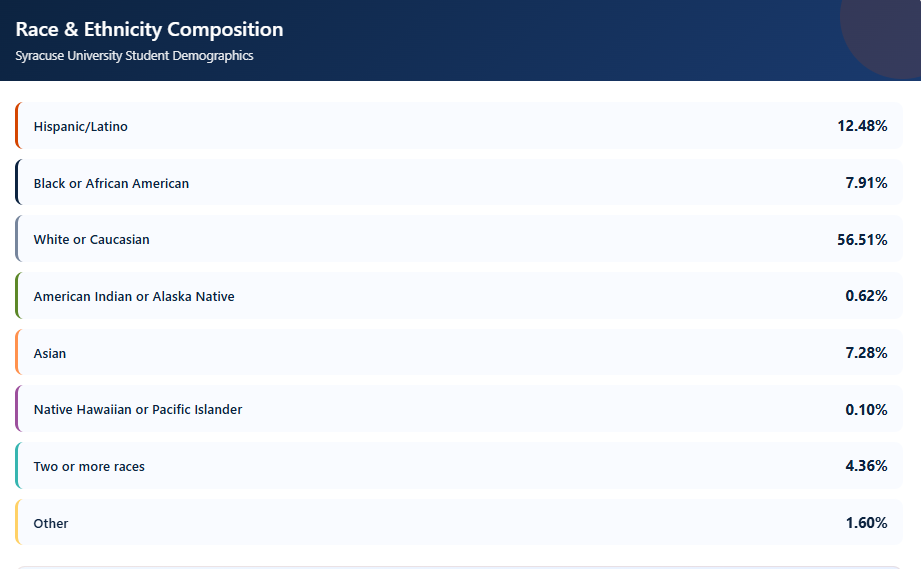
The data shows that Syracuse University has a diverse student body, with White/Caucasian students making up 56.51% and the remaining population representing a wide range of racial and ethnic backgrounds, including Hispanic/Latino, Black, Asian, and multiracial students.
Syracuse continues to strengthen its commitment to diversity and inclusion, with underrepresented student populations showing steady growth over time. This matters in admissions as well—because Syracuse evaluates applicants holistically and often favors students who can contribute to a vibrant, multicultural campus community, not just academically, but through lived experience, leadership, and perspective.
Syracuse University Campus Life
Syracuse University’s student life is one of the key factors shaping its admissions philosophy. Syracuse University hosts over 300 recognized student clubs and organizations, covering academic, cultural, political, and recreational interests. Syracuse actively cultivates a campus environment that values engagement, collaboration, and leadership. At the same time, a safe and well-managed campus, reinforced by visible DPS patrols and late-night escort services, creates a supportive living environment where students can focus on growth rather than logistics. Combined with structured career support, early internship encouragement, and a powerful alumni network—particularly in New York across media, finance, technology, and entertainment—Syracuse looks for applicants who are not only academically prepared, but also ready to actively participate in campus life and take advantage of its resources.
Sports
In the admissions process, Syracuse also values students who bring strong extracurricular strengths to campus, including athletics. As a Division I university in the ACC, Syracuse has a nationally recognised sports culture — especially in football, basketball, and lacrosse. The Orange have won a national championship in men’s basketball and have a long history of deep NCAA Tournament runs, while women’s basketball has continued to gain momentum and visibility in recent years. For students competing at a high level, being a recruited student-athlete can be a meaningful advantage in the application process, as athletic recruitment is one of the most direct pathways to admission at major Division I programs.
Syracuse University also offers athletic scholarship opportunities in select varsity sports, including basketball, football, lacrosse, soccer, cross-country running, track and field, and rowing, reflecting the university’s strong commitment to supporting student-athletes. Beyond varsity athletics, the university also offers extensive recreational facilities. With a student ID, students can access fitness centers, swimming pools, basketball courts, tennis courts, soccer and softball fields, and even ice rinks with equipment rental options.
FAQ
What is the acceptance rate at Syracuse University?
Syracuse University acceptance rate is 46%. Syracuse accepts about half of the students who apply, It’s selective, but not scary-level competitive.
How much does it cost for 4 years at Syracuse University?
The total estimated four-year cost for an undergraduate degree at Syracuse University, based on the 2025-26 rates, ranges from approximately $371,300 to $379,168 before financial aid. If you’re paying full price, four years can be pretty expensive (around the same as other private schools). Good news: 81% students get scholarships or aid, so most people don’t pay sticker price.
What GPA do you need to get into Syracuse University?
Most admitted students have a GPA around 3.6–3.8. You don’t need to be perfect—strong classes + decent grades can totally get you in.
Is Syracuse a top 50 university?
Overall, it’s usually just outside the top 50 nationally. In the 2026 edition of Best Colleges, Syracuse University is ranked No. #75 in National Universities. It’s also ranked No. #45 in Best Colleges for Veterans. For majors like communications, business, and public affairs, it’s a big deal.
Is a degree from Syracuse respected?
Yes—especially on the East Coast. Employers know the name, and the alumni network is strong and loyal. The university is in the heart of New York State, convenient for you to find internships.
Who famous went to Syracuse University?
A bunch of famous people, especially in media and sports. The list includes such notable alumni figures as Vanessa Williams, Jessie Mueller, Aaron Sorkin, Taye Diggs, Vera Farmiga, Frank Langella, Patti Murin, Reid Scott, and Arielle Tepper to name a few
Is it harder to get into Penn State or Syracuse?
Syracuse University is generally harder to get into than Penn State.
Syracuse has a lower acceptance rate (about 42%–46%) and is more selective,
while Penn State’s acceptance rate is higher (around 54%–60%). Syracuse also puts more emphasis on fit, essays, and major-specific strength, which gives strong applicants an edge