


The best neighborhoods in Washington, DC offer very different living experiences. Some are known for restaurants, nightlife, and convenient Metro access, while others stand out for tree-lined streets, historic row houses, parks, and a quieter residential atmosphere. When choosing the right neighborhood in DC, being close to a university or an easy commute may matter most for students and young professionals. Families may care more about space, daily amenities, and a calmer environment. To help you narrow down your options, this guide compares 10 of the best neighborhoods in Washington DC for different lifestyles, including their typical vibe, security, one-bedroom rent, nearby universities, and Metro access. You’ll also get a closer look at what daily life is like in each area.
Best Neighborhoods in Washington DC at a Glance
| Neighborhood | Best For | Typical Vibe | Security | Rent for 1B | University | Metro Access |
|---|---|---|---|---|---|---|
| Dupont Circle | Professionals | Cosmopolitan, lively | ★★★★☆ | ~$2,702 | GWU nearby | Red Line |
| Capitol Hill | Families | Historic, residential | ★★★★☆ | ~$2,767 | Gallaudet University nearby | Blue, Orange & Silver Lines |
| Logan Circle | Young professionals | Trendy, energetic | ★★★★☆ | ~$2,479 | Howard University nearby | Good |
| Georgetown | Students | Historic, elegant | ★★★★☆ | ~$2,397 | Georgetown University | No direct Metrorail |
| Adams Morgan | Nightlife lovers | Diverse, energetic | ★★★☆☆ | ~$2,619 | Howard University nearby | No station in the core |
| Cleveland Park | Families | Leafy, residential | ★★★★★ | ~$2,333 | UDC and American University nearby | Red Line |
| Navy Yard | Young professionals | Modern, waterfront | ★★★★☆ | ~$2,428 | Capitol-area campuses accessible by Metro | Green Line |
| Columbia Heights | Renters | Diverse, urban | ★★★☆☆ | ~$2,000 | Howard University nearby | Green & Yellow Lines |
| Foggy Bottom | Students | Academic, central | ★★★★☆ | ~$2,631 | George Washington University | Blue, Orange & Silver Lines |
| Brookland | Students | Relaxed, community-oriented | ★★★★☆ | ~$1,988 | Catholic University of America | Red Line |
Best Neighborhoods to Live in Washington DC
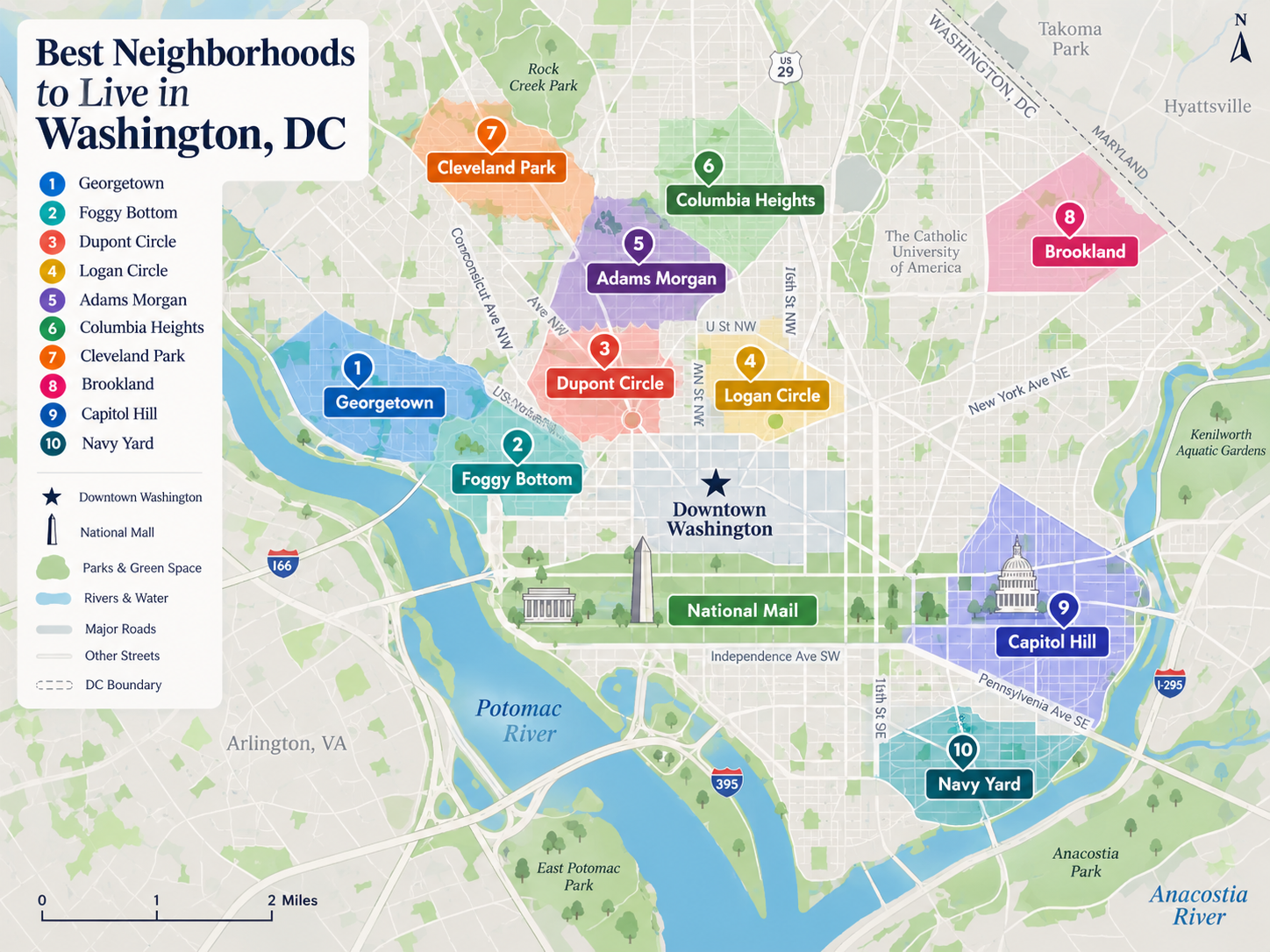
The 10 neighborhoods below represent different sides of DC living, from historic Capitol Hill and Georgetown to newer waterfront communities such as Navy Yard. Their relative locations also matter: Georgetown, Foggy Bottom, Dupont Circle, Logan Circle, Adams Morgan, Columbia Heights, and Cleveland Park are concentrated in Northwest DC; Brookland lies to the northeast; Capitol Hill sits east of downtown; and Navy Yard is farther south near the Anacostia River.
1. Dupont Circle
- Best for: Professionals, students, and people who want a central, car-light lifestyle
- Pros: Excellent walkability, Red Line access, restaurants, cafés, cultural attractions
- Cons: Higher rents and a busy urban atmosphere
Dupont Circle is one of the best areas to live in Washington DC for people who want to stay near the city center. Connecticut Avenue gives residents easy access to supermarkets, cafés, restaurants, bookstores, and everyday services, while the Dupont Circle Metro station makes commuting on the Red Line convenient. The neighborhood is also known for Embassy Row, The Phillips Collection, and the Dupont Circle Farmers Market. Dupont Circle has plenty of housing options, ranging from historic row houses and converted condos to older apartment buildings and newer luxury rentals, giving residents plenty of choice depending on their budget and preferred living style.
2. Capitol Hill

- Best for: Families, professionals, and people who enjoy historic residential streets
- Pros: Attractive row houses, strong walkability, Metro access, Eastern Market
- Cons: Desirable properties can be expensive
Capitol Hill is a good place to live in Washington DC if you want a quieter, more residential feel while staying close to central DC. The neighborhood has plenty of historic row houses, townhomes, condos, and smaller apartment buildings. Eastern Market and Barracks Row make everyday life easy, with grocery stores, cafés, restaurants, and local shops nearby. The Capitol South and Eastern Market Metro stations also make commuting convenient. Plus, landmarks such as the Library of Congress and the U.S. Capitol are within easy reach.
3. Logan Circle

- Best for: Young professionals, couples, and renters who enjoy an active city lifestyle
- Pros: Excellent dining, nightlife, walkability, and downtown access
- Cons: High rent and busy evenings along 14th Street
Logan Circle is one of the best DC neighborhoods for people who want restaurants, shops, and entertainment close by. Many activities are along 14th Street NW, where you’ll find cafés, bars, fitness studios, stores, and places like Studio Theatre. The neighborhood has historic Victorian row houses, condos, apartment buildings, and newer luxury rentals, with one-bedroom apartments averaging about $2,479. Logan Circle does not have its own Metro station, but Shaw-Howard University and McPherson Square stations are both within reach depending on where you live.
4. Georgetown
- Best for: Students, professionals, and renters looking for historic character and an upscale setting
- Pros: Georgetown University, waterfront access, shopping, dining, attractive architecture
- Cons: No direct Metrorail station
Georgetown offers a vibrant urban lifestyle, making it one of the best areas to live in Washington DC. M Street and Wisconsin Avenue are the main shopping and dining areas, while Georgetown Waterfront Park and the C&O Canal are popular places for walking, relaxing, and spending time outdoors. Georgetown University is also located here, so apartments in the neighborhood are especially popular with students and professionals. One drawback is that Georgetown does not have its own Metro station. Most residents rely on buses or walk to the Foggy Bottom-GWU station for Metrorail access.
5. Adams Morgan
- Best for: Young professionals, renters, and people who prioritize nightlife and dining
- Pros: Diverse food scene, nightlife, walkability, strong neighborhood character
- Cons: Weekend noise and no Metro station directly in the neighborhood core
As one of the most popular neighborhoods in DC, Adams Morgan offers renters plenty of things to do after work. Most of the restaurants, cafés, bars, and music venues are around 18th Street NW and Columbia Road, while Meridian Hill Park offers a nearby place to relax outdoors. Adams Morgan has classic row houses, condos, and older apartment buildings, providing more housing choices than newer neighborhoods like Navy Yard. Adams Morgan does not have a Metro station in the center of the neighborhood, so residents usually use the Woodley Park-Zoo/Adams Morgan station or nearby bus routes.
6. Cleveland Park

- Best for: Families, professionals, and renters who want a quieter residential environment
- Pros: Red Line access, Rock Creek Park, larger apartments, quieter streets
- Cons: Less nightlife and fewer late-night options than central neighborhoods
Cleveland Park is a good choice for people who want convenient transit without living in one of DC’s busiest nightlife areas. The Cleveland Park Metro station is on the Red Line, while Connecticut Avenue offers restaurants, grocery stores, cafés, and other everyday services. Rock Creek Park and the Smithsonian’s National Zoo are also nearby, giving residents easy access to green space and outdoor activities. Rents in Cleveland Park are generally more affordable than in Downtown DC, making it a practical option for budget-conscious people.
7. Navy Yard
- Best for: Young professionals and renters who prefer newer apartment buildings
- Pros: Modern housing, waterfront parks, Metro access, restaurants and entertainment
- Cons: Higher prices and less historic character than older DC neighborhoods
Navy Yard offers many newer high-rise apartments and condos in DC, suitable for people who like modern living. Those apartments often feature amenities such as gyms, rooftop spaces, lounges, and package rooms. Residents can easily reach Nationals Park, Yards Park, The Yards, and the Anacostia Riverwalk Trail, while grocery stores, restaurants, and fitness centers are also close by. The Navy Yard-Ballpark Metro station on the Green Line makes commuting convenient. Rents in Navy Yards are higher than the DC average, with a one-bedroom apartment costing about $2,428 per month in late 2026.
8. Columbia Heights
- Best for: Students, renters, and people looking for relative value with strong transit
- Pros: Excellent Metro access, practical shopping, varied housing, diverse community
- Cons: Street conditions and overall atmosphere can change noticeably from block to block
Columbia Heights is one of the affordable neighborhoods in Washington DC to live in. The Columbia Heights Metro station serves the Green and Yellow lines, while 14th Street offers supermarkets, restaurants, pharmacies, gyms, and other everyday services. Housing in Columbia Heights ranges from row houses and older apartment buildings to condos and renovated rentals, with many one-bedroom apartments priced from the high-$1,000s to the low-$2,000s. The neighborhood is also convenient for Howard University and for commuters heading downtown.
9. Foggy Bottom

- Best for: George Washington University students, interns, and professionals
- Pros: GWU campus, excellent Metro access, very central location
- Cons: Expensive rents and a more institutional feel in some parts of the neighborhood
Foggy Bottom is one of the most convenient neighborhoods in Washington DC for students because George Washington University occupies a large part of the area. The Foggy Bottom-GWU Metro station serves the Blue, Orange, and Silver lines, while the Kennedy Center, World Bank, IMF, State Department, and National Mall are all nearby. Studios and one-bedroom apartments are especially common among students, interns, and young professionals, although condos and larger units are available as well. Grocery stores, restaurants, campus facilities, and transit are all close at hand.
10. Brookland
- Best for: Students, families, and people who want a stronger residential community feel
- Pros: Red Line access, Catholic University, quieter streets, relatively lower rent
- Cons: Farther from Downtown than most neighborhoods on this list
Brookland is a good neighborhood in DC that features a quiet vibe with easy Metro access. Catholic University of America is located here, and the Brookland-CUA station connects residents to the Red Line. Monroe Street Market and the Arts Walk offer cafés, restaurants, local shops, and community events, while the Basilica of the National Shrine of the Immaculate Conception is one of the area’s best-known landmarks.
How to Choose the Best Neighborhood in Washington DC

Finding the best place to live in DC is less about identifying one universally “best” neighborhood and more about deciding which trade-offs matter most to you.
- Start with your rent budget. DC’s average one-bedroom rent is around $2,309, but neighborhood prices vary considerably. Brookland and parts of Columbia Heights may offer better relative value, while Capitol Hill, Dupont Circle, Foggy Bottom, and other central neighborhoods tend to cost more.
- Map out your commute before choosing an apartment. A neighborhood that looks close on a map can require a transfer or a long walk to the nearest station. If you commute daily, living near the right Metro line can matter more than living geographically closer to your destination.
- Think about whether you really need a car. Dupont Circle, Foggy Bottom, Navy Yard, Columbia Heights, Cleveland Park, Capitol Hill, and Brookland all have direct Metrorail access, which can make car-free living much easier.
- Match the neighborhood to your lifestyle. Adams Morgan and Logan Circle are better suited to people who enjoy restaurants and nightlife, while Cleveland Park and Brookland appeal more to residents looking for quieter surroundings. Navy Yard suits renters who prefer modern buildings, while Georgetown and Capitol Hill offer stronger historic character.
- Look beyond rent when comparing apartments. A slightly cheaper apartment in Washington DC can become less attractive if grocery shopping, transit, or your workplace is inconvenient. Check supermarkets, pharmacies, gyms, parks, restaurants, and other places you expect to use every week.
- Check safety at the address level. Safety can vary from one block to another, even within the same neighborhood. Before choosing an apartment, check recent MPD crime data for the exact area and, if possible, visit the street at different times of day.
- Students should prioritize campus access. Foggy Bottom is a popular area for GWU, Georgetown for Georgetown University, and Brookland for Catholic University of America. In other cases, compare actual Metro or bus travel times rather than choosing simply based on distance.
Looking for a place to live in Washington, DC?
Compare apartments by neighborhood, university, rent, room type, and amenities on uhomes.com.
Final Thoughts: Which DC Neighborhood Is Right for You?
The best neighborhood in Washington DC ultimately depends on what you want daily life to look like. Dupont Circle is one of the strongest all-around options for walkability and transit, while Capitol Hill works well for renters who prefer historic residential streets. Logan Circle and Adams Morgan stand out for young professionals and nightlife, while Cleveland Park provides a quieter environment with convenient Red Line access.
Students may find Foggy Bottom, Georgetown, or Brookland especially practical because of their proximity to major universities. Renters who want newer buildings and waterfront amenities should consider Navy Yard, while Columbia Heights can offer a useful balance of transit, everyday shopping, and relative value.
Before signing a lease, compare not only monthly rent but also commute time, Metro access, street environment, nearby amenities, and the type of housing available. Those factors usually matter more to everyday life than choosing the neighborhood with the highest ranking.
FAQ
What is the best neighborhood to live in Washington DC?
Dupont Circle is one of the best neighborhood to live in Washington DC because it combines Metro access, walkability, restaurants, shops, and a central location. Capitol Hill may be better for families, while Logan Circle and Navy Yard often appeal more to young professionals.
What are the best neighborhoods in DC for students?
The best neighborhoods in DC for students include Foggy Bottom, Georgetown, Brookland, and Columbia Heights. Foggy Bottom is especially convenient for George Washington University students, Georgetown is the obvious choice for Georgetown University, and Brookland is ideal for Catholic University of America. Columbia Heights can also work well for students who want good Metro access and more housing options.
What are the best neighborhoods in Washington DC for young professionals?
Logan Circle, Dupont Circle, Navy Yard, and Adams Morgan are among the best DC neighborhoods for young professionals. They offer strong access to restaurants, nightlife, transit, gyms, and central employment areas.
What are the best neighborhoods in Washington DC for families?
Capitol Hill, Cleveland Park, and Brookland are the best neighborhoods in Washington DC for families. Capitol Hill combines historic streets with central access, while Cleveland Park and Brookland generally feel quieter and provide good access to parks and Metro service.
Which Washington DC neighborhoods have the best Metro access?
Dupont Circle, Foggy Bottom, Cleveland Park, Columbia Heights, Navy Yard, Capitol Hill, and Brookland all have convenient Metrorail stations. Georgetown and Adams Morgan require more reliance on buses, walking, or nearby stations.
What are the safest neighborhoods in Washington DC?
Cleveland Park and parts of Capitol Hill and Georgetown are some of the safest neighborhoods in Washington DC, with less nightlife and a quieter atmosphere. But you should always review current MPD data for the specific address before renting apartments in DC.
Is it better to live near a Metro station in Washington DC?
Yes, it is better to live near a Metro station in Washington DC for most students and professionals without a car. It can reduce commute time, make it easier to reach universities and employment centers.