



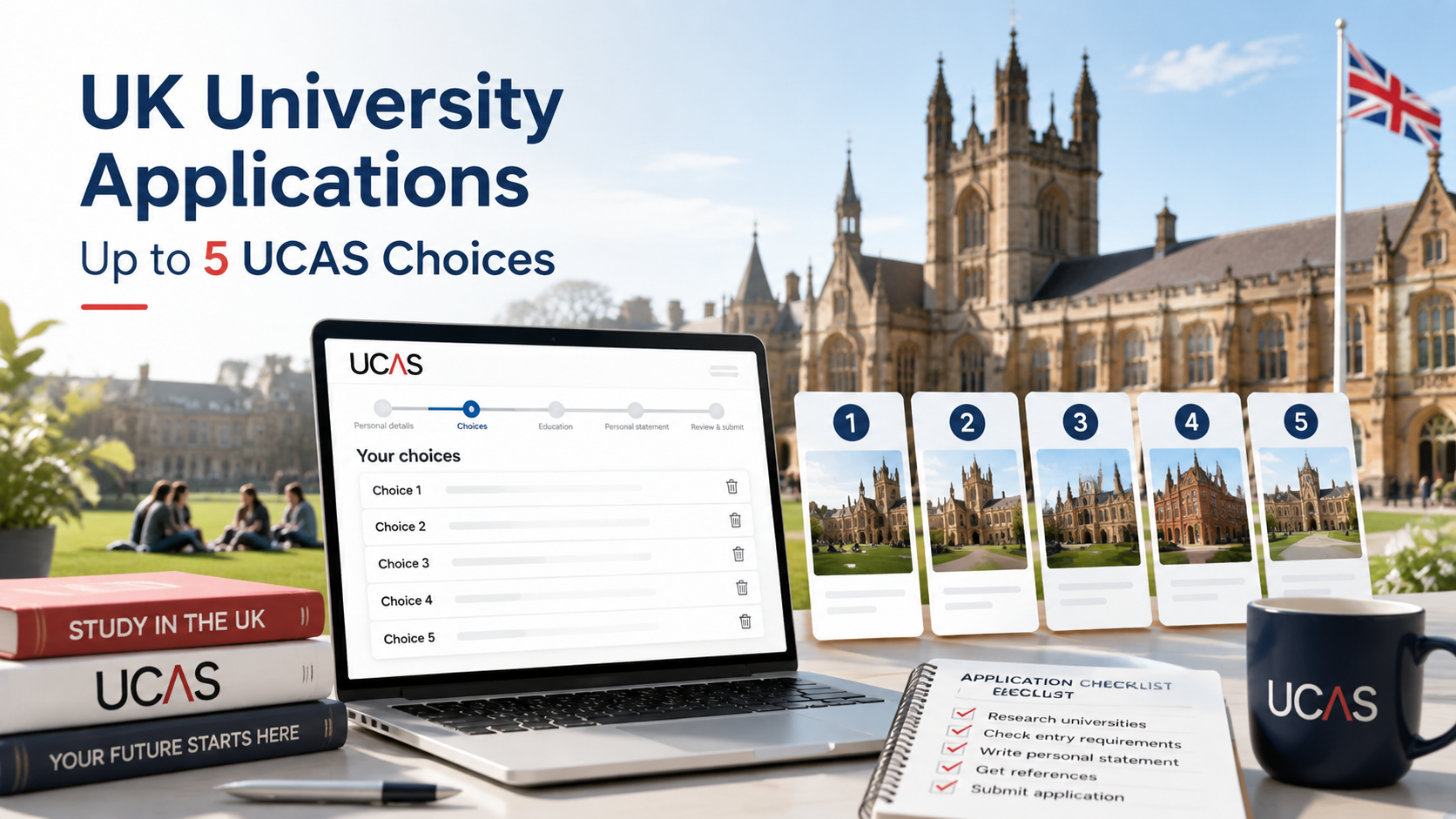
How many universities can you apply to in the UK? If you are searching how many universities can you apply to uk, the short answer is that most undergraduate students can apply for up to five UCAS choices in one application cycle.
However, these five choices do not always mean five separate universities. When students ask how many universities can you apply to in the uk or how many unis can you apply to, they often misunderstand how the UCAS system works. UCAS counts course choices rather than only university names, which means you can apply for different courses at the same university or choose courses across several institutions.
For students wondering how many universities can you apply for uk, understanding this difference is important before creating your application list. For example, applying for Business Management and Marketing at the same university may use two of your available choices. Small decisions like this can have a big impact on how you plan your application strategy.
The question of how many uk universities can you apply to is only the first step. Students also need to consider course requirements, university reputation, location, living costs and future career goals. International applicants should also think about visa preparation, application deadlines and where they will live after receiving an offer.
This guide will explain how many universities can you apply to uk ucas, how the five choice system works, whether can you apply to more than 5 universities in uk, and how to make the most of your university options before starting your UK study journey.
How Many Universities Can You Apply To In The UK Through UCAS?
If you’re trying to figure out how many universities can you apply to in the uk, the rules are set by how UCAS organises undergraduate submissions. Unlike education systems in other nations, where you have to send separate applications to each school, UK undergraduates submit all their university picks via UCAS.
Nearly all applicants get a maximum of five course selections on their UCAS form. You may spread these picks across distinct universities, or put forward several different programmes from one single university. This means the actual number of universities you end up applying for will shift, based on how you allocate your available slots.
Many prospective learners run into confusion around how many universities can you apply to uk ucas. It is worth clarifying that the cap applies to course selections you send off, rather than just how many higher education institutions you list.

How Many UCAS Choices Do You Get?
To revisit the question how many universities can you apply to in the UK: for anyone looking up how many universities can you apply to uk, the quick takeaway is that standard undergrad candidates receive up to five UCAS choices per application round.
Still, those five slots do not guarantee five separate universities. A lot of applicants ask how many universities can you apply to in the uk or casually enquire how many unis can you apply to, under the impression each choice equals one unique university. UCAS, nevertheless, tallies individual courses instead of institutions, so you can deploy your five slots flexibly to match what you hope to achieve academically.
For example, one student may use their five choices like this:
University A: Business Management
University B: Marketing
University C: Economics
University D: Finance
University E: International Business
In this situation, the student has applied to five different universities.
However, another student may use their choices differently:
University A: Business Management
University A: Marketing
University B: Accounting and Finance
University C: Economics
University D: International Business
Here, the student has selected courses from four universities but still used all five UCAS choices. This is why understanding how many universities can you apply for uk is not only about counting university names. It is also about choosing the right courses and planning your application strategy carefully.
Students also often ask how many unis can you apply to uk because they want to maximise their chances of receiving offers. However, applying to more universities does not always mean better results. A strong application should include a balance of ambitious choices, realistic options and backup choices based on your grades, preferred subject and future plans.
When it comes to how many uk universities can you apply to, this is just one piece of the whole UK university application puzzle. Beyond figuring out your application slots, prospective students also have plenty of other factors to weigh up: entry criteria, where each university is situated, tuition rates, everyday living expenses, and available accommodation. For international learners in particular, sorting out visa related paperwork and securing proper housing once you hold an offer count as critical milestones too.
This guide breaks down how many universities can you apply to uk ucas, walks you through the mechanics behind the five choice framework, addresses can you apply to more than 5 universities in uk, and shares practical tips to get the best out of your available university selections, all to help you get well prepared ahead of your UK study adventure.
Are UCAS Choices The Same As Universities?
One thing plenty of applicants keep asking is how many universities can you apply to in uk, alongside whether every single choice slot stands for a separate university.
Each UCAS choice corresponds to a single course offered by one university. That opens up the possibility for you to list the same university multiple times, should you submit applications for several different courses within that very institution.
For example:
University A
Business Management
Marketing
Both courses may count as two separate UCAS choices.
This is exactly why applicants ought to map out their UCAS submissions thoughtfully, rather than simply keeping a running tally of university names. Knowing what sets course choices apart from individual universities lets candidates put together a well rounded application plan.
Can You Apply To More Than 5 Universities In UK?
Lots of prospective students look into can you apply to more than 5 universities in uk, hoping to boost their odds of landing a university offer.
As a general rule, your main UCAS application will not let you put down over five separate choices. Even so, applicants wanting extra chances still have alternative routes they can explore.
UCAS Extra
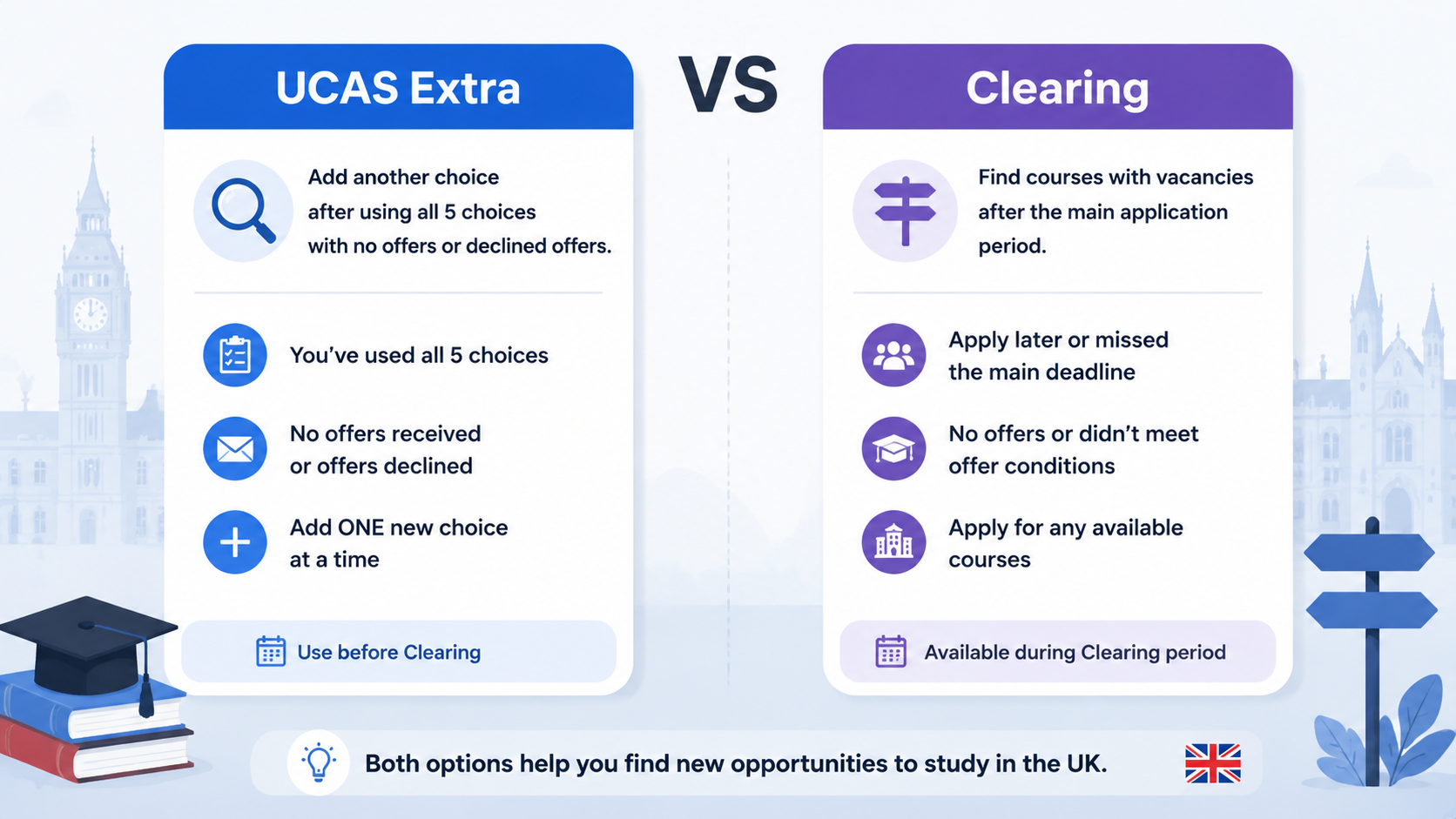
UCAS Extra provides another opportunity for students who have already used all five choices but have not received any offers.
This option can be useful for applicants who:
- Used all five UCAS choices
- Did not receive any offers
- Declined their existing offers
For example, imagine Sarah is an international student applying for Business courses in the UK. She uses all five UCAS choices:
University of Manchester: Business Management
University of Birmingham: International Business
University of Leeds: Marketing
University of Nottingham: Finance
University of Sheffield: Economics
After receiving her decisions, Sarah does not receive any offers from these universities. Since she has already used all five choices, she cannot add another option through her original application.
In this situation, Sarah may be able to use UCAS Extra to search for available courses and apply for another university choice. For example, she could find a Business Management course at another UK university that still has available places and add this as her new choice.
UCAS Extra allows eligible students to continue their university application journey and explore additional opportunities after their original five choices have been used.
Clearing
Clearing is another route for students who still need a university place after the main application period.
It can help:
- Students who apply later
- Applicants without offer
- Students looking for alternative courses
Take David as an example. He is an international student who once got a conditional offer for Business Management from a UK university. Unfortunately, his final exam scores fell short of the grade requirements for this programme, so this offer fell through.
Keen to pursue his studies in the UK still, David could turn to UCAS Clearing to hunt for universities with leftover course vacancies. He might well spot a comparable Business Management programme at a different institution and put in an application for that open spot via Clearing.
UCAS Clearing also works well for people who miss the key deadline for standard UK undergraduate applications. Think of an applicant who originally intended to study overseas elsewhere, yet changes their mind long after the main UCAS application window closes. Provided universities still hold unfilled spots, Clearing opens up another path to lock down a university place.
For international candidates, getting to know alternative pathways including UCAS Extra and Clearing brings far more flexibility when applying to UK higher education institutions. These options come in particularly handy if you have already exhausted all your original UCAS choices and wish to chase further study opportunities.
Are There Any Exceptions To The UCAS Application Limit?
Although most students can submit up to five UCAS choices, there are some exceptions that applicants should understand before preparing their university applications.
When considering how many universities can you apply for uk, students should also check whether their chosen subject has different application rules. Certain competitive courses have additional restrictions because of the limited number of places available.
Understanding these exceptions can help applicants create a realistic application plan and avoid using their choices incorrectly.
Medicine, Dentistry and Veterinary Courses

If you are aiming for ultra competitive degrees like medicine, dentistry or veterinary science, you will want to keep the UCAS choice restrictions firmly in mind.
For these particular courses, applicants are normally limited to four slots across medicine, dentistry and veterinary programmes combined. Your fifth available choice can go toward a completely different subject discipline instead.
That makes advance planning really important for anyone hoping to get into these highly sought after fields before sending off their application.
For example, a student going for medicine could pick:
Medicine at University A
Medicine at University B
Medicine at University C
Medicine at University D
Another related course at University E
Given just how fierce the competition is for these programmes, applicants ought to look deep into entry criteria, expected academic standards and interview procedures before locking in their UCAS selections.
Can You Apply To Oxford And Cambridge At The Same Time?
Lots of candidates researching how many uk unis can you apply to also wonder whether they are allowed to submit applications to both the University of Oxford and the University of Cambridge within a single application round.
For undergraduate study, you are generally not permitted to apply to Oxford and Cambridge in the same academic year. You will have to pick just one of the two, then make smart use of your leftover UCAS slots for the rest of your university shortlist.
This is why thorough pre planning matters so much for anyone setting their sights on one of these top tier, hard to get into universities.
How Should You Choose Your Five UCAS Choices?
Figuring out how many unis can you apply to is merely your starting point. The harder part comes next: working out how to make your limited choices count.
Filling out all five UCAS slots does not mean you should only target the highest ranking universities available.A strong application strategy should include a mixture of ambitious options, realistic choices and backup options.
Choose One or Two Ambitious Universities
Ambitious universities are institutions where admission may be more competitive based on grades, course requirements and applicant numbers.
These choices allow students to aim for their preferred universities while keeping realistic expectations.
Before applying, students should carefully review:
- Academic entry requirements
- Course content
- Graduate opportunities
- Location and living costs
Select Realistic Universities
Realistic choices should match your academic profile and qualifications.
As you weigh up different universities, double check that your predicted grades, English test scores and past academic profile line up with each institution’s entry standards.
Putting together a well-balanced shortlist boosts your likelihood of securing offers. It works far better than stacking all your slots on overly competitive programmes alone.
Include Backup Options
Backup universities provide additional security during the application process.
You will want to prioritise universities where your profile gives you solid odds of hitting admission benchmarks, alongside decent course fit and positive overall student life.
A thoughtfully assembled five option shortlist strikes a good balance between aiming high and keeping your options open.
What Should International Students Consider When Applying To UK Universities?

For overseas applicants, there is much more to UK university admissions than figuring out how many universities can you apply to in the uk. You also need to work through academic prerequisites, key submission cut offs and general overseas study prep work.
International applicants should keep the following points in mind before sending off their applications:
Entry Requirements
Expect academic standards to shift from one university and programme to another.
You need to verify:
- Required qualifications
- Grade expectations
- Subject requirements
- Portfolio requirements for specific courses
English Language Tests
Many international students need to provide proof of English ability.
Typical admission criteria often cover English exam results and the minimum language thresholds each university sets.
Getting your language assessments sorted well ahead of time helps applicants steer clear of hold-ups further along in the application journey.
Deadlines and Visa Planning
Overseas learners need to map out their whole application timeline with great care. University submission cut offs tie directly to later stages: confirming your offer, gathering supporting paperwork, and submitting your student visa application.
You will also want to factor in these points:
- Application timeline
- Financial planning
- Visa preparation
- Travel arrangements
Choosing a City and Planning Accommodation
Choosing a university is also choosing a place to live for several years. For international students, planning where to stay is an important part of preparing for university life in the UK. Students should consider different factors when looking for student accommodation in the uk, including:
- City lifestyle
- Living cost
- Transport options
- Student community
- Accommodation availability
As soon as you receive your university offers, hunting for the right place to stay becomes one of your most urgent tasks. It is wise for international students to start weighing up different housing options well in advance, so you can secure good accommodation prior to moving over to the UK. uhomes.com helps students explore a wide range of student accommodation options across UK university cities, making it easier to compare properties based on location, facilities, rental prices and distance from campus.
When choosing your accommodation, it is important to take real-world details into account, including where the property is located, what facilities it provides, how much rent you will pay and how convenient the daily commute will be. Comparing these factors through uhomes.com allows students to find living arrangements that better match their day-to-day routine and study requirements before starting their UK university journey.
Finding Student Accommodation After Receiving University Offers
Once you have settled on your target university, the next thing to sort out is your living arrangements. Where you stay shapes so much of day-to-day life, your spending budget, and how you experience university as a whole.
It can feel tricky for international students to hunt for housing abroad. Many newcomers have little knowledge of local rental trends, neighbourhoods around campuses, or the different kinds of student housing out there.
uhomes.com make this process simpler. Students can browse a wide range of student housing in major UK university towns, and filter through listings according to location, room style and individual budget needs.
Location Near Your University
Location ranks among your top considerations when picking student housing. A place close to campus will make everyday routines far smoother. You cut down on travel time, and it also lets you get settled into your new city much faster.
Students should consider:
- Walking distance to campus
- Public transport connections
- Nearby supermarkets and services
- Safety and convenience
uhomes.com offers a wide range of student accommodation options across popular UK university cities, helping international students find suitable housing near their chosen institutions. Whether you are looking for student accommodation near University of Oxford, student accommodation near University of Cambridge, or UCL student accommodation, uhomes.com provides different housing options to match various budgets and lifestyle preferences.
Many properties listed on uhomes.com are located in convenient areas with easy access to university campuses, public transport, supermarkets, restaurants and other everyday services. This allows students to compare accommodation based on location, facilities and surrounding amenities before making their final decision.
By exploring different options through uhomes.com, international students can find accommodation that fits their study plans and daily routines. Choosing a well-connected location means less time spent commuting and a smoother transition into university life in the UK.
Different Types Of Student Accommodation
Students get to pick from various housing styles based on how much they are able to spend, their daily living habits, and how much self-sufficiency they want. Learning what sets each accommodation type apart makes it much simpler to land a living space that fits well with both your study routines and personal requirements.
Common choices include:

Student Halls
Student halls stand out as a top housing pick for first-year undergraduates, particularly for anyone leaving home for the very first time. Most of these residences sit not far from university campuses, and come with shared amenities including communal kitchens, lounge zones and dedicated social areas for residents.
Student halls are ideal for:
- First year students who want to meet new people
- International students settling into life within an unfamiliar country
- Learners after move-in-ready accommodation that keeps household duties to a minimum
Quite a few student halls run regular social get togethers. These activities help fresh faces connect with fellow students, form new friendships, and feel more included within the wider university community.

Private Student Accommodation
Private student accommodation refers to housing built purely for university students. Most of these places come with up-to-date facilities. You can often get your own bathroom, quiet spots for studying, an on-site gym, shared lounges, plus regular social activities put on for residents.
This kind of private student housing is a good fit for:
- International students looking for a convenient living experience
- Students who want more facilities and services
- People wanting a good mix of personal privacy and chances to socialise
Unlike classic university halls, private student housing generally has far more room styles to pick from. Students can easily go with what fits their budget and daily living style.

Shared Apartments
With shared apartments, you rent a place alongside flatmates. You get your own separate bedroom, while kitchen and living-room areas are used by everyone in the flat. This tends to be a more wallet-friendly choice, since rent and household bills can be split between all residents.
Shared apartments are a good choice for:
- Students looking to bring down their living expenses
- Friend groups that wish to live together
- Anyone who likes living more independently
You get far more flexibility staying in this sort of place than university-run halls. On the flip side, you will need to sort out utility bills, keep the flat clean, and work things out with your flatmates.

Studio Rooms
Studio rooms are self-contained private units. Inside one single space, you get a sleeping area, your own bathroom and basic kitchen gear.
Studio rooms work well for:
- Students who want privacy and a quiet spot for studying
- Postgrads who like to live independently
- Anyone who does not want to share facilities with flatmates
Studios normally cost more than shared housing. Even so, they bring extra privacy and convenience, which makes them a top pick for students after a cosy, personal living area.
When picking from all these housing styles, think about your budget, daily living preferences, study routine, and how much independence you are after. uHomes.com lets students check out various UK student housing choices. You can look through university halls, private student properties, shared flats and studio rooms, all before you move overseas.
Conclusion
Starting your accommodation search early leaves you plenty of time to weigh up prices, locations and available facilities.
After you lock in your university spot, sorting out somewhere to live is your next big priority. uHomes offers international students an easy way to browse student housing across different UK university cities. You can compare locations, room layouts and various rental deals all in one place.
Platforms such as uhomes take much of the work out of hunting for UK student accommodation. You can find housing that fits your needs well, even before you set foot in the country.
FAQs:
Getting rejections from all five of your university picks does not mean you have no further paths forward. If you are wondering how many universities can you apply to uk, it is equally important to know what you can do when none of your selections work out. You can look into UCAS Extra, Clearing, or submit fresh applications in the next intake cycle. Going over your previous course picks and application approach will also boost your odds for future attempts.
Nearly all undergraduate applicants submit their applications via UCAS, yet some candidates can take alternative routes based on their personal circumstances. If you are figuring out how many universities can you apply to in the uk, keep in mind that a small number of universities and programmes accept direct-submitted applications. Double-check each school’s rules before you go for a non-UCAS application path.
International applicants follow the same UCAS choice cap as domestic students. If you look up can you apply to more than 5 universities in uk, the real answer hinges on which application pathway you use. Your regular UCAS form only supports five selections. That said, UCAS Extra and Clearing can open up extra possibilities under certain circumstances.
Medicine works by different application rules compared to most other degrees. Anyone researching how many universities can you apply to in the uk for medicine needs to be aware of special UCAS limits for medical programmes. Medical degrees are extremely competitive. Before you send in applications, spend time looking into entry criteria, required admission exams and suitable university options.
Finding out how many uk universities can you apply to is just your starting point. Picking well‑matched universities means thinking over your grades, desired subject, available budget and long‑term plans. It pays to compare course content, campus location, career prospects and local living expenses. For international learners, sorting out housing possibilities ahead of time will smooth your move to the UK.
Once university offers arrive, you will need to make your final study decision and get ready for life abroad. Apart from weighing up courses and locations, housing is another key point to think about. uhomes.com lets international learners browse student housing close to UK campuses. You can evaluate locations, room styles and personal living needs long before you relocate. Sorting out your accommodation early helps you adapt to your new city with far less stress.