




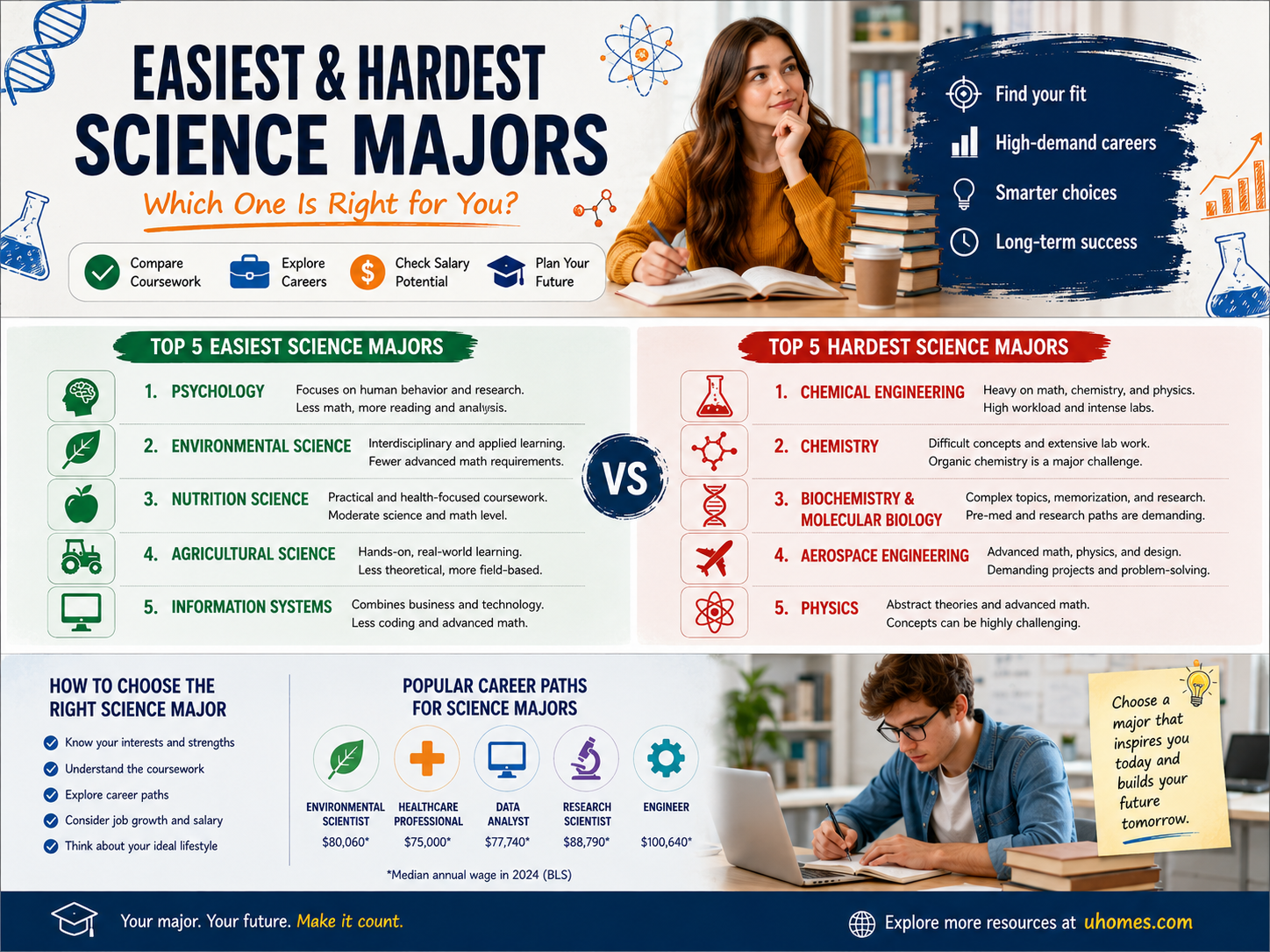
Evaluating the easiest science majors versus the hardest science majors is a top priority for students balancing academic workloads with future career potential. Within STEM fields, this distinction usually comes down to specific program demands, such as advanced mathematics, intensive laboratory hours, and weekly study loads. While some science degrees offer flexible coursework and broader career pathways with less calculus, others are known for gruelling schedules and highly technical problem-solving. In this guide, we’ll explore the easiest and hardest science majors, explain why students view them differently, and help you decide which science field may fit you best.
What Makes a Science Major Easy or Hard?
What makes a science major easy or hard depends on much more than intelligence. It is heavily based on your strengths, interests, study habits, and prior preparation. Science majors usually demand critical thinking, time, and persistence. Someone may feel it manageable, but others feel it overwhelming. Below are several factors usually determine how difficult a science degree feels:
- The amount of advanced math required
- Weekly laboratory workload
- Memorisation versus problem-solving
- Research expectations
- GPA pressure
- Graduate school requirements
- Time spent studying outside class
Engineering and chemistry majors often require advanced calculus and long lab sessions, while psychology or environmental science programs may focus more on theory, writing, and applied learning. That is why the “easiest” science major is ultimately subjective. However, some majors consistently appear easier for a large percentage of students.
5 Easiest Science Majors

1. Psychology
Psychology is frequently considered one of the easiest science majors because it focuses more on human behavior, research interpretation, and communication. While students still take statistics and research methods, the workload is usually more reading- and writing-based than calculation-heavy.
Psychology is also one of the most flexible science degrees. Graduates can work in counseling, education, business, human resources, healthcare administration, and marketing. Many students appreciate that psychology offers broad career options without requiring years of chemistry or physics coursework.
- Top universities known for psychology: Stanford University, University of Michigan, University of California, Berkeley
- Popular Courses: Cognitive Psychology, Developmental Psychology, Behavioral Neuroscience
- Median Pay: $94,310/year
2. Environmental Science
As sustainability and climate-related careers continue growing, environmental science has become increasingly popular. Compared with chemistry or engineering majors, environmental science programs are usually more interdisciplinary and applied. It is considered one of the easiest science majors because the calculus requirements are much lighter, the coursework is highly practical, and the learning structure is predominantly project-based.
Students combine biology, earth science, ecology, and policy studies rather than focusing heavily on advanced theoretical math. Many programs also emphasise fieldwork instead of intensive laboratory schedules.
- Top universities known for environmental science: University of California, Davis, Duke University
- Popular Courses: Ecology, Climate Change Science, GIS Mapping
- Median Pay: $80,060/year
3. Nutrition Science
Nutrition science is often viewed as a manageable healthcare-related science major because it focuses on health, wellness, and human physiology without requiring the intense chemistry depth found in pre-med or biochemistry tracks.
Many students enjoy nutrition science because the material feels practical and directly connected to everyday life. Coursework typically blends biology, public health, and wellness studies.
- Top universities for nutrition science: Cornell University, University of North Carolina at Chapel Hill, Tufts University
- Popular Courses: Human Nutrition, Food Science, Public Health Nutrition
- Median Pay: $73,850/year
4. Agricultural Science
Students often describe agricultural science as an easier science major because it emphasizes applied learning and hands-on experience rather than abstract theory. This major combines biology, sustainability, environmental science, and food production.
Many agricultural science programs include outdoor research, field projects, and practical applications that make coursework more engaging and less mathematically intense.
- Top universities for agricultural science: Texas A&M University, Iowa State University, University of Florida
- Popular Courses: Plant Science, Soil Science, Animal Nutrition
- Median Pay: $80,970/year
5. Information Systems
Information systems is often considered one of the easiest technology-related science majors because it combines business and computing rather than focusing purely on advanced computer science theory. Students learn practical technology skills that businesses need, but the major usually requires less intensive programming and mathematics than software engineering or computer science.
Many students ultimately choose information systems because it uniquely offers a combination of strong job demand, high salary potential, and a much more manageable technical coursework load compared to traditional tech tracks.
- Top universities for information systems: Carnegie Mellon University, University of Texas at Austin, Indiana University Bloomington
- Popular Courses: Database Management, Cybersecurity, Business Analytics, Information Technology, Systems Design
- Median Pay: Exceeding $169,000/year
5 Hardest Science Majors

1. Chemical Engineering
Chemical engineering is widely considered one of the hardest college majors because it combines advanced chemistry, physics, mathematics, and engineering principles into a demanding interdisciplinary curriculum.
Students often struggle with heavy lab schedules, advanced thermodynamics, complex calculations, and extremely high weekly workloads that require exceptional time management and problem-solving skills.
- Top universities for chemical engineering: Carnegie Mellon University, University of Texas at Austin, Indiana University Bloomington
- Popular Courses: Molecular Biology, Genetics, Cell Biology
- Median Pay: Exceeding $120,310/year
2. Chemistry
Chemistry majors are known for rigorous laboratory work and difficult theoretical concepts. Organic chemistry alone is considered one of the most difficult undergraduate science courses.
Students in chemistry programs spend significant time in labs conducting experiments and writing reports, which adds to the workload.
- Top universities for chemistry: California Institute of Technology, Harvard University, University of Wisconsin–Madison
- Popular Courses: Organic Chemistry, Physical Chemistry, Analytical Chemistry
- Median Pay: $88,310/year
3. Biochemistry and Molecular Biology
Biochemistry combines biology and chemistry at an advanced level, requiring students to master detailed molecular processes, intricate laboratory techniques, and difficult terminology. Because of this intense academic rigor, the major proves to be especially challenging for students pursuing demanding paths such as medical school, pharmaceutical research, genetics, and biotechnology careers.
- Top universities for biochemistry: Johns Hopkins University, University of California, San Diego, University of Pennsylvania
- Popular Courses: Molecular Biology, Genetics, Cell Biology, Organic Chemistry, Protein Biochemistry
- Median Pay: $120,310/year
4. Aerospace Engineering
Aerospace engineering is highly math-intensive and requires students to understand advanced physics, aerodynamics, and structural systems. Because of these rigorous core concepts, students often report very demanding workloads driven by complex simulations, intensive team design projects, and advanced calculus requirements.
- Top universities for aerospace engineering: Purdue University, Embry‑Riddle Aeronautical University, University of Michigan
- Popular Courses: Aerodynamics, Flight Mechanics, Aerospace Structures, Propulsion Systems, Fluid Dynamics
- Median Pay: $134,330/year
5. Physics
Physics is considered difficult because it relies heavily on advanced mathematics and abstract problem-solving.
Students must develop strong analytical thinking skills while studying concepts that are often highly theoretical.
- Top universities for physics: Princeton University, University of Chicago, Stanford University
- Popular Courses: Quantum Mechanics, Electromagnetism, Classical Mechanics, Thermodynamics, Advanced Calculus
- Median Pay: $166,290/year
Which Science Major Is Right for Me?

The right science major choice aligns with your interests, strengths, and goals rather than just prestige or salary potential. Always prioritize passion and fit over what’s “easiest” or most prestigious. A major you enjoy will keep you motivated through tough courses.
Here’s a practical step-by-step to help you choose the right science major:
- Assess Your Interests and Strengths: Start by identifying what truly excites you, such as math-heavy problem solving or biological systems. Evaluate your strengths in memorization versus quantitative analysis, and take introductory courses early to test different fields.
- Consider Career Goals and Outcomes: Align your major with long-term plans like research, medicine, or industry. Review salary prospects and job demand. For example, Chemical Engineering and Information Systems often offer high earnings but come with heavy workloads.
- Evaluate Program Fit and Difficulty: Research top universities and popular courses for each major and learn about the workload, including labs, advanced thermodynamics, and complex calculations.
- Take Practical Steps: Speak with advisors, professors, and current students to understand daily realities. Review full curricula, consider your preferred study hours, and remember it’s normal to switch majors in the first or second year.
Combining or Switching Science Majors
It is increasingly common for students to either combine multiple science majors or switch between them during college. Popular combinations include Biology with Neuroscience, Chemistry with Data Science, and Environmental Science with GIS or Public Policy. Many students also switch from Chemical Engineering to Biochemistry, or from Physics to Information Systems.
Switching majors is generally much easier in the first two years before specialized upper-level courses begin. When you decide to switch your science majors, carefully consider the following key factors:
- Credit transfer policies and how many courses will count toward the new major
- Potential delays in graduation timeline
- Impact on scholarships and financial aid
- Changes to internship or research prerequisites
Interdisciplinary combinations are becoming highly valuable in the job market, as employers increasingly seek graduates who can blend strong scientific knowledge with skills in data analysis, technology, or communication.
Job Growth of Science Major
The job market for science graduates remains strong, with several fields experiencing rapid growth due to technological advancement, environmental concerns, healthcare needs, and data-driven innovation. Here’s a clear overview of where the demand is heading:
Fastest Growing Science-Related Occupations
- Data Scientists — Projected growth: 35% (Much faster than average)
- Information Security Analysts — Projected growth: 33%
- Medical and Health Services Managers — Projected growth: 29%
- Environmental Scientists — Projected growth: 4% (Steady demand)
- Biochemists & Biophysicists — Projected growth: 11%
Source: U.S. Bureau of Labor Statistics (BLS)
High-Demand Science Fields
- Data Science & AI → Extremely high demand across industries
- Healthcare & Biotechnology → Driven by aging population and medical innovation
- Environmental Science & Renewable Energy → Growing focus on climate change and sustainability
- Information Systems & Cybersecurity → Critical for digital infrastructure protection
- Biochemistry & Molecular Biology → Key for pharmaceutical and biotech breakthroughs
Final Thoughts
It becomes evident that whether it is the “easiest” or “hardest” science major is highly subjective and deeply intertwined with individual aptitudes, interests, and dedication. The easiest science majors are typically fields that involve less advanced mathematics, fewer intensive laboratories, and more interdisciplinary or applied learning. A challenging major that genuinely interests you may ultimately feel easier. Pursue what you love and make a suitable choice considering both your professional aspirations and personal happiness. Combine your ability with whatever major you choose, and you can find a way to belong to yourself.
FAQ
What is the easiest science major?
Psychology is commonly considered one of the easiest science majors because it usually involves less advanced math and fewer lab requirements than chemistry or engineering.
Which science major has the highest salary?
Physics, aerospace engineering, and computer-related science fields often lead to some of the highest-paying careers.
Is psychology a STEM major?
Yes, psychology is a STEM field scientifically. But whether your specific degree counts as STEM often depends on your university’s classification and the exact program focus. If this matters for your goals (e.g., visas, funding, or jobs), check your program’s CIP code and speak with your academic advisor.
What is the hardest science major?
Chemical engineering is widely considered one of the hardest science-related majors because of its advanced math, chemistry, and engineering coursework.
Can I switch science majors in college?
Yes, you can switch science majors in college. Around 35% of STEM/science majors switch fields within the first three years. Among them, math, natural sciences, and engineering see some of the highest switch rates. The best time to switch your major is during your first or second year, before you start taking many specialized upper-level courses.