



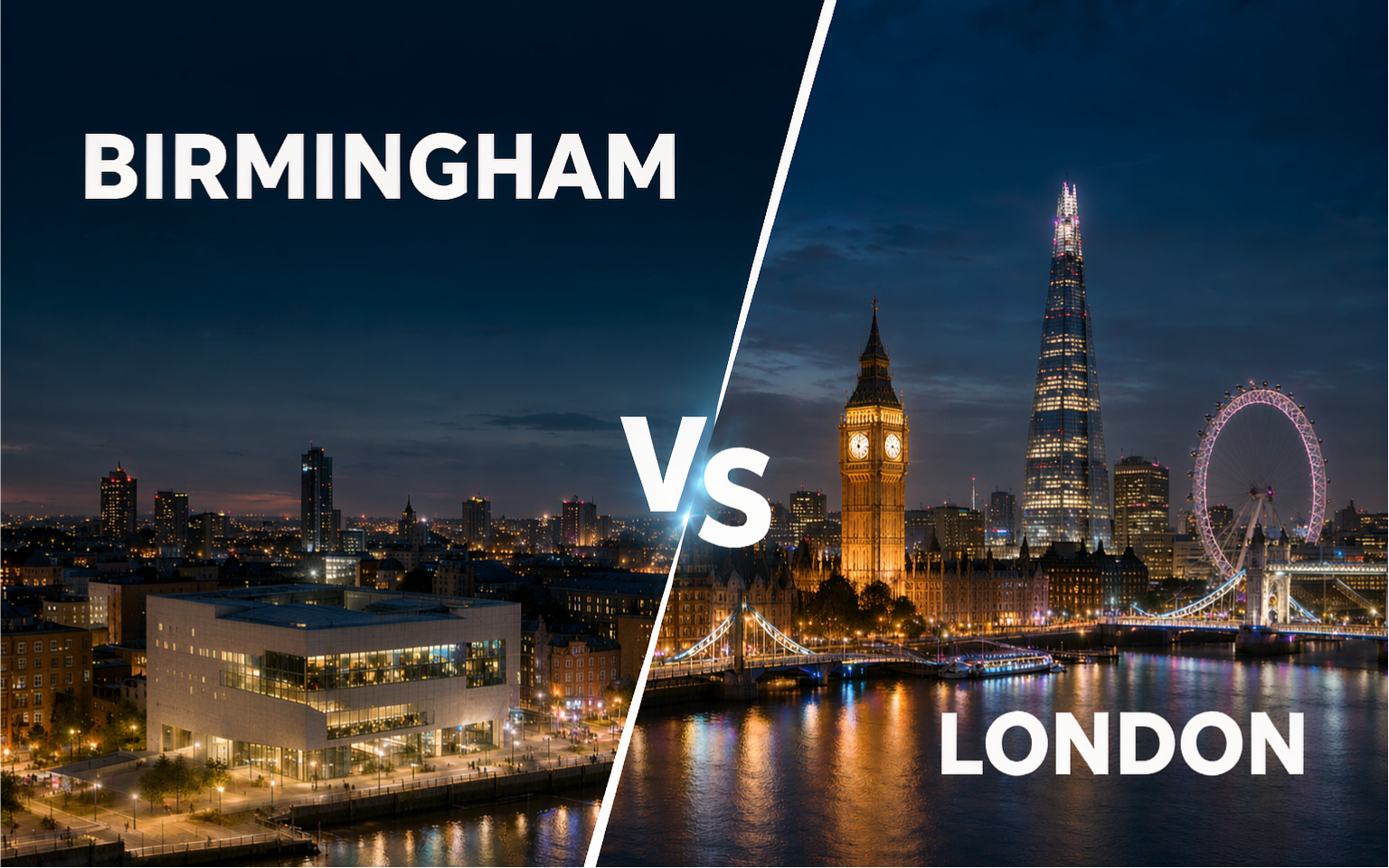
What is the difference between London vs Birmingham? London is known for its global career opportunities, prestigious universities, extensive public transport, and world-famous attractions, while Birmingham offers a more affordable cost of living, a strong university community, and a diverse mix of industries and cultural experiences. The two cities also differ in accommodation costs, salaries, safety, weather, healthcare, and sports. Whether you are planning to study, work, or settle in the UK, understanding these differences can help you decide which city better suits your budget, lifestyle, and long-term goals.
Birmingham vs London at a Glance
| Category | Birmingham | London |
|---|---|---|
| Population | 2.63 million | 10.42 million |
| Area | 671 km² | 1,646 km² |
| Monthly Cost of Living | £700–£1200 | £1,600–£2,500 |
| Student Accommodation | £77–£250 / week | £130–£355 / week |
| Public Transport | Buses, trams and regional rail; generally lower travel costs | Extensive Underground, bus and rail networks; higher travel costs |
| Universities | University of Birmingham, Aston University, Birmingham City University | Imperial College London, UCL, King’s College London, LSE |
| Job Opportunities | Engineering, manufacturing, banking, healthcare and professional services | Finance, law, technology, creative industries and international business |
| Salary | £29,000–£30,000 | £39,000–£44,000 |
| Safety | 118.38 offences per 1,000 | 103.04 offences per 1,000 |
| Climate | Generally cooler, with slightly more annual rainfall | Generally warmer, with slightly more annual sunshine |
| Attractions and Activities | Canals, Cadbury World, museums, the Jewellery Quarter and shopping | Iconic landmarks, major museums, West End theatres and shopping districts |
| Healthcare | Strong specialist services, including cancer care, transplantation and children’s healthcare | Extensive specialist hospitals, teaching hospitals and private healthcare services |
| Sports | Aston Villa, Birmingham City, Edgbaston Stadium and Alexander Stadium | Arsenal, Chelsea, Tottenham Hotspur, Wimbledon and Wembley Stadium |
Birmingham vs London: Population and City Size
London is the largest and most populous city in the UK, with a population of about 10.42 million and an area of 1,646 square kilometers,Birmingham is the second largest city, with a population of about 2.63 million and an area of 671 square kilometers. Additionally, in terms of Birmingham vs London, London is located in the Greater London region of southeast England, while Birmingham belongs to the West Midlands. London consists of the City of London and 32 boroughs, often divided into Inner London and Outer London. Birmingham itself is a unitary metropolitan borough, overseeing 40 constituencies and combined into 11 regional councils.

Cost of Living in Birmingham vs London
A single person’s total monthly living costs in Birmingham range from approximately £700 to £1,600, compared with £1,200 to £2,500 in London, meaning London costs roughly £500 to £900 more each month, based on accommodation choices and personal spending habits. Overall, Birmingham is generally 35% to 40% cheaper than London, a contrast that defines birmingham city vs london city living costs.
Average Cost of Living in Birmingham vs London
| Cost Category | Birmingham | London |
|---|---|---|
| Accommodation Costs | £77–£250/week | £130–£355/week |
| Public Transportation | £80/month | £260/month |
| Restaurants & Dining | £15.50 per inexpensive meal £5.50 per pint | £20.00 per inexpensive meal £7.00 per pint |
| Utilities & Internet | £241/month | £281/month |
| Fitness & Leisure | £28.80/month | £45.82/month |
Overall, the estimated monthly cost of living in Birmingham ranges from approximately £700 to £1,600, compared with £1,200 to £2,500 in London, based on accommodation choices and personal spending habits. Birmingham is generally more affordable for accommodation, public transport, dining, utilities, and leisure activities. London tends to have higher expenses across most categories, particularly housing and transportation. For students and young professionals, Birmingham can offer a more budget-friendly lifestyle, while London provides access to a larger range of urban amenities and career opportunities at a higher cost.
Accommodation Costs
Accommodation is a major part of the cost of living in Birmingham vs London. Weekly rents typically range from £77–£250 for student accommodation in Birmingham and £130–£355 for student accommodation in London. On uhomes.com, students can compare rental prices, room types, and facilities to find accommodation that suits their budgets and preferences. Options range from studio apartments in Birmingham to en-suite rooms in London, with properties to explore near universities. Before booking, check each listing for transport links, available amenities, and whether utility bills are included in the rent.
Studio: A studio provides a private sleeping area, bathroom, and kitchenette. In Birmingham, typical student studio rents are around £77–£216 per week, compared with approximately £195–£301 or more in London. For students who prefer a self-contained living space, comparing studio apartments in Birmingham with studio accommodation in London can help them understand the price difference before choosing a property.
En-suite Room: An en-suite gives you a private bedroom and bathroom while you share a kitchen with other residents. Birmingham rents are typically around £77–£149 per week, while London en-suite rooms can cost approximately £130–£239 per week. For those looking to balance privacy and affordability, browsing en-suite student rooms in Birmingham and en-suite accommodation in London offers a practical way to compare room options across the two cities.
One-Bedroom Apartment: A one-bedroom apartment offers a separate bedroom and greater privacy. Central Birmingham apartments typically cost around £126–£250 per week, while London one-bedroom apartments can cost approximately £247.67–£355 per week. For students and young professionals seeking more independent living, comparing one-bedroom apartments in Birmingham with one-bedroom apartments in London can help clarify the potential difference in rental expenses.
The accommodation price ranges above are based on listings from uhomes.com. The platform offers a wide range of student accommodation in both Birmingham and London, including studios, en-suite rooms, one-bedroom apartments, and other property types. To find accommodation that suits different budgets, students can compare available student housing in Birmingham with student housing in London before making a decision. Many student residences include utility bills such as electricity, heating, water, and Wi-Fi in the rent, helping students manage their budgets and avoid unexpected household expenses. Before booking student accommodation, always check the individual property listing to confirm which bills are included.
Transportation in Birmingham vs London
London’s transportation is vast and deeply integrated, heavily reliant on dense underground and multimodal networks, Birmingham’s transport system, in contrast, is more decentralized, car-centric, and built around regional railways, buses, and the ever-evolving tram line.
Public Buses, Trams and Railways
London’s buses are standardized red double-decker buses, equipped with two or three doors, with a unified one-way fare (about £1.50, including one hour of unlimited bus transfers), and strict daily frequency limits. Birmingham’s buses are diverse and diverse, mainly operated by single-door vehicles. Fares typically range from £1.50 to £2.40 one way, with day tickets even more expensive and routes often going directly to the city center rather than seamlessly running through the city.
London has extensive subway coverage (both subway and suburban rail), extending deep into the outskirts, with an average commute time of about 46 minutes. Birmingham has the West Midlands Underground (tram), which runs from Edgebaston through the city center to West Bromwich and Wolverhampton, and continues to expand. The heavy rail system is mainly concentrated at major junctions such as Birmingham New Street and Birmingham Moore Street, with an average commute time of about 31.4 minutes.
London monthly passes usually cost around £261, with an average price per ticket. Birmingham’s monthly pass prices are noticeably cheaper, averaging between £62.50 and £78.43.
Universities in Birmingham vs London
Regarding universities, Birmingham features 5 main universities, self-contained green campuses, and lower living costs. London features 45+ institutions, scattered city-integrated campuses, top global prestige, and higher expenses. The choice is influenced by your budget, campus preference, and career goals.
Universities in Birmingham
Birmingham’s university sector is smaller, with 5 main institutions offering academic programmes, practical training, and career development. Compared with London, campuses are more self-contained and traditional, student communities are tighter-knit, and living costs are lower.
- University of Birmingham: Ranked 68th in the QS World University Rankings 2027, this Russell Group university is renowned for its research excellence, strong academic reputation, and green Edgbaston campus.
- Aston University: Located in the city centre, Aston is particularly recognised for business, management, and its focus on employability and industry placements.
- Birmingham City University (BCU): Known for practical, career-focused education, BCU offers strengths in creative arts, media, fashion, architecture, and health-related subjects.
- University College Birmingham (UCB): Specialising in vocational education, UCB is a popular choice for students interested in hospitality, tourism, culinary arts, and related fields.
- Birmingham Newman University: A smaller institution offering a supportive learning environment, with particular strengths in education, teacher training, and social sciences.
Universities in London
London’s higher education sector is far larger and more dispersed, with 45+ institutions integrated across the city rather than clustered on self-contained campuses. It concentrates globally prestigious, research-intensive universities offering internationally recognised degrees, but with higher living costs and a faster-paced environment.
- Imperial College London: Ranked 2nd in the QS World University Rankings 2027, Imperial is internationally recognised for science, engineering, medicine, and business.
- University College London (UCL): Ranked 8th globally in the QS World University Rankings 2027, UCL is a leading research university with strengths across science, medicine, engineering, arts, and social sciences.
- King’s College London: A prestigious Russell Group university known for medicine, law, health sciences, humanities, and its central London campuses.
- London School of Economics and Political Science (LSE): Globally recognised for economics, politics, finance, and other social sciences, LSE is particularly attractive to students pursuing careers in business, government, and international affairs.
- Queen Mary University of London: A Russell Group institution offering a broad range of programmes, with notable strengths in medicine, dentistry, law, and the humanities.
Jobs in Birmingham vs London
In terms of career oppounties, London offers higher salaries, a larger market, and more finance, law, tech, and corporate headquarters roles, but at a much higher cost of living. Birmingham, by contrast, is a major regional hub for banking, professional services, digital media, manufacturing, engineering, and tech, with lower pay but stronger affordability, shorter commutes, and growing corporate relocation. Choose London for the highest salaries, largest market, and fastest career scaling; choose Birmingham for lower living costs, shorter commutes, regional growth opportunities, and better real disposable income.
Industry Differences
London: A leading international financial center, a hub of global law firms, an emerging technology startup ecosystem, a major media center, and home to numerous multinational corporations, which provides a large number of positions with fast-moving career paths. Major employers in London include JPMorgan Chase & Co., HSBC Holdings PLC, Barclays Bank PLC, Google DeepMind Technologies Ltd., AstraZeneca PLC, and the British Broadcasting Corporation (BBC).
Birmingham: A significant regional center for financial institutions such as HSBC, professional and legal service providers, digital media organizations, manufacturing companies, engineering organizations, and technology-related businesses. Some of the most prominent employers within the area include Goldman Sachs, PwC, Jaguar Land Rover, Cadbury, BT, and Gymshark.
Salary and Graduate Starting Pay Differences
London: Typical salary is approximately £39,000 to £44,000 annually. New graduates entering the workforce earn on average £30,000 to £35,000.
The average salary for a professional in the Birmingham area ranges from approximately £29,000 – £30,000 each year. Graduate level entry-positions typically pay in the range of £25,000 – £30,000.
Safety in Birmingham vs London
About safety, London is generally considered safer than Birmingham. Birmingham has a reported rate of 118.38 offences per 1,000 residents, while the Metropolitan Police force area records 103.04 offences per 1,000 residents. Within London, rates vary considerably by borough, ranging from 57.22 in Richmond upon Thames to 292.37 in the City of Westminster. These figures show differences in recorded crime across local areas and provide a statistical basis for comparing Birmingham vs London.
Statistical Comparison
Birmingham: 118.38 recorded offences per 1,000 residents.
London: 103.04 recorded offences per 1,000 residents across the Metropolitan Police force area.
Weather in Birmingham vs London
The Weather in London vs Birmingham is that London is generally slightly warmer, drier, and sunnier than Birmingham, though both share a temperate marine west coast climate (Cfb) with frequent rain and mild seasonal variation.
London has a higher average mean temperature of about 12.2°C to 15.0°C, whereas Birmingham is cooler at roughly 10.6°C to 13.8°C — a typical difference of about 1°C to 1.5°C across the year. London receives around 1,533 hours of annual sunshine, giving it a modest edge over Birmingham’s 1,373 hours. Both cities experience frequent rain spread across the year. London averages around 604 mm of annual precipitation, while Birmingham receives about 612 mm — slightly more, but the difference is small.
From a London vs Birmingham climate perspective, London has a slight edge in temperature and sunshine, while Birmingham is marginally cooler and wetter, but overall, the two cities have very similar temperate, rainy marine climates.
Attractions and Activities in Birmingham vs London
Birmingham and London offer two distinctly different urban experiences in the UK. London is defined by iconic landmarks, world-class museums, and premium costs, while Birmingham is characterized by canal-side industrial heritage, family-friendly interactive attractions, and strong value for money.
London: Major Attractions & Activities
- Iconic Landmarks: Home to global symbols like the Tower of London, Buckingham Palace, Big Ben, and the London Eye.
- World-Class Museums & Galleries: Free access to massive collections at the British Museum, the National Gallery, and the Tate Modern.
- Entertainment & Culture: West End theatre district for world-famous musicals and plays, plus diverse global food scenes in Chinatown and Borough Market.
- Immersive & Specialty Spots: Experiences like The Crystal Maze LIVE Experience and Dinosaur Escape Adventure Golf.
- Cost & Vibe: Fast-paced, high-energy, international, and expensive — hotel rates typically starting at £150+ per night and pints running £6–£8.
Birmingham: Major Attractions & Activities
- Canals & Industrial Heritage: More miles of canals than Venice, accessible from Brindleyplace for narrowboat tours and walks, alongside the historic Jewellery Quarter (producing 40% of UK jewellery).
- Family & Interactive Sites: Cadbury World in Bournville for chocolate-making and 4D rides, and the Thinktank Birmingham Science Museum with a planetarium and interactive exhibits.
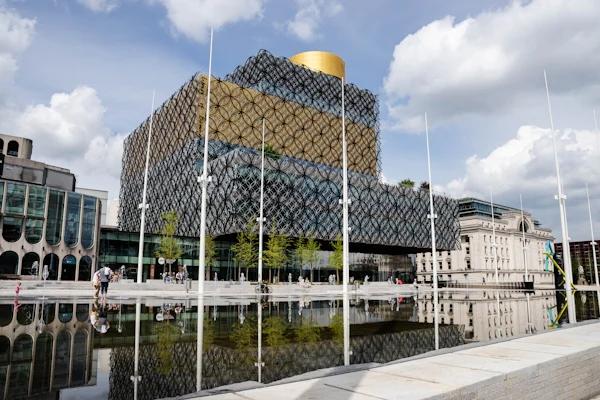
- Culture & Literature: The striking Library of Birmingham (the UK’s largest public library with rooftop gardens) and the Birmingham Museum & Art Gallery housing Pre-Raphaelite works.
- Food & Markets: Famed as the birthplace of the Balti (Balti Triangle) and home to the Bullring & Grand Central shopping centre and vibrant street food like the Digbeth Dining Club.
- Cost & Vibe: Laid-back, walkable, industrial-chic, and budget-friendly — with hotel rates averaging £50–£80 per night, pints at £3–£5, and most local attractions under £15.
Healthcare in Birmingham vs London
For healthcare London is known for its globally renowned teaching and specialist hospitals, while Birmingham stands out for stronger local healthcare access and slightly higher scores in some user satisfaction metrics. For residents, students, and families evaluating birmingham city vs london city healthcare options, these differences can directly affect convenience, specialist referral pathways, and waiting times.
Healthcare Access and Numbers
Birmingham: Ranked top among major UK cities for overall healthcare access in recent urban studies, largely due to a high concentration of local facilities relative to population size. Birmingham has roughly 16 major hospitals and a strong density of community clinics.
London: Home to globally renowned, world-class teaching and specialist hospitals. However, because of its massive and dense population, physical convenience and localized access can be more strained.
Hospital Specialist Strengths
Birmingham: Queen Elizabeth Hospital provides specialist care for cancer, organ transplantation, and complex conditions, Birmingham Children’s Hospital focuses on paediatric care, and Birmingham Women’s Hospital specialises in maternity, fertility, and newborn services.
London: Guy’s Hospital specializes in cancer, kidney, and surgical treatments; University College Hospital is recognized for cancer treatment, neurological treatments, and complex treatments, and Imperial College Healthcare provides specialized treatment across many areas of medicine.
Public Perceptions and User Metrics
According to crowd-sourced data from Numbeo’s Health Care Comparison, local residents rate several metrics slightly higher in Birmingham than in London:
Skill and competency of medical staff: Birmingham 71.43 vs. London 68.27.
Equipment for modern diagnosis and treatment: Birmingham 86.17 vs. London 81.59.
Friendliness and courtesy of staff: Birmingham 74.49 vs. London 71.44.
Convenience of location & cost satisfaction: Both rate well above 78%, with Birmingham edging slightly higher (82.61 vs. 79.47 for location).
Responsiveness (wait times): Both cities face severe NHS backlogs, with low responsiveness scores (London 43.55 and Birmingham 39.06).
From a Birmingham city vs London city healthcare perspective, Birmingham leads in access and some user satisfaction metrics, while London leads in specialist reputation and private healthcare resources. When selecting a place to reside or study, in addition to considering the proximity of local GP services and access to the appropriate specialized department, it would be beneficial to take into account how long you will have to wait for an appointment, as both cities face shared challenges of NHS waiting times.
Sports in Birmingham vs London
For sports Birmingham offers an active, accessible sporting community focused on football, cricket, and athletics, while London provides a larger volume of major events and internationally famous venues, though often at higher ticket and transport costs.
Birmingham is known for having an active sporting community with a focus on football, cricket, and athletics. Football fans can see Aston Villa play at Villa Park or Birmingham City at St Andrew’s. Cricket fans can attend large-scale matches at Edgbaston Stadium, while athletics fans will find Alexander Stadium one of the top athletics venues in the UK. In addition to hosting major international events such as the 2022 Commonwealth Games, Birmingham offers residents numerous opportunities to watch professional sports and join local clubs and fitness programmes.
Compared to Birmingham, London has a greater number of major sports events and internationally famous venues. Football fans can go to Wembley Stadium or watch Arsenal, Chelsea, and Tottenham Hotspur. Cricket supporters can see matches at Lord’s and The Kia Oval, and tennis fans can watch the Wimbledon Championships. London also hosts major rugby matches, the London Marathon, and many other international events. As a result of its larger event schedule, London offers sports enthusiasts more opportunities than Birmingham, though ticket prices and transport costs within London may be higher.
Conclusion
Overall, the Birmingham vs London comparison comes down to your priorities, budget, and lifestyle. Birmingham is a practical choice for those seeking lower living costs, affordable student accommodation, and a balanced urban lifestyle. London may be a better fit for those pursuing higher salaries, internationally recognised universities, a broader job market, and more cultural and sporting events. Before deciding where to live, study, or work, compare accommodation prices, commuting costs, career opportunities, and local amenities to find the city that best suits your needs and long-term goals.
Frequently Asked Questions About Birmingham vs London
No, Birmingham is generally 35% to 40% cheaper than London overall. Accommodation, public transport, dining, utilities, and leisure activities typically cost less in Birmingham, making it a more budget-friendly option for students and young professionals. London offers a wider range of career opportunities and attractions, but living expenses are generally higher.
No, London is much bigger than Birmingham in terms of population and geographical area. London’s urban area had approximately 10.42 million residents across 1,646 km², compared with Birmingham’s 2.63 million residents across 671 km². London also offers a wider range of job opportunities, attractions, and public transport options, while Birmingham is a smaller city with generally lower living costs.
No, Birmingham is not the same as London. Birmingham is a smaller city in the West Midlands, known for its lower living costs, manufacturing, engineering, and more affordable student accommodation. London is the UK’s largest city, offering a wider job market, more globally renowned universities, and extensive public transport, but with higher living expenses.
Yes, Birmingham UK is a good place to live, offering relatively affordable housing, diverse job opportunities, reputable universities, and a variety of cultural and leisure activities. Its public transport network and healthcare services also make it a practical choice for students, professionals, and families.
The best way to get travel between London and Birmingham is by train, which takes about 1 hour and 20 minutes from London Euston to Birmingham New Street Station. Additionally, long-distance buses offer more affordable options, but usually take longer, about 2-3 hours.
Spring and early autumn is the best time to visit London and Birmingham, as the weather is pleasant and the crowds are lighter. Summer is the peak tourist season in London, while Birmingham’s Frankfurt Christmas Market makes December a popular travel season.
London offers more major football clubs, including Arsenal, Chelsea, and Tottenham Hotspur, while Birmingham is home to Aston Villa and Birmingham City. London provides more top-level football matches and club options, while Birmingham offers a strong local football culture.