





Renting in the UK can be expensive, so knowing what you can comfortably afford is an important first step before choosing a property. A rent affordability calculator in the UK can give you a quick estimate based on your income, but rent is only one part of your monthly budget.
Bills, transport, everyday spending and savings all affect how much rent you can afford. This guide explains the main ways to calculate rent affordability and helps you work out a realistic budget before you start your search.
Rent affordability calculator UK
Calculate Your Rent Budget
Enter your monthly income and living costs to estimate a comfortable monthly rent.
How is rent affordability calculated?
There is no single formula for calculating rent affordability. Some methods use income as a simple benchmark, while others consider how rent fits into your wider monthly budget.
1. The 30% rent rule: Useful but limited
The 30% rent rule is a simple benchmark for estimating how much rent you can afford. It suggests keeping monthly rent at around 30% or less of your gross income, which is your income before taxes and other deductions.
How the 30% rent rule works
The calculation is straightforward: Gross monthly income × 30% = suggested monthly rent
For example, if you earn £2,800 per month before tax, the 30% rule gives you a rent budget of around £840 per month. This makes it useful as a quick starting point, and some simple rent affordability calculators use a similar income-based approach.
Why the 30% rule has limits
The problem is that income alone does not show your full financial picture. The rule does not account for Council Tax, energy bills, food, transport, debt repayments or savings, and rental costs also vary considerably across the UK. Two people earning the same amount may therefore have very different answers to how much rent they can afford in the UK.
This is why the 30% rule works better as a benchmark than a fixed spending target. A broader budgeting method can give you a more realistic view of what is affordable month to month.
2. The 50/30/20 rule: More flexible and realistic
Unlike the 30% rent rule, the 50/30/20 rule looks at your take-home income and wider monthly budget, rather than rent alone. It divides your after-tax income into three categories: 50% for needs, 30% for wants and 20% for savings or additional debt repayments.
How the 50/30/20 rule works
The 50% needs budget covers essential expenses such as rent, utility bills, groceries, transport and minimum debt repayments. The remaining 30% can go towards non-essential spending, while 20% is reserved for savings or extra debt payments.
For example, with a monthly take-home income of £2,800, the guideline would divide your budget into:
- £1,400 for needs
- £840 for wants
- £560 for savings or extra debt repayments
How much rent can you afford with the 50/30/20 rule?
The important point is that the full 50% is not your rent budget. Rent has to share that amount with your other essential costs. If your monthly take-home income is £2,800 and you spend £450 on other essentials and £150 on housing bills, your suggested rent would be:
- £1,400 − £450 − £150 = £800 per month
This makes the 50/30/20 approach particularly useful when using a rent affordability calculator in the UK, because it gives a more complete picture of how much rent you can afford without ignoring the rest of your monthly spending.
How much rent can I afford UK
Rent affordability can vary significantly depending on where you live. Even with the same income and spending habits, the amount you can comfortably afford in London may look very different from your budget in cities such as Manchester, Birmingham or Leeds.
Regional considerations
Rent affordability varies considerably across the UK. According to ONS data, average rents in London were equivalent to 41.6% of private-renter household income in 2024, compared with 19.8% in the North East. Over the period from 2016 to 2024, London’s rent-to-income ratio ranged from 38.5% to 57.0%, while other English regions generally remained between 19% and 36%.
Location should therefore be treated as part of your affordability calculation, not just a property-search preference. If you are using a rent affordability calculator in the UK, compare the result with typical rents in the city where you plan to live. A £900 monthly budget may leave you with plenty of options in some areas but severely limit your choices in London or Bristol.
If your preferred city is above your comfortable budget, the solution does not always have to be spending more. Looking slightly further from the city centre, choosing a smaller property, sharing accommodation or selecting a bills-included option can sometimes reduce the total monthly cost.
How much rent can I afford based on my income?
The examples below are based on the 50/30/20 budgeting rule, which allocates 50% of take-home income to essential needs, including rent and other necessary expenses. The figures are illustrative and show how different income levels and household costs can affect a realistic monthly rent budget.
| Monthly Take-Home Income | Essential Costs | Housing Bills | Suggested Monthly Rent |
|---|---|---|---|
| £2,000 | £400 | £150 | £450 |
| £2,500 | £400 | £150 | £700 |
| £3,000 | £400 | £150 | £950 |
| £3,500 | £400 | £150 | £1,200 |
| £4,000 | £400 | £150 | £1,450 |
| £4,500 | £400 | £150 | £1,700 |
| £5,000 | £400 | £150 | £1,950 |
Example only: these figures assume £400 in other essential monthly costs and £150 in housing bills. Your suggested rent may be higher or lower depending on your actual expenses.
Rent affordability examples by household income
Household type can affect rent affordability because housing needs and shared costs vary. The examples below use recommended rent shares of 28% for a single renter, 23% for a couple, 33% for a family and 25% for a retired household. Couples may benefit from sharing household costs, while families often need more space and retired households may rely on more fixed incomes. These figures should be treated as practical reference points rather than fixed UK rules.
| Household Type | Example Gross Annual Income | Recommended Share | Recommended Monthly Rent |
|---|---|---|---|
| Single Renter | £30,000 | 28% | £700/month |
| Couple | £50,000 combined | 23% | £958/month |
| Family | £60,000 combined | 33% | £1,650/month |
| Retired Household | £30,000 | 25% | £625/month |
These figures are illustrative examples rather than fixed affordability limits. Your actual rent budget will depend on your income, bills, debt repayments and other essential expenses.
What costs should you include when calculating rent affordability?
Rent is only one part of your overall housing budget. To work out how much rent you can afford in the UK, you should also consider the costs of moving in, ongoing household bills and the everyday expenses that compete with rent for your monthly income.
1. Upfront costs before you move in
Before signing a tenancy, you may need to pay a security deposit, holding deposit and your first month’s rent, as well as moving costs or basic furniture and household items.
These are not usually part of your monthly rent budget, but they still affect whether a property is affordable when you first move in. When using a rent affordability calculator, it is therefore useful to keep your monthly budget and your upfront cash requirements separate.
2. Monthly housing costs beyond rent
The advertised rent is not always the full amount you will pay each month. Some properties come with additional household or property-related costs, while others include them in the rent.
Advertised Rent
+
Household Bills
Council Tax · Energy · Water · Wi-Fi
+
Property Extras
Parking · Contents insurance
=
Your Real Monthly Housing Cost
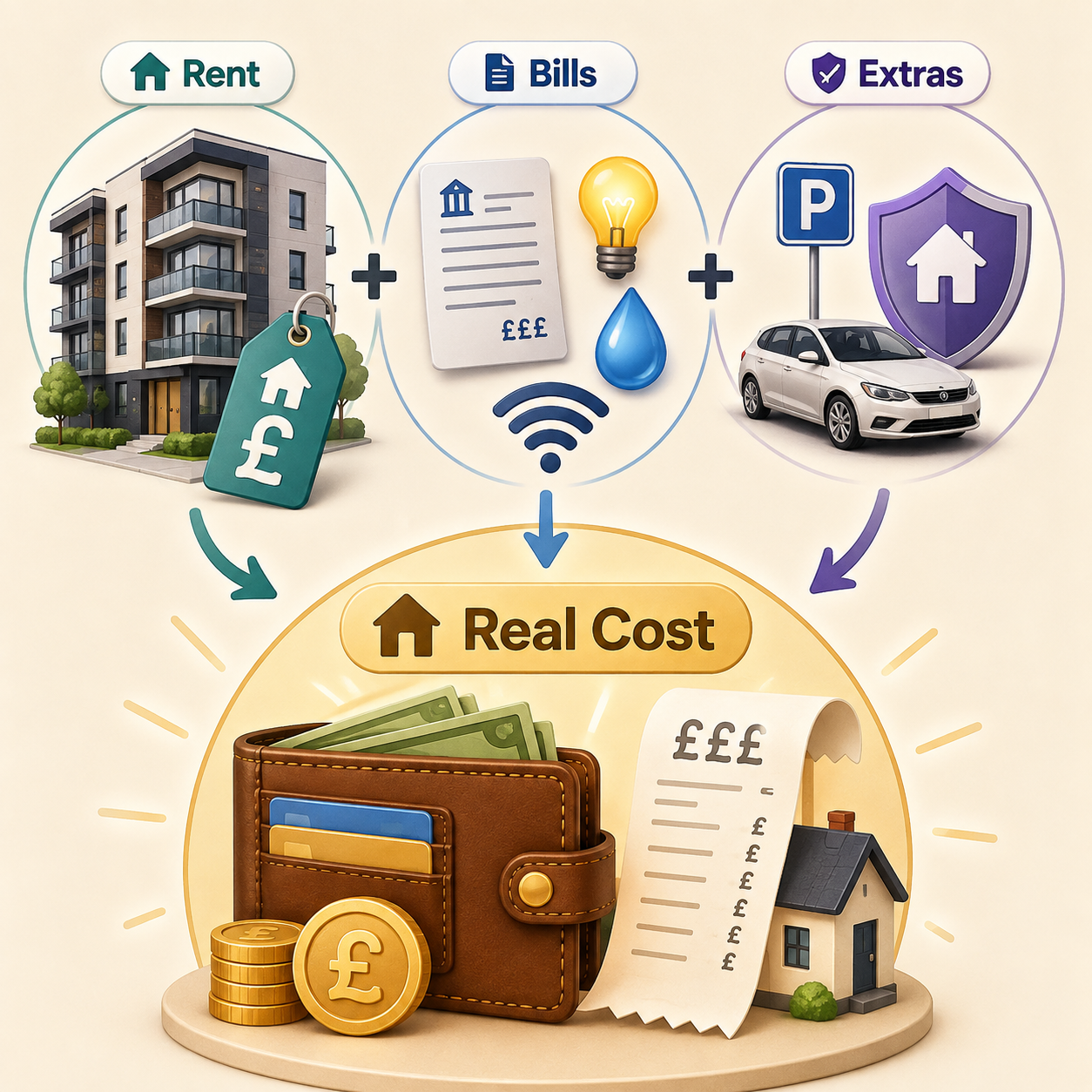
A real London comparison shows why advertised rent does not always reflect the true cost of renting. The Lyra – Gold Studio and Alto Building – Studio have similar headline prices, but their utility arrangements are different. The Lyra includes water, electricity, heating and Wi-Fi in the rent, while Alto Building charges an additional monthly utility fee. The table below shows how this difference affects the estimated annual cost.
| The Lyra – Gold Studio | Alto Building – Studio | |
|---|---|---|
| Advertised rent | £390.50/week | £1,650/month |
| Water | Included | Extra |
| Electricity | Included | Extra |
| Heating | Included | Extra |
| Wi-Fi | Included | Included |
| Utility charge | £0 | £95/month |
| Annualised rent | £20,306 | £19,800 |
| Annual utilities | Included | £1,140 |
| Estimated annual total | £20,306 | £20,940 |
Alto Building looks cheaper at first: £1,650 per month compared with The Lyra’s annualised monthly equivalent of about £1,692. Once the £95 monthly utility charge is added, however, Alto rises to around £1,745 per month. Over a year, The Lyra works out about £634 cheaper.
If you are renting in the UK and prefer more predictable monthly spending, bills-included accommodation can make budgeting much simpler. You can compare this type of student accommodation in UK on uhomes.com, where many properties include utilities such as water, electricity and Wi-Fi in the rent. Some residences may also offer extras such as free breakfast or cleaning services.
3. Everyday costs and financial commitments
Your personal spending also affects how much rent you can realistically afford. Groceries, transport, mobile phone bills, childcare and minimum debt repayments all reduce the amount left for housing each month.
Regular savings and an emergency buffer should also be considered rather than treating every pound left after essential spending as available for rent. This is why a rental affordability calculator that considers your wider monthly budget can give a more useful estimate than salary alone.
How to calculate rent affordability for students in UK?
Calculating rent affordability works a little differently for students, as many do not have a fixed monthly salary. If you are trying to work out how much rent you can afford in the UK as a student, it is often more useful to look at the money available across your whole tenancy rather than applying a fixed percentage to monthly income.
1. Start with your total student budget
Start by adding up the money you can realistically rely on during your tenancy. For students, this may come from several sources rather than one fixed salary. The latest comprehensive Department for Education Student Income and Expenditure Survey shows that full-time students commonly rely on a mix of Maintenance Loans, paid work, family support and university funding.
| Budget Source | Official UK Evidence |
|---|---|
| Maintenance Loan | For 2026/27, eligible full-time students in England can receive up to £14,135 in London or £10,830 outside London when living away from home. |
| Part-time Work | In the DfE 2021/22 survey, 58% of full-time students worked alongside their studies. Median earnings among those in paid work were £3,600 over the academic year. |
| Family Support | Family support is common, but the amount varies widely. In the DfE survey, 78% of full-time students had some financial exchange with family. |
| Scholarships & Bursaries | 22% of full-time students received a bursary or scholarship from their university or college, with a median value of £1,000 among recipients. |
| Personal Savings | Savings are also recognised by GOV.UK as one way students may make up a gap between student finance and actual living costs. |
Do not build your rent budget around money you might receive. A scholarship you have not yet secured or extra shifts you hope to work during term time should not be treated in the same way as confirmed student finance or savings already available to you.
2. Subtract your essential living costs
Your total student budget cannot all go towards accommodation. Before setting a rent limit, estimate how much you will need for everyday essentials such as food, transport, personal spending and study-related costs.
The latest comprehensive Department for Education (DfE) Student Income and Expenditure Survey covers the 2021/22 academic year. It found that full-time students in England had median living costs of £5,841 over the academic year, equivalent to around £140 per week. Food alone accounted for a median £46.50 per week.
| Essential Cost | Official DfE 2021/22 Data | Approx. Weekly Equivalent |
|---|---|---|
| Food & Groceries | £1,814 per academic year | £46.50/week |
| Non-course Travel | £1,000 per academic year | ≈ £26/week |
| Personal Items | £998 per academic year | ≈ £26/week |
| Direct Course Costs | £200 median | ≈ £5/week |
| Household Goods | £67 per academic year | ≈ £2/week |
| Total Living Costs | £5,841 per academic year | £140/week |
These figures are from 2021/22, so they should be used as a reference rather than a recommended 2026 budget. ONS research later found that 92% of higher education students reported rising living costs in early 2023.
For a more current reference point, UK Student visa rules now require applicants to demonstrate the following amount for living costs:
| Study Location | Current UKVI Living-Cost Requirement |
|---|---|
| London | £1,529/month |
| Outside London | £1,171/month |
These amounts apply for up to nine months and were updated at the end of 2025. They are visa financial requirements, not official recommended student spending budgets, but they provide a useful current benchmark for the difference between living in London and elsewhere in the UK.
3. Turn what is left into a weekly rent budget
Student accommodation in the UK is often advertised by the week, so converting your remaining budget into a weekly figure makes it much easier to compare properties.
You can use: You can use the formula below or our student rent calculator to estimate how much you can afford to spend on accommodation each week:
Affordable weekly rent = (Total student budget − Essential living costs − Emergency buffer) ÷ Contract length
Student Weekly Rent Calculator
Estimate how much you can afford to spend on accommodation each week.
The result gives you a practical starting point for understanding how much rent you can afford as a student in the UK, rather than a fixed spending limit. Your actual budget may vary depending on your living costs, financial support and whether bills are included in the rent.
Tips for a realistic rental budget
A realistic rental budget should leave enough room for everyday expenses, savings and unexpected costs, rather than simply showing the maximum rent you could pay.
1. Set a comfortable rent and a maximum rent
Do not treat the highest figure you can technically afford as your target. Set a comfortable rent for most of your property search, then keep a separate maximum that you would only consider for the right property.
For example, if your budget suggests £1,000 per month is possible, you might focus your search below that figure rather than automatically looking at £1,000 properties. The closer you rent to your maximum, the less room you have for higher bills, unexpected expenses or changes in income.
2. Build your budget around a normal month, not your cheapest month
When working out how much rent you can afford, look back at several months of actual spending rather than estimating from memory. Food, transport and energy costs can change from month to month, so one unusually cheap month can make your rental budget look healthier than it really is.
Leave some money unallocated as well. A budget that only works when nothing unexpected happens is probably too tight.
3. Compare the all-in cost — and the time cost
A cheaper property is not always the better-value option once bills, Council Tax and commuting costs are included. Location can also add a time cost, especially if lower rent means a much longer journey to work or university.
When comparing properties, consider both the total monthly cost and the time you will spend commuting. A lower rent may save money, but that saving can quickly shrink once transport costs and longer travel times are taken into account.
Conclusion
A rent affordability calculator in the UK can give you a useful starting point, but the final budget should reflect more than income alone. Rent, bills, living costs, location, commuting and savings all affect what is genuinely affordable.
Whether you are renting in London, another UK city or choosing student accommodation, the best budget is one that you can maintain comfortably each month — not simply the highest rent you can technically pay.
FAQ
How much rent you can afford in the UK depends on your income, essential expenses, housing bills and savings goals. The 30% rent rule can provide a quick benchmark, but looking at your take-home pay and wider monthly budget usually gives a more realistic figure. A rent affordability calculator can help you estimate a comfortable starting point.
When calculating rent affordability, include more than the advertised rent. Council Tax, electricity, water, Wi-Fi, transport, groceries, debt repayments and other essential expenses can all affect how much rent you can realistically afford. You should also leave some room for savings and unexpected costs.
There is no fixed amount that works for everyone, but your budget should still leave room for food, transport, savings and unexpected expenses after rent is paid. If paying rent leaves almost nothing for emergencies or normal monthly spending, the property is probably too close to your maximum budget.
Not always. A bills-included property may cover electricity, water, heating and Wi-Fi, but Council Tax, laundry, parking or other charges may still be separate. Always check exactly what is included before comparing the total cost of different properties.
Not necessarily. The maximum rent you can technically afford is not always the amount you should aim for. Keeping your rent below your upper limit gives you more room for unexpected bills, savings, travel or changes in income.
Letting agents calculate rent affordability by comparing your income with the rent you want to pay. A common benchmark is that your gross annual income should be around 30 times the monthly rent, although different landlords and referencing companies may use different criteria.
The rent you can afford on your salary depends on both your income and your regular expenses. A common starting point is around 30% of gross income, but your actual budget should also allow for bills, transport, food, savings and other essential costs.
The income a guarantor needs for renting depends on the landlord or referencing provider. Some require the guarantor’s gross annual income to be around 36 times the monthly rent, while others may use a higher or lower threshold.
Whether you should enter gross or net income in a rent affordability calculator depends on what the calculator is designed to measure. Gross income is commonly used for landlord affordability checks, while net or take-home income is more useful for working out what rent you can comfortably afford each month.