



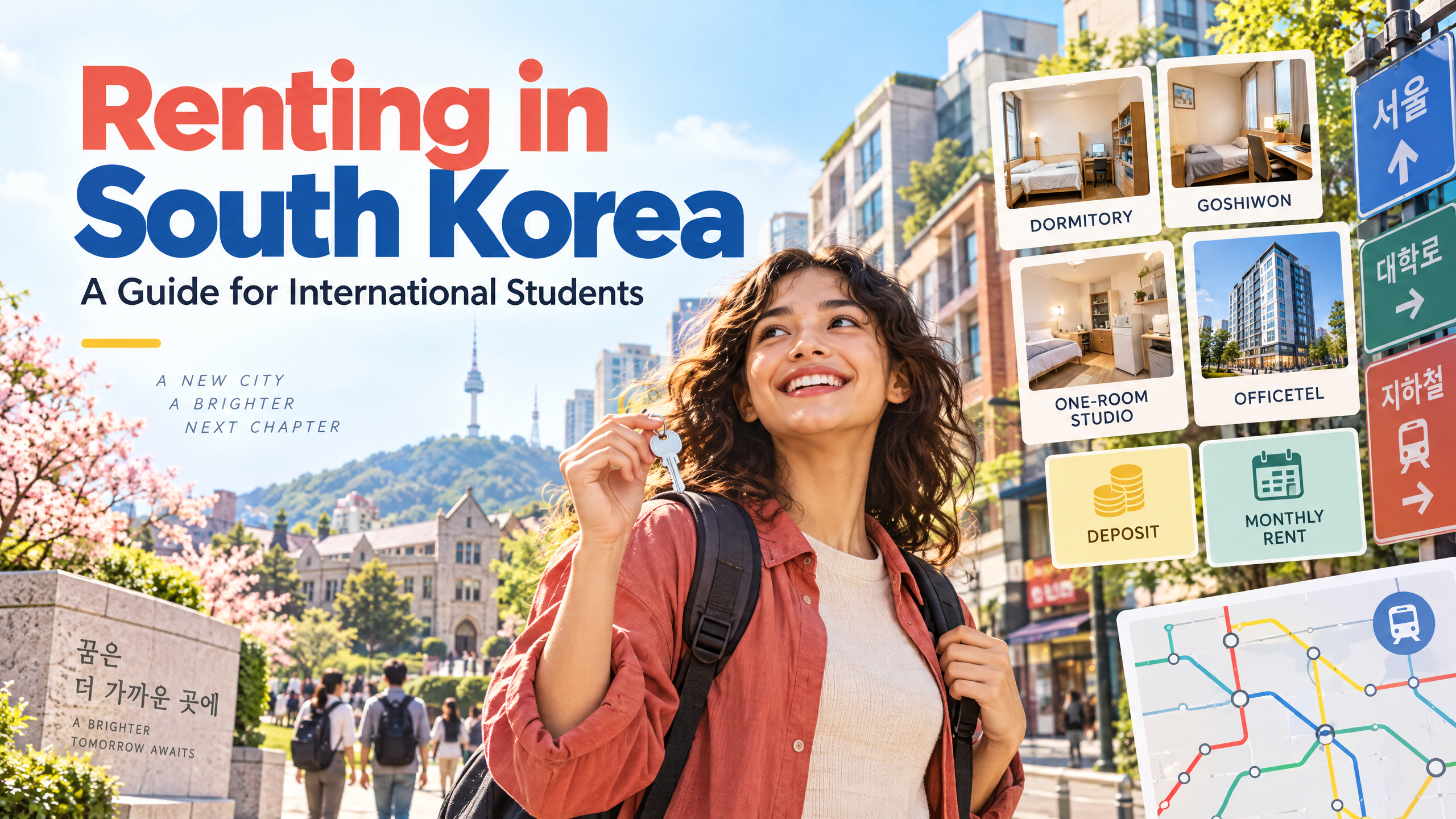
For international students renting in South Korea, the key steps are to confirm your actual campus, set a budget that covers the deposit, rent and management fees, verify the property and landlord before paying, and complete the required move-in and lease-protection procedures after signing.
Key Takeaways
- Student housing in South Korea includes university dormitories, goshiwon, shared houses, one-room studios, officetels and private apartments. Each option differs in price, privacy, room size, facilities and contract requirements.
- Korean rental listings usually show a deposit and monthly rent together, such as 10,000/600, meaning a KRW 10 million deposit and KRW 600,000 monthly rent. International students should consider both the upfront deposit and ongoing monthly costs.
- Your total housing budget includes more than rent. Check the deposit, management fees, utilities, internet, moving costs and other initial expenses before choosing accommodation.
- Wolse (monthly rent) is usually the most practical option for international students, as it requires a lower upfront cost than jeonse. However, a lower deposit may result in higher monthly rent.
- Choose your accommodation location based on your university campus and daily commute. Popular student areas in Seoul include Sinchon, Hongdae, Anam, Hoegi, Gwanak and Wangsimni, but the best choice depends on your actual university and lifestyle.
- The rental process usually involves searching for accommodation, checking property details, reviewing the contract, paying the deposit and moving in. Before signing, verify the landlord or agent, contract terms, payment details and included fees.
- Before moving in, document the condition of the property and keep all important records, including the contract, payment receipts, utility information and communication with the landlord.
Housing Options at a Glance
| Housing type | Typical monthly rent budget | Typical initial funding pattern | Suitable for |
|---|---|---|---|
| Goshiwon (고시원, 고시텔) | KRW 300,000–600,000 | Usually a low deposit, with some rooms requiring little or no large deposit | Short-term stays, students on a tight budget |
| Share house (셰어하우스) | KRW 350,000–700,000 | Deposit and fees depend on the operator and contract | Students who want to reduce costs and are comfortable sharing facilities |
| One-room studio (원룸) | Seoul: around KRW 450,000–900,000. Regional cities: commonly around KRW 300,000–650,000 | Often requires a deposit of several million to more than KRW 10 million | Students who want private living space |
| Officetel (오피스텔) | Seoul: around KRW 650,000–1.2 million or more | Deposit and management fee require careful comparison | Students who prioritise building facilities and have a larger budget |
| University dormitory | Depends on the university, room type and semester | Usually paid in advance according to university rules | Students arriving in Korea for the first time who want a simpler initial move |
Types of Student Housing in South Korea
Korean student accommodation can be broadly divided into university dormitories, goshiwon, one-room studios, officetels and sharehouses.
University Dormitories
A university dormitory is worth checking as early as possible, particularly if you are travelling to Korea for the first time and do not yet have a Korean phone number or bank account. Dormitory prices, application deadlines and eligibility requirements vary between universities. Students should always check their own university’s housing policies early to make sure they apply on time and prepare all required documents.
Each university determines its own:
- Application dates
- Eligibility
- Room types
- Fees
- Meal arrangements
- Curfews or access rules
- Holiday occupancy rules
- Renewal conditions
Goshiwon
A goshiwon (고시원) or gositel (고시텔) can be a practical option for students looking for budget-friendly short-term accommodation. Rooms are usually small and designed for basic living, but the exact size, facilities and conditions vary significantly between properties.
Although the Korean government’s Study in Korea guide describes goshiwon rooms as small and relatively affordable, students should not assume that all goshiwons offer the same facilities. Some rooms have private bathrooms, while others use shared facilities. Some properties provide shared kitchens or meals, while others do not.
If you are considering a goshiwon, check the following details before renting:
- Is there a private bathroom?
- Does the room have a window?
- Is cooking allowed?
- Is a refrigerator provided?
- Are laundry facilities available and included?
- Is internet included?
- What fire safety measures are in place?
- Are there quiet hours or other house rules?
- Can you register the address for any required administrative procedures?
One-Room Studio
A one-room (원룸) is a popular private rental option in South Korea. It usually combines a sleeping and living area with a private bathroom and a small kitchen, making it suitable for students who want more privacy and independence.
However, one-room sizes and layouts can vary significantly. Photos may make a room look larger than it feels in daily use, so students should check whether there is enough usable space for essential items such as a bed, desk, refrigerator, washing machine, wardrobe, kitchen equipment and personal belongings.
Before signing a contract, also confirm which appliances are included. Some properties provide items such as air conditioning, a refrigerator, a washing machine or a microwave, while others may require students to arrange their own.
Officetel
An officetel (오피스텔) is a type of Korean building designed for both residential and office use. Many officetels are popular among students because they often provide private bathrooms, modern facilities, lifts, controlled access and convenient locations with good transport connections.
Compared with smaller one-room studios, officetels usually offer more facilities and a more modern living environment. However, they may come with higher additional costs, especially management fees (관리비), so students should check the full monthly cost before renting.
Before signing a contract, confirm:
- What is included in the management fee?
- Are electricity, gas, water, heating or internet charged separately?
- Is parking available, and does it have an additional cost?
- What furniture and appliances are provided?
- What facilities are available in the building?
- Is the unit officially registered for residential use?
Students should also confirm the brokerage fee and contract conditions, as rental costs and requirements can vary depending on the property.
Sharehouse
A sharehouse (셰어하우스) or co-living accommodation allows students to rent a private bedroom while sharing common areas such as the kitchen, living room or bathroom. It can be a more affordable option than renting a private studio and is suitable for students who want a more social living environment.
However, the living experience depends heavily on the house rules and rental arrangement. Before moving in, make sure you understand who you are signing the contract with, which areas are private or shared, and how daily responsibilities are managed.
Before renting a sharehouse, check:
- Who is the contractual landlord or accommodation provider?
- Which spaces are private and which spaces are shared?
- How are utilities such as electricity, gas, water and internet divided?
- How is cleaning organised between residents?
- Are there visitor rules or quiet hours?
- How much notice is required before moving out?
- How and when will the deposit be returned?
- Is the agreement a direct lease, sublease or room licence?
If you are taking over a room from an existing tenant, confirm that the person has permission to transfer or sublet the room. Do not send a large payment only based on chat messages, student IDs, passport copies or room videos. Always verify the rental agreement and payment details before transferring money.
Where Should International Students Live in South Korea?
- Walking time from the property to the station or bus stop
- Waiting time
- Transfers
- Walking time after leaving the station
- The actual entrance of your campus
- Hills and steep roads
- Traffic conditions
- Late-night transport options
Sinchon, Ewha and Hongdae
Sinchon (신촌) is closely associated with students at Yonsei University, Sogang University and Ewha Womans University. The area has a dense concentration of restaurants, supermarkets, banks, cafés and public transport. One-room studios and goshiwons are also common around university districts. For students comparing homes near Yonsei University, you can also review the student accommodation near Yonsei University as a separate reference point. Hongdae (홍대) and Hapjeong (합정) are convenient for students who enjoy a lively neighbourhood and need good connections across central Seoul. However, “near Hongdae” can describe very different living environments. Check:- Which station exit is nearby
- Whether the building faces a main road
- Whether it is close to bars or nightlife streets
- Night-time noise
- Late-night pedestrian traffic
- The walking route home after dark
Anam, Jongam and Hoegi
Students at Korea University often compare Anam (안암) and Jongam (종암). There are many student-oriented properties, and some older buildings can offer lower rents. However, older buildings can differ significantly in:- Kitchen condition
- Bathroom condition
- Natural light
- Ventilation
- Insulation
- Soundproofing
- Heating
- Storage
Sillim and Nakseongdae
Students at Seoul National University’s Gwanak Campus commonly consider Sillim (신림), Nakseongdae (낙성대) and neighbourhoods connected to the campus by bus. Do not interpret “living in Sillim” as automatically meaning that you can walk to your classroom. SNU’s Gwanak Campus is large, so your actual journey depends on:- Your department building
- The campus entrance
- Bus routes
- Bus frequency
- Morning traffic
- Walking distance after arriving on campus
Hyehwa, Wangsimni and Konkuk University
Hyehwa (혜화) is relevant to students studying at Sungkyunkwan University’s Humanities and Social Sciences Campus. The neighbourhood has extensive dining and cultural facilities. Sungkyunkwan University’s Natural Sciences Campus is in Suwon, so students must confirm their campus before searching. Wangsimni (왕십리) and the area around Hanyang University Station have several transport connections and can be practical for students at Hanyang University’s Seoul Campus. Konkuk University Station (건대입구) and Hwayang-dong are common areas to consider for students at Konkuk University. Commercial facilities are extensive, although streets around busy nightlife areas can be noisy.Other Seoul areas to consider
Students at Chung-Ang University’s Seoul Campus can look at Heukseok (흑석) and Sangdo (상도). Students who need to combine university with an internship or part-time work may prefer an area with convenient subway connections rather than living immediately beside campus. Gangnam, Seocho and Seongsu have many housing options and strong transport and lifestyle infrastructure, but housing and everyday spending can also be higher. Compare them against your actual budget rather than choosing an area because of its name. Seoul’s official housing information also identifies areas around Ewha, Hongik and Yonsei as student-oriented neighbourhoods with many officetels and one-room studios.Other Main Student Housing Areas Outside Seoul in South Korea
Regional cities can offer different housing choices, but the same rule applies: locate your campus first, then build your daily living area around it.Busan
Students around Pusan National University can consider Jangjeon (장전) and neighbouring areas of Geumjeong-gu, where student restaurants and one-room studios are concentrated. Students at Pukyong National University can compare Daeyeon (대연) and areas around Kyungsung University and Pukyong National University Station. Haeundae and Gwangalli suit students who value coastal living, but tourist-oriented areas should not be used as a direct benchmark for ordinary student housing. Sea-view homes and short-term properties can be priced differently from ordinary student one-rooms. As an initial screening range, a Busan one-room can be considered around KRW 350,000–650,000 per month, with the actual cost adjusted according to deposit, location, building condition and management fee.Daejeon
Start with the campus. Students at KAIST’s Daejeon campus and Chungnam National University commonly compare Yuseong (유성), Gung-dong (궁동) and Eoeun-dong (어은동). Living near Daejeon Station may provide convenient transport to other parts of the city but can still result in a longer journey to class.Daegu
Students at Kyungpook National University can look around northern Daegu and nearby university districts. Students at Keimyung University’s Seongseo Campus should search around the campus rather than central Daegu.Gwangju
Students at Chonnam National University can begin by looking around Yongbong-dong and nearby university areas.Suwon
Suwon requires particular attention to campus location. For example, Sungkyunkwan University’s Natural Sciences Campus is in Suwon, while its Humanities and Social Sciences Campus is in Seoul. These require completely different housing searches.Incheon
For universities around Songdo, prioritise:- Walking distance
- Bus frequency
- Evening transport
- Campus access
- Local supermarkets
- Daily living costs
| Cost factor | What to compare |
|---|---|
| Deposit | How much cash is tied up |
| Monthly rent | Fixed monthly payment |
| Management fee | What is actually included |
| Utilities | Electricity, gas and water |
| Transport | Daily commuting cost |
| Time | Door-to-door travel time |
| Moving costs | Initial and final moving expenses |
What Is the Difference Between Wolse, Jeonse and Ban-jeonse?
| Rental type | Deposit | Monthly rent | Main feature |
|---|---|---|---|
| Wolse (월세) | Lower or moderate | Paid monthly | Easier to budget around monthly cash flow |
| Jeonse (전세) | Very large | Usually little or no monthly rent | Large deposit is returned at the end subject to the contract and applicable law |
| Ban-jeonse (반전세) | Higher than typical wolse | Lower monthly rent | Combines a larger deposit with reduced monthly rent |
Wolse
Wolse (월세) means paying a deposit and monthly rent. This is often easier for international students to plan because the initial deposit can be lower than a jeonse deposit. However, a lower deposit does not mean there is no deposit risk.Jeonse
Jeonse (전세) involves a large deposit in exchange for little or no monthly rent. The key question is not simply whether the contract says the deposit will be returned. You need to consider whether the landlord will be able to return the deposit when the lease ends and whether your legal protection and priority position have been properly established. For a high-deposit lease, check:- Property ownership
- Existing mortgages
- Existing security interests
- Property value
- Building register
- Contracting party
- Payment account
- Deposit-protection options
- Applicable tenant-protection procedures
Ban-jeonse
Ban-jeonse (반전세) sits between wolse and jeonse. You pay a relatively higher deposit to reduce the monthly rent. When comparing two properties, do not ask only which has the lower rent. Compare how much cash will be tied up in the deposit and how much you will spend over your expected period of study.How Much Money Do You Need to Rent in South Korea?
A Korean rental budget should cover the deposit, monthly rent, management fee, utilities and one-off move-in costs rather than monthly rent alone.
Korean rental listings often display the deposit and monthly rent in a compact format. For example, a listing showing “1,000/60” usually means a KRW 10 million deposit plus KRW 600,000 monthly rent. The KRW 600,000 normally does not include the management fee, and electricity, gas, water, or internet may also be charged separately.
Before viewing a property, remember to ask two separate questions:
- How much do I need to pay when I move in?
- How much will I actually spend each month?
These figures are screening ranges for student housing, not official 2027 rent medians or live market quotations. Actual prices can change significantly according to the deposit, building age, floor area, distance from a station, furnishing, contract length, neighbourhood and management fee.
Official Korean guidance confirms that Korean rental structures can involve substantial deposits, with wolse combining a deposit with monthly rent and jeonse relying primarily on a large deposit.
Do not forget the management fee
Set aside roughly KRW 50,000–150,000 per month as a starting allowance for management fees, then check the actual amount for the property.
A management fee may cover some combination of:
- Building cleaning
- Common-area electricity
- Lift maintenance
- Security
- Building facilities
- Internet
- Water
- Heating-related costs in some buildings
It does not automatically include all utilities.
Ask the landlord or agent:
- What exactly does the management fee include?
- Is electricity billed separately?
- Is gas billed separately?
- Is water included?
- Is internet included?
- Is there a fixed management fee or a variable amount?
- Are there additional seasonal charges?
- Can you see previous utility bills?
Gas costs deserve particular attention in winter because many Korean homes use floor heating, known as ondol.
Calculating your initial housing budget
For example, suppose a Seoul one-room has:
- Deposit: KRW 10 million
- Monthly rent: KRW 600,000
- Management fee: KRW 80,000
- First month’s rent: KRW 600,000
Your initial payment is already more than KRW 10.68 million, before any brokerage fee, moving costs, internet installation or household purchases.
Your recurring housing cost is at least KRW 680,000 per month, before electricity, gas and other separately billed utilities.
The deposit should normally be settled according to the lease at the end of the tenancy, subject to the contract and applicable law. It should not be treated as money that you can freely use during your stay or assume will arrive immediately on the day you move out.
If a large deposit is difficult to arrange, consider a university dormitory, goshiwon or share house as an initial option. After arriving in Korea, getting your documents and Korean contact details organised and viewing properties in person can make it easier to decide whether a long-term one-room is appropriate.
What Extra Costs Should You Budget for When Renting in Korea?
Security Deposit
The security deposit (보증금) varies according to the property and rental structure. A range such as KRW 5 million to KRW 20 million should never be treated as a universal standard for all one-room studios. There are properties with:- Lower deposit and higher monthly rent
- Higher deposit and lower monthly rent
- Very low-deposit arrangements
- Short-term arrangements with different fee structures
Brokerage Fee
A licensed real estate agent may charge a brokerage fee (중개보수). It is incorrect to assume that the fee is always a simple 0.3% to 0.5% of the deposit. For Seoul residential leases, the applicable maximum rate depends on the transaction value and property type. For monthly rent, Seoul’s official calculation uses the deposit plus monthly rent multiplied by 100, with a different calculation when the resulting transaction value is below KRW 50 million. Different rules apply to certain officetels. For example, Seoul’s current official table sets the residential lease maximum rate at:| Transaction value | Maximum rate | Fee ceiling where applicable |
|---|---|---|
| Under KRW 50 million | 0.5% | KRW 200,000 |
| KRW 50–100 million | 0.4% | KRW 300,000 |
| KRW 100–600 million | 0.3% | No separate ceiling shown |
| KRW 600 million–1.2 billion | 0.4% | No separate ceiling shown |
| KRW 1.2–1.5 billion | 0.5% | No separate ceiling shown |
| Above KRW 1.5 billion | 0.6% | No separate ceiling shown |
Other move-in costs
Also allow for:- First month’s rent
- Management fee
- Moving costs
- Bedding
- Kitchenware
- Cleaning supplies
- Internet installation
- Utility deposits or connection costs where applicable
- Small furniture or household items
Do not confuse the contract deposit with the security deposit
The contract deposit (계약금) and security deposit (보증금) are not necessarily the same thing. The contract deposit is normally an initial payment made when the lease is signed. How it is counted towards the final amount and what happens if the transaction is cancelled depend on the contract. Before transferring money:- Read the contract.
- Confirm the recipient.
- Check the bank account.
- Confirm how the payment is credited.
- Keep the transfer record.
Where Can International Students Find Housing in Korea?
Use several channels, but treat every listing as something that needs verification.
University dormitories and international offices
Check your university’s housing website and international student office first.
They can help you confirm:
- Dormitory application dates
- Room types
- Move-in dates
- Eligibility
- Holiday arrangements
- University housing guidance
- Local accommodation information
Check the housing notice as soon as you receive your admission offer. Waiting until your flight is booked can mean missing the dormitory application deadline.
University guidance about private housing does not mean the university guarantees the deposit or condition of a particular property.
Zigbang and Dabang
Zigbang (직방) and Dabang (다방) can be useful for getting a sense of local prices and filtering by:
- Area
- Deposit
- Monthly rent
- Property type
- Size
- Location
Use them to compare several properties around the same station or campus.
When contacting an agent, ask:
- Is the property still available?
- Is the listed price current?
- Is the management fee included?
- What is the deposit?
- What is included in the management fee?
- What is the minimum lease period?
- When can I move in?
A photograph or “available immediately” label does not replace an in-person inspection.
International student housing platforms
The main advantage for international students to use a leading student housing platform like uhomes.com is not simply having more listings. It is being able to search, compare and communicate about accommodation in one place, with tools and support designed around the difficulties international students face when renting in South Korea. For international students who need English-language support, online booking and more straightforward housing searches can be useful. uhomes.com is designed to make this process easier for international students. Its South Korea listings cover Seoul and other major university cities, with different options including private apartments, one-room studios and dorms. The broader student accommodation guide for South Korea can also be used when comparing Seoul, Incheon, Suwon and other study destinations.
uhomes.com also provides tools that are useful when searching for housing remotely. Students can use VR property tours, map and subway filters, detailed search filters and property ratings to compare homes based on location, room type, facilities and other requirements. Rental prices are based on actual listings, making it easier to compare the real cost of different properties. For example, student accommodation in Seoul provides a separate accommodation search environment covering university-oriented housing and different property types.
For students who are unfamiliar with Korean rental procedures or cannot visit properties in person, uhomes.com offers one-to-one consultant support. Students can chat directly with a consultant through the app, or choose support from a uhomes.com consultant in Korea. This can be particularly useful when checking property details, understanding rental terms or choosing accommodation before arriving in Korea.
Some properties listed on uhomes.com platform may also offer zero-deposit or zero-key-money promotions, depending on the property and current offer. Students should always check the specific promotion, contract terms and included costs before booking.
Licensed real estate agents
A licensed Korean real estate agent is generally identified as a 공인중개사.
An agent who understands foreign tenants can reduce language friction, but English or Chinese service does not itself guarantee a safe transaction.
Ask the agent to explain:
- Property registration information
- Landlord identity
- Deposit
- Monthly rent
- Management fee
- Brokerage fee
- Lease term
- Required documents
- Address-registration arrangements
- Payment schedule
Seoul Metropolitan Government operates a system of global real estate agencies that provide multilingual assistance and guidance on deposits, contract terms and rental-fraud prevention.
Social media and private sublets
WeChat groups, KakaoTalk groups, university communities and student-to-student transfers can provide useful local information.
They can also create additional risks.
Before paying a private individual, confirm:
- Who owns the property?
- Who is named on the original lease?
- Does the person have the right to sublet?
- Is the deposit being transferred to the correct party?
- Will you receive a written contract?
- Can you obtain appropriate proof of address?
Do not send a large amount to a private bank account merely because the person provides a passport photograph, student ID or video of the room.
If you cannot verify a long-term home before arriving, arranging short-term accommodation first can give you time to inspect properties in person.
How Does the Rental Process Work in South Korea?
Follow the process in this order.
Step 1: Confirm your campus, budget and move-in date
Start monitoring housing around one to two months before your expected move-in date.
For university dormitories, check the application calendar earlier because the deadline may be well before your arrival.
Set two financial limits:
- The maximum deposit you can provide
- The maximum monthly amount you can afford for rent, management fees and utilities
Also calculate the cost of commuting.
A property that is KRW 100,000 cheaper per month may not be cheaper overall if it requires multiple transfers and a long daily commute.
Step 2: Prepare your documents and arrange viewings
Common documents can include:
- Passport
- Admission letter or proof of enrolment
- Korean contact details
- Foreign resident registration information where applicable
- Payment information
- Other identity or financial documents requested by the landlord or agent
Do not assume that every one-room lease requires an ARC before signing.
Whether you can sign without an ARC depends on the landlord, property type, contract arrangement and required procedures.
Ask before viewing:
- Can I rent with my passport and university documents?
- Is an ARC required before signing?
- Can the contract be signed before my ARC is issued?
- What proof of address can you provide?
- Can I complete the required residence-related procedures after moving in?
When providing identity documents, send only what is necessary and confirm who receives them.
What should you check during a viewing?
Test or inspect:
- Water pressure
- Hot water
- Air conditioning
- Floor heating
- Bathroom drainage
- Windows
- Window seals
- Door locks
- Kitchen equipment
- Refrigerator
- Washing machine
- Cupboards
- Walls
- Corners
- Ventilation
- Mould
- Insects
- Odours
- Natural light
- Noise
For semi-basement housing (반지하), pay particular attention to:
- Natural light
- Ventilation
- Dampness
- Flooding risk
- Drainage
- Window position
- Emergency exits
- Escape routes
Visit the commute route during normal class hours and, if possible, return to the neighbourhood at night to check lighting, noise and the surrounding environment.
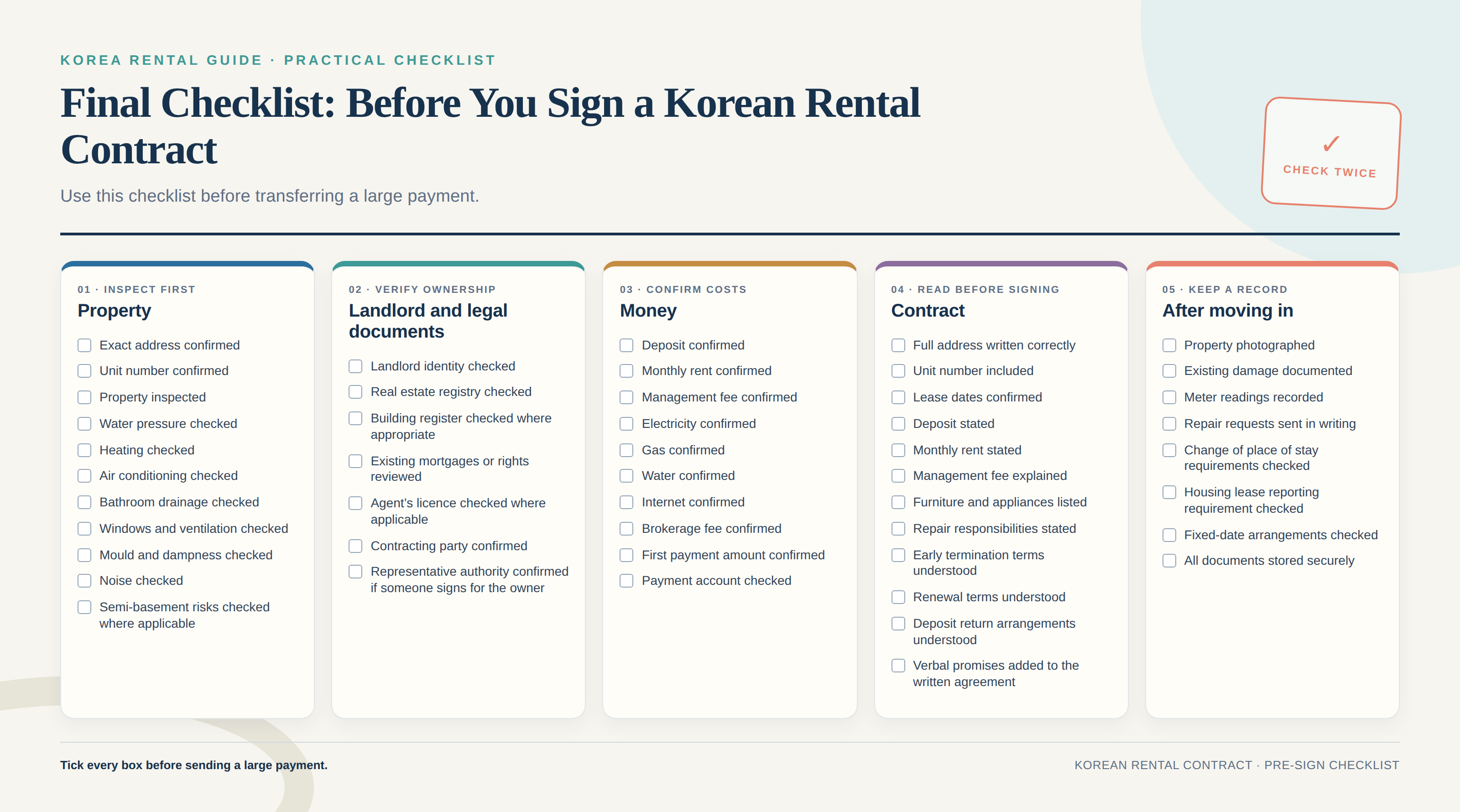
Step 3: Verify the property and landlord
Before committing to the property, request the real estate registry extract (등기부등본). Seoul’s foreign resident housing guidance specifically recommends checking ownership and property records before signing.
You should check:
- Registered owner
- Ownership details
- Existing mortgages
- Existing rights or security interests
- Property address
- Any information that could affect your deposit position
Also check the building register (건축물대장) where appropriate.
This can help confirm:
- Building use
- Property structure
- Registered details
- Whether the property is being used in a way that matches the official records
If the person signing the contract is not the registered owner, establish their authority to act for the owner and request appropriate supporting documents.
For a high-deposit lease, consider obtaining additional professional assistance before transferring the balance.
It is also sensible to check the registry again before paying the final balance if there is a significant time gap between signing and move-in.
Step 4: Read the contract before paying
Your lease should clearly identify:
- Full property address
- Unit number
- Lease period
- Deposit
- Monthly rent
- Management fee
- Payment dates
- Furniture
- Appliances
- Repair responsibilities
- Early termination conditions
- Renewal arrangements
- Notice requirements
- Deposit return arrangements
If the landlord says such as “Pets are fine”, “Internet is free”, “I will replace the washing machine”, “You can leave early” or “The management fee includes water”, you should make sure the agreement is recorded in writing.
If you do not understand Korean legal or contractual language, ask your university support office, a trusted interpreter or an appropriate professional to review important clauses.
Do not rely solely on machine translation for clauses involving deposits, termination, penalties or legal responsibilities.
Check the payment account
Before paying, compare:
- Contracting party
- Landlord identity
- Bank account holder
- Payment amount
- Payment date
If someone other than the landlord is receiving the money, ask why and request documents showing their authority.
Keep documents as records, including the signed contract, receipts, bank transfer records, messages, property photographs and any copies of relevant registration documents.
Step 5: Photograph the property and complete the post-move-in procedures
On the day you receive the keys, your steps should include:
- Photograph every room.
- Photograph existing damage.
- Record electricity, gas and water meter readings.
- Photograph appliances and fixtures.
- Record defects in writing.
- Send important repair issues to the landlord or agent.
- Keep all communication.
Then separately confirm the administrative procedures that apply to your situation.
Students should understand that address registration, rental contract reporting and getting a fixed date (확정일자) are different procedures. Finishing one step does not automatically complete the others. Do not assume that changing your address also completes your lease report or all deposit protection steps.
Change of registered address (체류지 변경 신고)
Registered foreign residents must report a change of address after moving to a new home. The deadline is generally within 15 days of moving. You can usually complete this through the local community service centre or immigration-related channels, depending on your situation.
Housing lease contract reporting
The Housing Lease Contract Reporting System is a separate procedure.
If residential contracts have a deposit over KRW 60 million or monthly rent over KRW 300,000, you generally should apply to Korea’s housing lease reporting system.
The property location and contract conditions also affect whether reporting is required. Eligible contracts must generally be reported within 30 days of signing.
Fixed date (확정일자)
A fixed date (확정일자) gives your lease contract an official date and can help protect your deposit rights. However, it is only one part of the rental protection process.
When a reported lease contract meets the requirements, the system can automatically issue a fixed date (확정일자).
What Should You Do When Moving Out or Your Deposit Is Delayed?
Start preparing before your tenancy ends. Check your contract expiry date, notice period, renewal terms, early termination rules and deposit return process.
Before handing back the keys:
- Compare the property condition with your move-in photos
- Clean the room and check furniture and appliances
- Settle bills and record meter readings
- Confirm the key handover and expected deposit return date
If your landlord wants to deduct money from your deposit, ask for:
- The reason for the deduction
- The contract basis
- A detailed calculation
- Supporting receipts when needed
If your deposit is delayed, keep records including the lease contract, payment records, photos before and after moving out, messages with the landlord, repair and utility records, and key handover evidence.
Five Rental Details International Students Often Miss
International students often overlook five rental details when renting abroad, including hidden costs, actual commute time, property inspections, deposit protection and rental records. These details can affect your budget, safety and rental experience.
1. Compare the total cost, not just the rent
A lower monthly rent does not always mean a cheaper home. A property with a KRW 10 million deposit and KRW 550,000 monthly rent may cost more upfront than a property with a KRW 5 million deposit and KRW 650,000 monthly rent.
Students should compare the full housing cost, including the deposit, monthly rent, management fees, utilities, internet, transport, moving costs and expected length of stay.
2. Check the real commute, not just the subway location
A property near a subway station is not always convenient for university.
The actual commute depends on the campus entrance, classroom location, walking distance, bus connections, hills and evening transport options.
When searching for housing, check the exact campus and class location instead of only searching the university name.
3. Do not treat a video viewing as a property inspection
A video viewing helps you check the basic condition of a property, but it cannot show everything.
You may miss issues such as mould smells, noise, poor ventilation, corridor conditions, water pressure, building security, neighbourhood noise and the actual room size.
If you rent remotely, ask for a live video tour showing the unit number, windows, bathroom, kitchen, appliances, outside view, corridors, entrance and shared facilities.
At the same time, verify who you are signing the contract with. If possible, inspect the property in person before making a large payment.
4. Check how your deposit is protected before paying
Your deposit protection depends on the property, contract terms, ownership status and the required legal procedures.
Deposit guarantee options are not automatically available for every tenant or property.
The larger the deposit, the more carefully you should check the property details and contract before payment.
5. Keep rental records after moving in
Getting the keys does not mean your rental process is finished.
Keep all important rental records in one digital folder, including your lease, deposit and rent payment records, property photos, meter readings, address documents, rental reports, important dates, repair records and landlord messages.
These records can help with future renewals, moving out and deposit returns.
Conclusion
Renting in South Korea as an international student becomes much easier when you compare the entire housing arrangement rather than focusing on monthly rent alone.
Start by confirming your campus and commute. Then set a realistic limit for both the deposit and monthly housing costs. Choose between a dormitory, goshiwon, share house, one-room, officetel or another housing arrangement according to your study period and cash-flow needs.
Before signing, verify the property, landlord, registry information, contract and payment account. After moving in, document the property’s condition and separately confirm the residence, lease-reporting and deposit-protection procedures that apply to you.
The most useful way to evaluate a Korean rental is to put deposit, rent, management fees, utilities, transport, contract conditions and deposit risk into the same decision. That approach gives international students a much clearer picture of the real cost and practical suitability of a home before committing to a lease.
Korea Rental FAQs for International Students
Do I need a KRW 10 million deposit to rent in Korea?
No. A one-room studio may require a deposit of several million won or more than KRW 10 million, while goshiwons and some share houses require much lower deposits. Lower deposits may come with higher monthly rent.
Can I rent in Korea without an ARC?
Yes, some accommodation providers accept a passport and university documents instead of an Alien Registration Card (ARC). Requirements depend on the property, landlord and contract. Confirm the required documents and whether the address can be used for residence procedures before paying.
Which Seoul neighbourhood is best for international students?
The best Seoul neighbourhood depends on your university, commute and budget. Students at Yonsei, Sogang and Ewha can consider Sinchon and nearby areas. Korea University students can compare Anam and Jongam, while Seoul National University students can look at Sillim and Nakseongdae. Hanyang University students can consider Wangsimni, and Konkuk University students can explore areas near Konkuk University Station.
Are Busan, Daejeon and Daegu cheaper than Seoul?
Often, but not always. Many student areas in Busan, Daejeon and Daegu offer lower rents than comparable areas in Seoul. However, costs vary by property, location and building condition. Compare rent, deposit, management fees, utilities and transport costs before choosing a city.
Is jeonse cheaper than wolse in Korea?
Jeonse can reduce or eliminate monthly rent but requires a much larger deposit. Wolse involves a deposit and monthly rent, often making it more manageable for students with limited savings. Compare the upfront payment, total housing cost and deposit recovery risks before signing.
When should I look for accommodation for the 2027 academic year in Korea?
Start checking university dormitory application dates early and monitor private accommodation around one to two months before your planned move-in date. Housing demand can increase before the February, March, August and September semester periods. If you cannot verify a long-term rental before arrival, consider short-term accommodation first.
Does the management fee in Korea include electricity, gas and internet?
Not always. The management fee may cover building maintenance, cleaning, security or shared internet, while electricity, gas, water and heating may cost extra. Confirm which services are included and ask for a breakdown of recurring charges before signing.
What does “1,000/60” mean in Korean rental listings?
“1,000/60” usually means a KRW 10 million deposit and KRW 600,000 in monthly rent. Your initial payment may be higher than KRW 10.6 million because management fees, brokerage fees and other agreed charges may apply. Confirm the payment schedule with the landlord or agent.
How can I check whether my rental deposit is safe in Korea?
Check the landlord’s identity and authority to rent the property, the real estate registry, existing mortgages, the building register where relevant, and the contract details. Verify that the payment account belongs to the appropriate recipient and check which deposit-protection procedures apply before transferring money.
Is changing my foreign resident address the same as reporting my lease in Korea?
No. A change of place of stay is an immigration-related procedure for registered foreign residents. A housing lease contract report is a separate real estate reporting requirement for qualifying leases, while a fixed date is a separate legal concept relevant to deposit protection. Applicable requirements and deadlines depend on your circumstances and the current rules.
When must I report a Korean housing lease contract?
Qualifying leases generally require reporting within 30 days of signing when the deposit exceeds KRW 60 million or monthly rent exceeds KRW 300,000, subject to the applicable location and contract conditions. Check the current reporting rules to confirm whether your lease qualifies.
How soon must I report a change of address in Korea?
Registered foreign residents generally must report a change of place of stay within 15 days of moving. Confirm the applicable deadline and procedure with the relevant immigration or local government office.
What should I do if my landlord does not return my deposit?
Check your lease for the deposit return terms, outstanding charges and handover requirements, then request repayment in writing. Keep your contract, payment records, messages, photographs and handover evidence. If the landlord refuses to return the deposit or continues to delay payment, seek local housing or legal assistance promptly.