



As a global leading educational institution, the University of Birmingham Acceptance Rate has been a hot issue for many prospective students. The University is located in Birmingham, the second-largest city in the UK. Boasting an excellent geographical location, it is only about 1 hour’s drive away from London. As a prestigious member of the Russell Group and a founding “Redbrick” university, the University of Birmingham attracts a high volume of applications from the UK and internationally. This guide provides a comprehensive breakdown of the acceptance rate of University of Birmingham, it also analyzes its rankings and admission data, offers key application tips, and gives essential details about the programmes and entry requirements.
University of Birmingham Acceptance Rate: Comprehensive Analysis
Understanding the University of Birmingham acceptance rate is crucial as it gives an indication of the competitiveness and selectivity of the institution. The UoB acceptance rate can fluctuate based on various factors, such as the applicant’s level of study and the popularity of specific programmes.
UoB Acceptance Rate for Different Groups of People
The overall University of Birmingham acceptance rate is around 13%-15%, which is selective and reflects its status as one of the top UK institutions. It is important to note that the acceptance rate varies slightly based on application numbers. Below is a detailed overview of the UoB acceptance rate for different groups of people.
- The University of Birmingham UK acceptance rate for domestic students is generally aligned with the overall offer rate at around 13%.
- The University of Birmingham acceptance rate for international students seems slightly higher, which is estimated to be around 15%.
- The University of Birmingham undergraduate acceptance rate is competitive at 12-14%, which is a little bit lower than the general acceptance rate. This suggests the potential high volume of applications received for bachelor’s degrees.
- Generally, the University of Birmingham postgraduate acceptance rate is slightly higher than at the undergraduate level. For taught master’s programmes, the acceptance rate of the University of Birmingham is around 15-18%, while for research degrees, it can be more accessible, with an acceptance rate of approximately 20-25%.
UoB Acceptance Rate for Different Programmes

It has become a truism that the acceptance rate of the University of Birmingham varies across programmes. Some sought-after or top-tier programmes have a lower acceptance rate due to the large volume of applications. This subsection breaks down the acceptance rates for some sought-after programmes as examples.
- The University of Birmingham computer science acceptance rate is around 20%, which reflects the growing demand for STEM programmes. As a discipline aligned with global tech industry growth, computer science attracts a large pool of high-achieving applicants. To improve your University of Birmingham computer science acceptance rate, you had better possess strong A-level results in Maths and Further Maths.
- The estimated University of Birmingham dentistry acceptance rate is less than 8%, which is one of the lowest across its programmes. This extreme selectivity is driven by the programme’s professional requirements and limited capacity. Dentistry is a vocational discipline requiring extensive practical training, so the university caps intake to ensure quality supervision that directly drives the low acceptance rate.
- The University of Birmingham law acceptance rate stands at approximately 15%, reflecting the strong reputation of the Birmingham Law School. A key advantage for applicants is that the LLB programme does not require the LNAT (National Admissions Test for Law), unlike many other top UK law schools. Selection is therefore heavily based on academic merit and the personal statement. The school encourages applicants to demonstrate a genuine engagement with law beyond the curriculum.
- The University of Birmingham medicine acceptance rate is among the lowest in the UK, estimated at less than 5%. The same as dentistry, Medicine programmes are constrained by strict regulatory caps on intake as well. Therefore, applicants should be equipped with exceptional academic credentials, typically A*AA at A-level and high UCAT scores.
Below is a summary table for a clear and quick comparison of the different acceptance rate for University of Birmingham.
| Category | Group / Programme | Acceptance Rate |
|---|---|---|
| By Applicant Group | University-Wide | 13% – 15% |
| UK Domestic Students | ~13% | |
| International Students | ~15% | |
| Undergraduate Programmes | 12% – 14% | |
| Postgraduate Taught | 15% – 18% | |
| Postgraduate Research | 20% – 25% | |
| By Competitive Programme | Computer Science | ~20% |
| Law | ~15% | |
| Dentistry | < 8% | |
| Medicine | < 5% |
Improve UoB Acceptance Rate: Tips for Getting Admitted
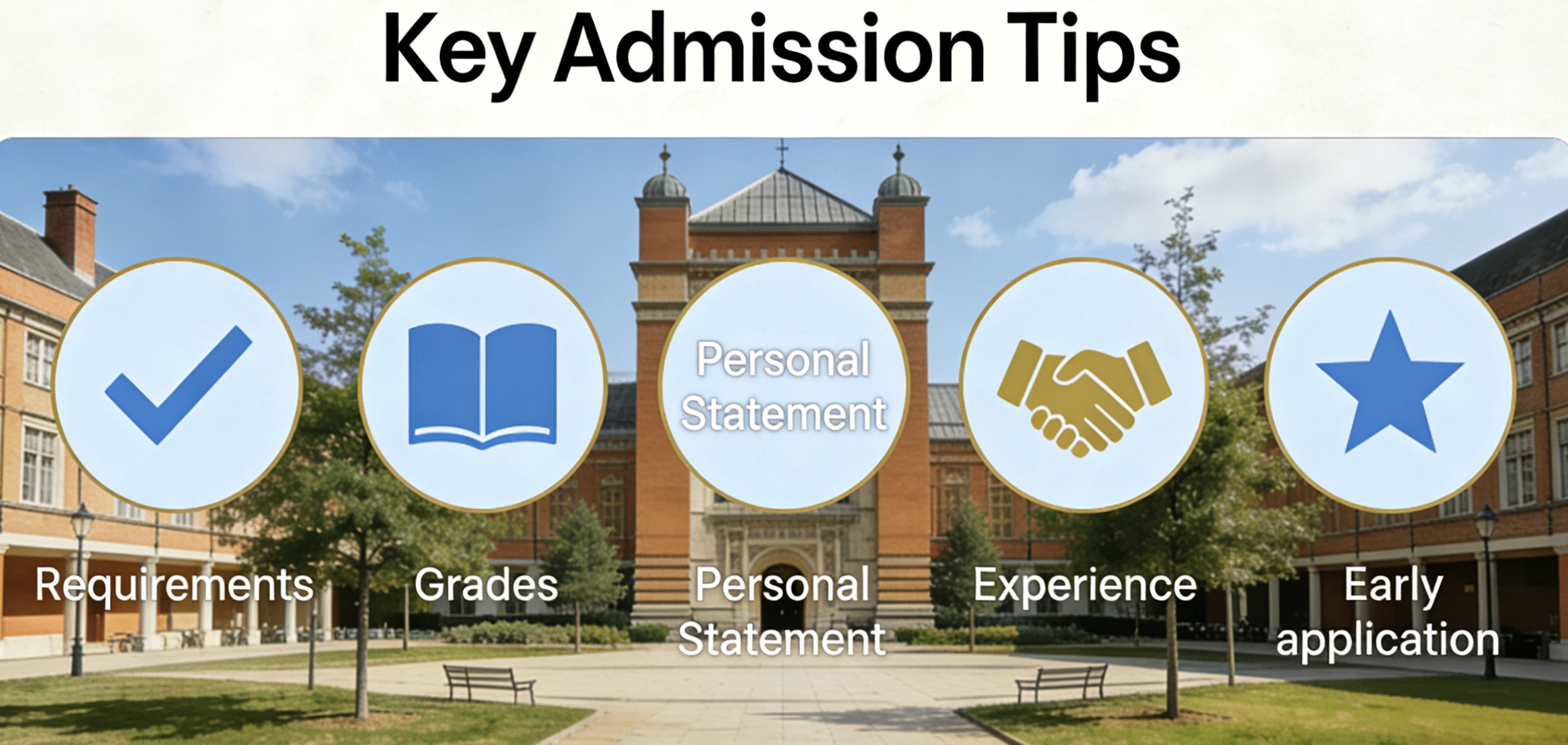
Understanding the University of Birmingham acceptance rate is the first step; actively improving your chances of admission is the crucial next one. With a selective overall acceptance rate for the University of Birmingham, a strategic and polished application is essential to stand out. This section provides actionable advice to strengthen your University of Birmingham England acceptance rate.
1. Excel Academically
Your academic record is the most critical factor in the University of Birmingham admissions process. Simply meeting the minimum entry requirements is insufficient for the most competitive programmes; thus, building a strong foundational profile is pivotal.
- Aim to Exceed Requirements: For undergraduate applicants, this means striving for A-level or equivalent grades that are at the upper end of, or above, the standard offer range (typically A*AA – AAB). Strong GCSE results, particularly in subjects relevant to your chosen degree, are also closely scrutinised.
- Subject Relevance is Key: Ensure your A-level or equivalent subjects align precisely with your chosen course. For example, applying for the University of Birmingham computer science programme requires A-level Mathematics, while Chemistry and Biology are non-negotiable for the University of Birmingham medicine and dentistry programmes. Check course pages meticulously for required and preferred subjects.
- Postgraduate Considerations: For master’s applicants, a strong undergraduate degree classification (usually a 2:1 or First) from a recognised institution is expected. What’s more, your academic references should speak to your readiness for further study.
2. Craft a Standout Personal Statement and Supporting Materials
Your personal statement is your primary opportunity to present yourself to the admissions team. It must convincingly argue why you are a perfect fit for this programme and the university.
- Demonstrate Academic Passion: Move beyond simply listing what you have done. Analyse, reflect, and connect your experiences to your chosen field of study. Discuss what sparked your interest and how it relates to the University of Birmingham’s course structure.
- Showcase Skills and Insight: Use examples from your academic work, relevant employment, or extracurricular activities to demonstrate skills like critical thinking, independent research, and subject-specific ability. For vocational courses like Law or Medicine, this is where you link your work experience to a genuine understanding of the profession.
- Tailor Your Application: Avoid a generic statement! Mention specific aspects of the University of Birmingham programme that attract you, and your particular speciality that align with the programme. These show dedicated research and sincere interest.
3. Gain Relevant Experience and Referees
Practical experience adds significant weight to your application, providing context for your academic interests and demonstrating commitment.
- Quality Over Quantity: Seek meaningful experiences that offer genuine insight. Instead of a long list of short-term involvements, focus on sustained commitments where you made a tangible contribution or developed a specific skill. For example, for a computer science programme, a personal coding project or internship is more valuable.
- Find Strong Referees: Choose referees who know you well academically and can provide specific, positive examples of your abilities. An insightful reference from a teacher or professor who can attest to your suitability is a powerful asset.
4. Prepare Thoroughly and Submit Early
Organisation and attention to detail reflect your professionalism and can prevent unnecessary setbacks.
- Focus on Key Dates: Check the deadline on the official website and mark it in your calendar. For most undergraduate courses, the UCAS deadline is in late January. Postgraduate deadlines vary by course.
- The Early Advantage: Submitting your application well before the deadline ensures it receives full consideration and allows ample time. It also signals your enthusiasm and organisational skills, which are good qualities.
- Prepare for Interviews and Tests: If applying for the University of Birmingham medicine or dentistry, you will need to sit the UCAT. It is recommended to start preparation early, because for any programme that may interview, practice articulating your motivation and knowledge clearly and confidently is necessary.
Why Choose the University of Birmingham?
While the competitive University of Birmingham acceptance rate reflects its selectivity, understanding what truly makes this institution a top choice for UK and international students helps you to make a more informed decision. As a founding Russell Group and “Redbrick” university, Birmingham distinguishes itself through world-class rankings, pioneering research, and exceptional graduate outcomes.
1. Excellent Birmingham University Ranking
A primary indicator of the university’s calibre is its strong and consistent performance across major league tables. These high rankings signal global recognition and academic quality. The table below summarises its recent standings:
| Ranking Publication | 2026 Position | Focus & Significance |
|---|---|---|
| The Times University Guide | 16th | A UK-focused ranking assessing teaching quality, student experience, and graduate prospects. |
| The Guardian University Guide | 28th | Emphasises teaching satisfaction and career outcomes, with a unique methodology. |
| QS World University Rankings | 76th | A global benchmark evaluating academic reputation, employer reputation, and research impact. |
| THE World University Rankings | 98th | Assesses universities worldwide on teaching, research, knowledge transfer, and international outlook. |
2. Exceptional Research Power
The University of Birmingham is defined by its research excellence, which directly enriches the teaching and learning environment, it consistently commits to producing world-leading research.
In the Research Excellence Framework, 87% of the university’s research activity was judged to be ‘world-leading’ or ‘internationally excellent’. This research prowess spans disciplines, from pioneering medical breakthroughs at the Institute of Cancer and Genomic Sciences to cutting-edge engineering solutions and influential social policy studies. This environment means students are often taught by leading experts and can engage with groundbreaking ideas, adding immense value to their degree.
3. High Graduate Employability
Employability is a key measure to assess a university’s success, which receives many students’ attention. The University of Birmingham excels with a proven track record of producing highly employable graduates. The University of Birmingham Careers Network is one of the largest and most active in the UK, offering tailored support, mentoring, and exclusive internship opportunities. According to the HESA data, over 90% of the university’s graduates are in work or further study within 15 months of graduation. Furthermore, the university is regularly ranked highly for graduate starting salaries, particularly for professional programmes like University of Birmingham medicine, law, and computer science.
University of Birmingham Entry Requirements
Familiarising yourself with the University of Birmingham entry requirements is the most critical step to a successful application. They vary between undergraduate and postgraduate levels and between different programmes. However, to strengthen your acceptance rate at the University of Birmingham, you had better exceed the minimum entry requirements.
UG entry requirements
The University of Birmingham undergraduate entry requirements are as follows:
1. Academic Qualifications
- A-levels: UoB requires three A-levels. Offers generally range from A*AA to ABB, depending on the subject.
- International Baccalaureate (IB): The IB Diploma is highly valued. Typical offers require a minimum of 32 points overall, with Higher Level (HL) grades ranging from 6,6,6 to 6,5,5.
- Subject-Specific Requirements: Certain courses require specific grades in relevant subjects (e.g., Mathematics or Sciences). Additionally, all applicants must normally hold a GCSE Grade 4 (C) or above in English and Mathematics.
2. English Language Requirements (Required for non-native English speakers)
The University of Birmingham categorises its undergraduate programmes into 4 groups (A, B, C, and D), each with distinct requirements.
| Course Group | Typical Subject Areas | IELTS (Academic) Requirement | TOEFL (iBT) Requirement |
|---|---|---|---|
| Group A | Bio-sciences, Engineering, Physics, Maths | 6.0 overall (min 5.5 in any band) | 80 overall (min 19 in R/L/W, 21 in S) |
| Group B | Business, Economics, Law, Arts, Education | 6.5 overall (min 6.0 in any band) | 88 overall (min 21 in R/W, 20 in L, 22 in S) |
| Group C | Dental Hygiene, Social Work, Physiotherapy | 7.0 overall (min 6.5 in any band) | 95 overall (min 22 in any band) |
| Group D | Medicine (MBChB), Dentistry (BDS), Nursing | 7.0 overall (min 7.0 in any band) | 95 overall (min 23 in any band) |
PG entry requirements
The University of Birmingham postgraduate entry requirements are presented below:
1. Academic Qualifications
- UK Qualifications: Applicants are usually required to hold a ‘good’ Honours degree (typically a 2:1 or First-Class Honours) from a recognised university.
- International Qualifications: The university accepts a wide range of overseas qualifications equivalent to a UK Honours degree.
2. Work Experience
For certain vocational programmes, relevant professional experience may be considered alongside academic grades.
3. English Language Requirements (Required for non-native English speakers)
Requirements are generally divided by academic discipline, though some specific courses may vary.
| Academic Area | IELTS (Academic) Requirement | PTE (Academic) Requirement |
|---|---|---|
| Science, Engineering & Maths | 6.0 overall (min 5.5 in any band) | 64 overall (min 59 in all skills) |
| Arts, Business, Law, Social Sciences | 6.5 overall (min 6.0 in any band) | 67 overall (min 64 in all skills) |
| Clinical Psychology, Management | 7.0 overall (min 6.5 in any band) | 76 overall (min 67 in all skills) |
How to Apply to University of Birmingham
Applying to the University of Birmingham is a structured process. The route differs slightly depending on whether you are seeking an undergraduate or postgraduate place, but the process is actually very simple.
Undergraduate Applications
All full-time undergraduate applications for the University of Birmingham must be made through UCAS (Universities and Colleges Admissions System). This applies to both home and international students.
- Choose Your Course: Identify your programme and check specific entry requirements.
- Register with UCAS: Create an account and complete your personal details.
- Personal Statement: Write a compelling essay explaining why you want to study your chosen subject.
- Reference: You will need a recommendation from a teacher or professional.
- Submit by the Deadline: For most courses, the standard deadline is in January.
Postgraduate Taught Applications
Unlike undergraduate study, most postgraduate taught applications are submitted directly to the University of Birmingham through their own online application portal.
- Determine Your Programme: Visit the specific course page to locate the ‘Apply Online’
- Prepare Supporting Documents: Ensure you have high-quality digital copies of your academic transcripts, degree certificates, and English language test results (if applicable). In addition, most courses require two references. You must provide the contact details of your referees in the application portal.
- Pay Application Fee: While many programmes are free to apply for, some competitive courses (particularly in the Birmingham Business School) may require a non-refundable application fee of £50.
- Focus on Application Timeline: While many postgraduate programmes accept applications throughout the year, popular courses can fill up quickly. For a September start, it is highly recommended that international students apply by 1st July to allow sufficient time for visa processing and accommodation arrangements.
Top-Ranking Programmes at the University of Birmingham
As we discussed, the University of Birmingham acceptance rate varies across different disciplines. Here, we explore some of the university’s top-ranking programmes and what their standing might mean for prospective applicants.
Sports-related subjects (2026 QS ranking by subject: 8)
Birmingham’s programmes in Sports-Related Subjects are exceptionally strong. The School of Sports offers an environment where students learn from leading experts. The curriculum is research-led, ensuring you explore the latest developments in health, nutrition, and physical performance. Students can benefit from state-of-the-art facilities, including custom-built laboratories and a world-class sport and fitness centre. Whether you are interested in elite performance or community health, the programme provides the practical skills needed to lead in this competitive industry.
Dentistry (2026 QS ranking by subject: 23)
Dentistry is one of the university’s most prestigious and sought-after programmes. Consequently, the University of Birmingham Dentistry acceptance rate is among the most competitive. The School of Dentistry provides students with direct access to clinical environments from an early stage. This integration allows for exceptional hands-on training. You will work with real patients under the supervision of experienced clinicians, bridging the gap between academic theory and professional practice.
English language and literature (2026 QS ranking by subject: 29)

The university boasts a rich English literary heritage and offers a wide breadth of its studies, from Old English texts to contemporary digital narratives. A unique advantage for Birmingham students is the university’s collaboration with the Shakespeare Institute in Stratford-upon-Avon. This partnership provides exclusive access to resources and expertise that are unavailable elsewhere, making it an ideal choice for English language and literature enthusiasts.
Anatomy and physiology (2026 QS ranking by subject: 36)
The programme is heavily integrated with the Medical School, giving students access to prosection labs and advanced learning resources that underpin careers in medicine and healthcare research.

Linguistics (2026 QS ranking by subject: 37)
Linguistics department is celebrated for its cutting-edge research, particularly in corpus linguistics and bilingualism. Students here develop analytical skills that are highly valued in sectors ranging from technology to education. The UoB acceptance rate for Linguistics appears less intense than courses like Dentistry, but it still requires strong academic credentials.
Birmingham’s Tuition and Cost of Living
Understanding the financial commitment is vital for your journey to Birmingham. Compared to London, Birmingham offers a high quality of life with significantly more affordable living costs.
Tuition Fees
| Student Type | Undergraduate Fees (Per Annum) | Postgraduate Fees (Per Annum) |
|---|---|---|
| UK (Home) | £9,535 (Capped) | £9,500 – £14,000 |
| International | £22,000 – £29,000 | £21,000 – £32,000 |
Accommodation Costs
Accommodation is usually the largest expense after tuition. The University of Birmingham offers housing to all first-year international students who meet the application deadline.
- University Halls: Prices range from £140 to £210 per week, depending on whether the room is self-catered or part of the “Meal Plan” (catered), and whether you have an en-suite bathroom.
- Off-campus Accommodations: Many students, especially in their later years, choose off-campus housing due to better personal privacy and comfort. To help students find trusted off-campus accommodations, the University of Birmingham officially partners with uhomes.com.
uhomes.com can simplify your search for University of Birmingham accommodation. The platform lists hundreds of verified properties near campus, from budget-friendly accommodations like IQ Broderick House to premium studios in Vita Student Pebble Mill. These often come with all-inclusive bills, modern amenities like gyms and study rooms, and proximity to the university, city center, or public transportation.

Monthly Living Expenses
Excluding tuition, a typical student in Birmingham should budget between £985 and £1,350 per month for a comfortable lifestyle.
| Expense Category | Estimated Monthly Cost |
|---|---|
| Rent (Average) | £550 – £750 |
| Food & Groceries | £180 – £250 |
| Utilities & Internet | £60 – £90 |
| Local Transport | £45 – £60 |
| Leisure & Social | £150 – £200 |
| Total Estimate | £985 – £1,350 |
University of Birmingham Acceptance Rate: Final Thoughts
In summary, while the overall University of Birmingham acceptance rate is around 13-15%, your chances are shaped by your chosen programme, academic profile, and the strength of your application.
This guide has provided a detailed analysis, from the competitive rates for Medicine and Dentistry to strategic tips for enhancing your application. In addition, the University of Birmingham is also known for its compelling world-class rankings, research excellence, and strong graduate outcomes.
Securing a place requires dedication, but by thoroughly understanding the entry requirements, crafting a standout personal statement, and submitting a polished application, you can significantly improve your acceptance rate.
FAQs about University of Birmingham Acceptance Rate
Is it difficult to get into the University of Birmingham?
Yes, it is moderately difficult to get into the University of Birmingham, especially for popular programmes. Based on recent UCAS data, each of its undergraduate places receives about 6.6 applications. While not the most selective in the Russell Group, it demands strong grades and careful preparation.
What is the current university of Birmingham acceptance rate?
The overall University of Birmingham acceptance rate is roughly 13% in 2025, but this rate can vary by programme and level of study.
What is the acceptance rate for international students at Birmingham University?
The acceptance rate for international students at Birmingham University is approximately 13-15%, similar to the university’s overall acceptance rate. This competitive rate applies across most programs, though some high-demand courses may be more selective. International students represent about 25-31% of the total student body.
Is University of Birmingham a Russell Group Uni?
Yes, the University of Birmingham is a Russell Group university, which represents 24 top-tier institutions that produce 65% of the UK’s research output and are renowned globally for academic excellence.
Is Birmingham a top 100 university?
Yes, Birmingham is consistently ranked among the world’s top 100 universities. In the 2026 QS World Rankings, it sits at 76th globally and 11th in the UK.
What subject is the University of Birmingham known for?
The University of Birmingham is best known for its exceptionally strong Sports-related subjects, ranked 8th in the UK. It is also highly regarded for its prestigious programmes in Dentistry and English Language and Literature, as well as its foundational courses in Anatomy and Physiology.
Is Birmingham a red brick uni?
Yes, Birmingham is one of the original six “Redbrick” universities. Founded in 1900 as England’s first civic university, it pioneered accessible higher education for students from diverse backgrounds. The term “red brick” refers to these prestigious, traditional universities established in major industrial cities during the late 19th and early 20th centuries.