




Understanding the PCM meaning for rent is essential if you are navigating the UK rental market. PCM stands for “Per Calendar Month“, and it appears in nearly every rental listing. However, many first-time renters are unsure of what PCM means in rent for their bank accounts. In this guide, we will explain everything you need to know about PCM rent. You will learn how to calculate your monthly payments, understand the factors that affect the price, and get expert tips for managing your budget. Whether you are a landlord preparing a contract or a tenant looking for a room, this guide will help you make the right financial decisions before signing your tenancy agreement.
What is PCM Rent?
PCM stands for “Per Calendar Month”. PCM defines the fixed amount of rent a tenant pays each month, as officially stated in the Assured Shorthold Tenancy (AST) agreement. Simply put, it is your total monthly housing cost. PCM rent provides a win-win for both parties. For landlords, PCM rent ensures a predictable cash flow, making it much easier to manage long-term finances and property expenses. For tenants, this model offers financial stability because your rent payment stays exactly the same, whether the month has 28 or 31 days. Navigating the competitive UK rental scene requires a clear understanding of the PCM meaning in renting and other payment options. This knowledge ensures that both renters and landlords act quickly, compare listings accurately, and make smarter financial choices with confidence.
How to Calculate PCM Rent?
Calculating PCM rent is very simple. There are 2 common cases:
- PA → PCM (PCM from Annual Rent)
If the rent is provided annually, you can convert it to a monthly amount by dividing the total annual rent by 12.
– Formula: PCM = Annual Rent ÷ 12
– Example: If the annual rent is £24,000, divide £24,000 by 12 to get £2,000 PCM. This means the tenant would pay £2,000 per month. - PW → PCM (PCM from Weekly Rent)
If the rent is given per week, you first calculate the annual rent by multiplying the weekly rent by 52 (weeks in a year), then dividing by 12 to get the monthly rent.
– Formula: PCM = (Weekly Rent × 52) ÷ 12
– Example: If the weekly rent is £300:
£300 × 52 = £15,600 (annual rent)
£15,600 ÷ 12 = £1,300 PCM

How to Calculate What Rent You Can Afford?
In the UK, the most common rule for determining how much rent you can afford is the “30x Rent Rule”. This means your annual income should be at least 30 times your monthly rent. Using this rule, you can estimate how much rent you can comfortably afford based on your income. For example, if your annual income is £30,000, you can afford a monthly rent of approximately £1,000 PCM. This approach is widely used by landlords and letting agents to check if tenants meet the income requirements. It also helps tenants plan the budget more realistically, taking into account other essential expenses such as bills, food, transport, and study costs.
PCM vs PW vs PA Rent: What's the Difference?
When you search for a flat in the UK, you will see 3 main terms: PCM, PW, and PA. Understanding PA, PCM and PW meaning for rent is essential when comparing weekly, monthly, and yearly property prices.
- PCM (Per Calendar Month): PCM is the most common way to pay rent in the UK. It is the standard payment method for long-term UK tenancies. The tenant pays the same fixed rent on the same date each month, even if the month has 28 or 31 days. This makes budgeting simple and fits most monthly banking or salary cycles.
- PW (Per Week): PW means “per week”. It is common in short-term rentals and for tenants who are paid weekly. It is also widely used in marketing for properties in London, Manchester, and other major student cities because weekly prices appear lower and are easy to compare with weekly income. However, PW is usually a display price rather than the real payment schedule. Converting weekly rent into a monthly budget can be misleading, as most months are longer than 4 weeks. Simply multiplying weekly rent by 4 may result in underestimated costs and budget shortfalls.
- PA (Per Annum): PA stands for “per annum” and shows the total yearly rent. Some tenants can choose to pay yearly. If the landlord allows, paying the full year upfront often comes with a discount, as it gives the landlord more cash flow for further investment. For many students in Purpose-Built Student Accommodation (PBSA), the yearly rent is usually paid in instalments that follow the university terms.
In short, paying rent per calendar month (PCM) better fits a tenant’s monthly budget. It is also important to know how to convert between PW, PA, and PCM, so you can accurately compare properties priced weekly or monthly and avoid potential pitfalls.
Advantages & Disadvantages of PCM Rent
Having explained the PCM definition in renting, the next step is to consider its advantages and disadvantages for tenants.
- Advantages of PCM Rent
Renting per calendar month (PCM) means predictable and stable payments. It helps you align rent with monthly bills and income. With a set monthly amount, you can plan your budget with ease. Most PCM rental agreements in the UK set a fixed payment date each month. This ensures you don’t pay for 2 properties at once when moving. Many landlords accept direct debit, making rent payments automatic and hassle-free. - Disadvantages of PCM Rent
Rent paid PCM is spent without any return, unlike mortgage payments that build equity. PCM rent can lack flexibility, especially for short-term rentals such as holiday lets or serviced accommodation. For long-term commercial properties, landlords often prefer annual rent payments, which are more suitable for business leases.
Factors That Affect PCM Rent
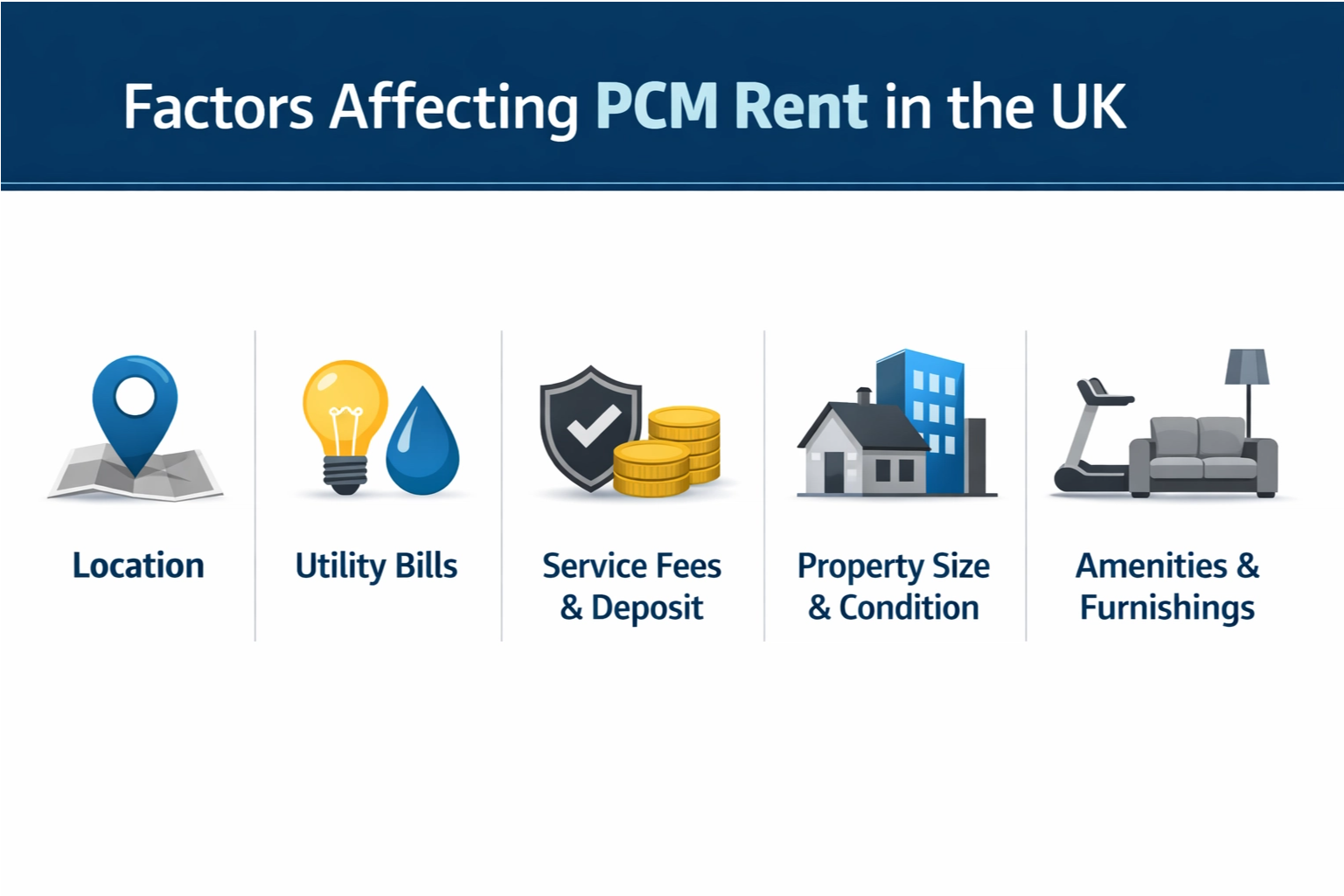
There are many factors that affect PCM rent in the UK, ranging from location to property type. Here are the key points to consider:
- Location: Location has a major impact on PCM rent. Rental prices are typically higher in major cities like London, Manchester, and Edinburgh. Areas with strong transport connections, renowned universities, and accessible amenities tend to command higher rents. In contrast, properties situated in rural locations or further afield often offer lower rental prices.
- Utility Bills & Maintenance Costs: Many tenants overlook utility bills, but these can add a significant amount to monthly expenses, often over £270 per month. Some property types include bills, while others do not, so it is wise to choose properties where bills are included. Purpose-Built Student Accommodation (PBSA) typically includes utilities and often provides free maintenance, saving tenants money. Other property types usually exclude bills, which can substantially increase monthly costs.
- Service Fee & Deposit: A security deposit is usually required for most rentals. If you rent through an agency or platform, a service fee is often charged. These costs vary by property. For example, booking PBSA through uhomes.com does not charge service fees, and some properties on the platform do not even require a deposit at all. Meanwhile, in the UK, once a deposit is paid, the landlord or property provider must place it in a government-approved Deposit Protection Scheme (such as DPS, TDS, or LPS) within 30 days. uhomes.com supervises this process and ensures students receive a Deposit Protection Certificate. If any unfair deductions occur at the end of the tenancy, the uhomes.com UK team can assist students in filing a claim with the relevant authority.
- Property Size & Condition: You need to pay more for larger properties or those that are newly built or recently renovated. For instance, a newly built 1-bedroom flat usually has a higher PCM rent than an older flat of the same size.
- Amenities & Furnishings: Properties with extras like a gym, a laundry room, or furniture usually cost more per month. These features make the property more attractive, so the rent is higher. PBSA is different in this regard. They usually provide complete furniture and many shared amenities, but the rent remains reasonable.
Tips for Managing PCM Rent Successfully
If you decide to move forward with a PCM lease, you must stay organised. Follow these simple tips to manage your rent and protect your rights in 2026.
- Automate Rent Payments
Set up a Standing Order or Direct Debit to pay your PCM rent. This makes sure your rent is always on time, helps you manage your budget, and builds a good rental history for future rentals in the UK. - Track Your Spending
Keep a clear record of your monthly income and expenses. This helps you plan your rent and avoid overspending on other things. - Budget for Extra Costs
PCM rent is usually just the base rent. Additional expenses, such as electricity, gas, water, council tax, and the TV licence, can add a significant burden to your monthly budget if not planned for correctly. To avoid hidden financial surprises, you can book a PBSA through uhomes.com with all utility bills included, enjoying a hassle-free stay. - Save for Emergencies
Set aside a small amount each month for unexpected costs, like repairs or extra fees. This helps you stay financially safe. - Know Your Rights
Learn about your tenant rights, including deposit protection, rules about rent increases, and your responsibilities. This helps you avoid problems or unfair charges. Also, under the 2026 Renters’ Rights Bill, most tenancies are now periodic. This makes it easier to move, but landlords must follow Section 13 rules to raise PCM rent. - Talk to Your Landlord Early
If you think you may have trouble paying rent, contact your landlord early. Speaking to them or the property manager is much better than saying nothing.
Why uhomes.com is Your Best Choice?
uhomes.com has been dedicated to helping domestic and international students find overseas accommodation for over 10 years, serving more than 3.1 million users and successfully booking over 400,000 rooms, making it the top choice for student housing abroad. Here are the reasons to choose uhomes.com:
- Price Guarantee: uhomes.com offers a lowest price guarantee with no agency fees and no hidden price differences. If students find a lower price elsewhere, uhomes.com will cover the difference.
- Consultant Team: The uhomes.com team provides support in 10 languages, including Chinese, English, Japanese, Korean, and Vietnamese. From property search to contract review, deposit protection, and move-in guidance, the team offers full support at every step.
- Move-in Guidance: uhomes.com provides detailed checklists for key collection and inventory checks, ensuring that students settle in smoothly and are well-prepared for their new home.
- Digital Viewing Tools: Students can easily search for properties via the uhomes.com app, website, or mini-program. The platform provides detailed property information, including facilities, transport options, and surrounding areas. VR tours and live viewings are also available to help students make well-informed decisions.
Conclusion
Mastering the PCM meaning for rent is the first step to a successful stay in the United Kingdom. By now, you should fully understand what PCM means in rental terms and how it affects your housing budget. To make the process even easier, you can use uhomes.com to book your accommodation. Whether you are looking for a studio flat in London or a 2-bedroom flat in Manchester, the platform supports you throughout the whole journey — from your first property search to the day you move in.
FAQ
Does PCM include bills?
Your PCM rent does not automatically include utility bills unless stated in your contract. In private rentals, you are usually responsible for electricity, gas, water, and the TV licence. To make budgeting easier, many students choose to book through uhomes.com, where offer a huge range of bills-inclusive rooms. In these properties, your monthly payment covers all your bills and high-speed Wi-Fi.
Is PCM per person or total?
In Purpose-Built Student Accommodation (PBSA) or shared houses (HMOs), the PCM rent means the rent is charged per person. However, if you are renting an entire private flat or house, the PCM definition of rent usually represents the total cost for the whole property. At uhomes.com, we clearly label each listing so you know exactly if the price is per room or for the full apartment.
What is the future of PCM rent?
The future of PCM in rent means a shift towards more flexibility due to the 2026 Renters’ Rights Bill. Starting in May 2026, the UK is abolishing fixed-term contracts in favour of “periodic tenancies”. This means most rentals will officially run on a rolling month-to-month basis. This change makes the PCM the most important legal standard for tenants, as it will define your notice periods and payment cycles for almost all new agreements.
How much is the average monthly rent in the UK?
In 2026, the average monthly rent in the UK is approximately £1,422. However, prices are much higher in the capital, at around £2,716 to £2,736. If you are looking for a bargain, northern cities like Sunderland (£480 PCM) and Hull (£500 PCM) are currently the cheapest places to rent in the UK.
When can your rent be increased?
Landlords can now only increase the PCM rent once every 12 months. They cannot use automatic increase clauses in your contract anymore. To raise the price, your landlord must send you a formal Section 13 notice at least 2 months before the new rent starts. You have the legal right to challenge any increase if it is higher than that of other similar homes in your area.