




Few decisions impact a student’s daily university experience quite like student housing. The choice between on campus vs off campus housing is essentially a choice between two different lifestyles: the immersive, community-focused ‘dorm bubble’ versus the freedom of living on your own terms. Because costs and responsibilities vary so wildly between the two, students need to look beyond the price tag and consider which environment best supports their academic and personal growth.
What is On-Campus Accommodation?
On-campus housing basically covers dorms and university apartments that sit right in the middle of the university. It’s the low-stress option: rooms usually come furnished, and things like electricity and meal plans are often rolled into one simple fee. Since the school runs the show, the whole setup is meant to cut down on daily hassles so you can stay plugged into campus life.
Types of On-campus Accommodation
- Traditional Single/Double/Triple: Individual or shared rooms located along a corridor, with bathrooms shared by residents on the same floor.
- Suite-Style: A group of two or more bedrooms connected by a shared living space and/or a private bathroom, instead of using a hallway bathroom.
- Semi-Suite: Similar to a suite setup, but the bathroom is shared by a small number of residents (usually 3–5) from nearby rooms.
- Apartment-Style: Features a full kitchen, living room, and bathroom within the unit; commonly available to upper-year students.
- Studio/Efficiency: A private, single-occupancy space that includes its own kitchenette and bathroom within one compact unit.
Pros of Living On Campus
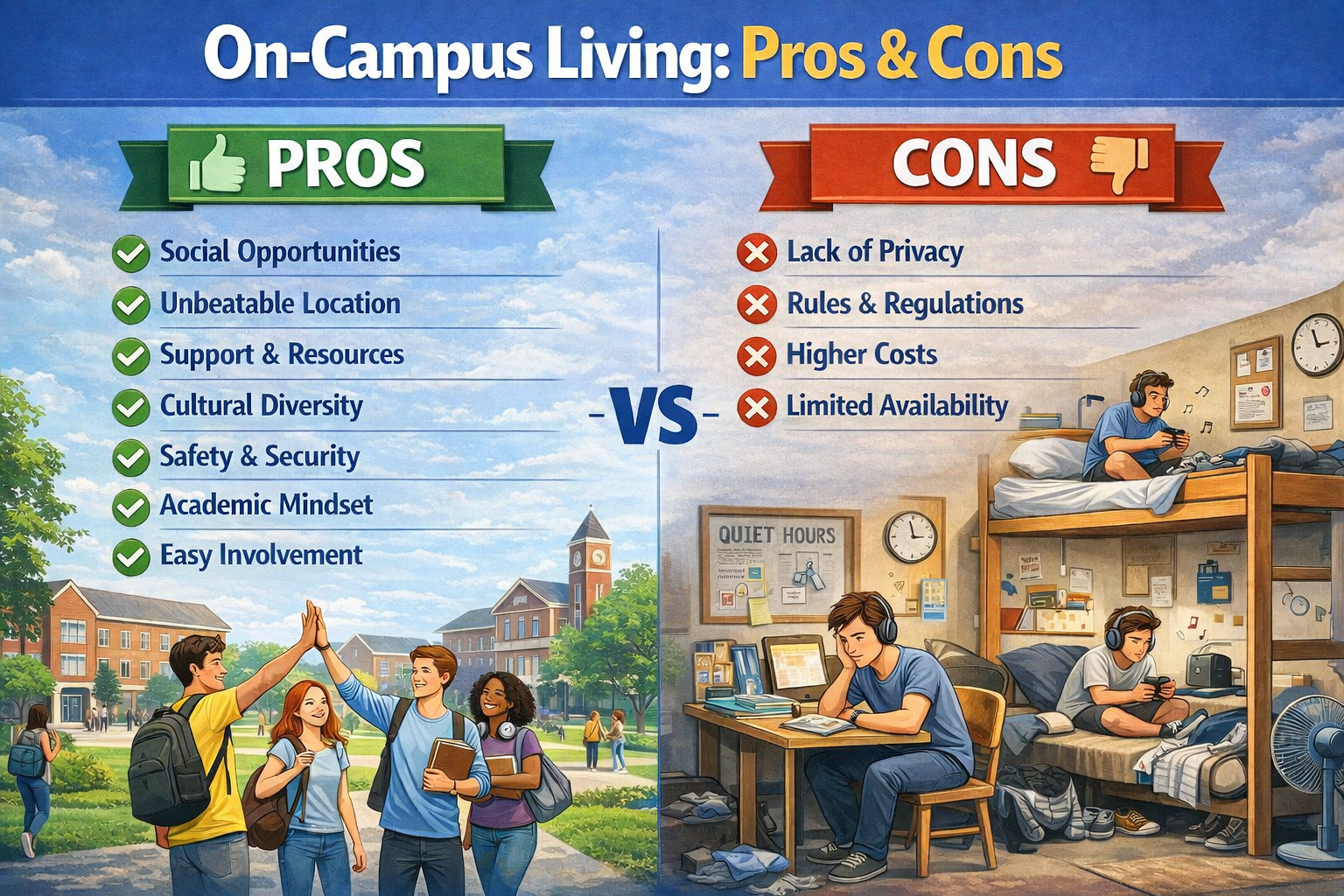
- Social Opportunities: Living on campus is the fastest way to meet new people. Instead of trying to coordinate meetups, you’re naturally bumping into roommates and neighbors every day. This constant interaction builds a tight-knit community and creates friendships that often last a lifetime.
- Unbeatable Location: Students can’t beat a five-minute walk to class. Being steps away from the library, dining halls, and lecture centers means you aren’t wasting hours commuting.
- Support and Resources: Residence halls come with Resident Advisors (RAs) and staff who are there specifically to help you navigate university life. Plus, having on-site perks like study lounges and laundry facilities removes a lot of the daily friction.
- Cultural Diversity: Campus life throws you into a mix of people you might never meet otherwise. Your neighbor could be from a different state or a completely different country. It’s a rare chance to broaden your worldview naturally, just by making friends with the people down the hall.
- Safety & Security: Live on-campus housing is hard to top. With features like keycard access, security patrols, and 24/7 staff presence, help is always nearby. It’s a controlled environment that lets you and your family rest easier.
- Academic Mindset: Compare living on campus vs off campus, to choose an on-campus hall, it’s easier to focus when everyone around you is in the same boat. Living among other students creates a natural study environment where you can easily form study groups, ask a neighbor for help, or just find motivation in seeing others work hard.
- Easy Involvement: With events and volunteer opportunities happening just downstairs, you don’t need to go out of your way to participate. It’s the simplest way to build your resume and social circle without adding to your commute.
Cons of Living On Campus
- Lack of privacy: Sharing rooms or facilities often means there is limited space and privacy. This can be a challenge for students who prefer personal comfort, freedom, and autonomy.
- Rules and regulations: There could be specific rules and regulations in campus accommodation, such as curfews, visitor policies, alcohol policies, etc. Some places may even impose penalties for violations. For some, this can feel restricting or controlling.
- Cost: While costs can vary greatly depending on the location, type, and quality of the accommodation, it is sometimes inclusive of the cost of utilities and meals. This could make it a more expensive choice than independent living. However, it might be possible for you to apply for financial aid or scholarships that assist with accommodation.
- Availability: There is often limited availability or capacity for students who want to live on campus. The demand may exceed the supply, especially during peak seasons or periods. You may have to apply early or compete with others for a place.
What is Off-campus Housing?
Off-campus housing includes apartments, houses, or shared rentals that are located outside of university property and are not managed by the school. Choosing between living on campus vs living off campus, the latter gives students more independence and privacy, as well as greater freedom to choose their roommates, lease length, and preferred location.
Types of Off-campus Housing
1. Apartment Living
- Studios
- One and Two-Bedroom Apartments
- Condos (Condominiums)
2. Detached Houses
- Seasonal chores: Shoveling snow in the winter and mowing the lawn in the summer.
- Security: You’ll need to be more proactive about locking up and general safety, as there isn’t a front desk or building security.
3. Townhouses
Pros of Living Off Campus
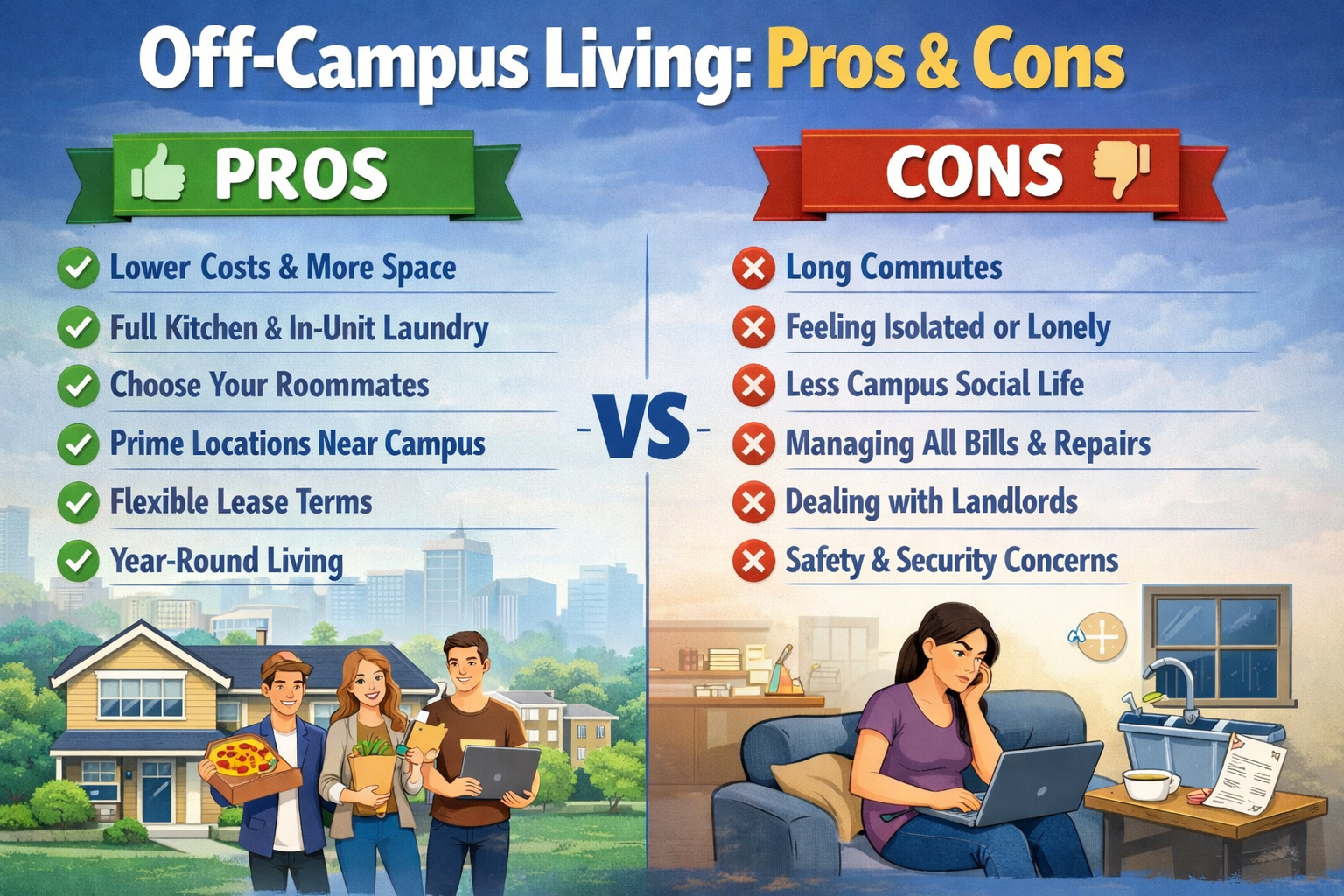
- More Independence and Privacy: Dorms are surprisingly expensive when you factor in those mandatory (and often overpriced) meal plans. Splitting a house or apartment with friends usually ends up being much cheaper, and you get way more flexibility with your lease.
- Lower Costs & Flexibility: Let’s be honest: having a real kitchen and an actual washing machine inside your apartment is a total game-changer. You’re not just getting more square footage; you’re getting a functional home.
- More Space & Amenities: You get to hand-pick your roommates and choose a neighborhood that actually fits your personality, whether you want a quiet street for studying or a spot right next to the best coffee shops downtown.
- Prime Location: Many private student homes sit right on the doorstep of major universities and the city’s best hangouts, easy for students to explore the city within a short commute.
- Lifestyle Choice: Managing your own utilities, grocery shopping, and rent is a learning curve, but it’s better to figure it out now than after graduation.
- Flexible lease term: You won’t have to pack up your entire life every time winter or summer break hits. Your apartment stays yours year-round.
Cons of Living Off Campus
- Transportation: If you live far from your university campus or public transportation systems, it gets harder to commute to your classes. You may have to spend more time and money on transportation, or deal with traffic, weather, or safety issues.
- Isolation: You could end up feeling lonely or disconnected from your peers and the campus community, especially if you’re a first-year student who is new to the country. There could be fewer opportunities for social interaction, networking, friendship, and support. There’s also the possibility of encountering cultural or language barriers with neighbors or landlords.
- Responsibility: Unlike on-campus living, you usually need to take care of everything on your own, such as finding a suitable place, signing a contract, paying bills, cleaning, maintaining, etc. You may have to deal with problems such as repairs, damages, disputes, or scams.
How can uhomes.com help you?
Finding your ideal student housing shouldn’t be the hardest part of your degree. Whether you’re heading to New York, Boston, Los Angeles, London, Sydney, or Glasgow, uhomes.com puts you right where the action is. Many private student apartments are close to campus typically within a 10-minute walk, and the buildings tucked into neighborhoods filled with the best local eats and hangouts. From self-contained studios en-suites, to shared flats, we’ve got a space for every budget. Our multilingual team is available 24/7 to make sure everything goes off without a hitch. To book your student accommodation on uhomes.com with our various greatest deals such as the early bird discounts, the highest cashback, group reservation discounts, vouchers, and more.
Considerations of Choosing On Campus vs Off Campus Living
There are factors you should consider when making this decision between living On Campus vs Off Campus accommodation for your higher educational journey.
- Location:Take into account the proximity of the accommodation to your campus, local amenities, and transportation options. Determine if it is convenient and easily accessible for your needs.
- Cost: Check if the cost of your ideal properties falls within your budget. Remember to check whether the rent includes expenses like utilities.
- Roommates: Decide whether you prefer living with roommates or having a place all to yourself. If you opt for roommates, consider their habits, personalities, and lifestyles to ensure compatibility.
- Facilities: Consider the amenities provided by the student housing, such as fitness centers, game rooms, or study spaces. Assess whether these facilities are important to you and meet your requirements.
- Safety and Medical Support: Pay attention to safety measures like doors, security cameras, or, on-site staff at the accommodation.
- Policies:Take into consideration policies and regulations of the accommodation, such as guest policies, noise restrictions, and pet policies. Determine if these policies align with your lifestyle and preferences.
- Privacy: Privacy is something that cannot be found easily. Usually, students struggle with finding an accommodation that ensures their privacy and independence.
- Commute: Students who have shifted for educational purposes should choose accommodations near their university and college. You should consider the time of travel or commute when finalizing your accommodations.
- Lease Terms: Consider the lease terms of your apartment, including the length of the lease, move-in and move-out dates, and any penalties for breaking the lease. When you’re looking for a place to live, it’s important to be aware of rental scams. Some of these rental scams include non-existent rentals, hijacked advertisements, and missing amenities.
Conclusion
University life can be a whirlwind of emotions, new experiences, and academic challenges. As students flock to NYC, LA, and other student cities for the first year of university living, a crucial consideration that demands early attention often dominates the first semester: student accommodation. Choosing to live in on-campus or Off-campus housing isn’t an easy decision, which is why we have put together the pros and cons of each accommodation type. uhomes.com will be your first choice for affordable, reliable, and comfortable student accommodation as a backup force in the students’ educational process.
FAQ
Choosing between on and off-campus living usually comes down to a trade-off: convenience vs. independence. On-campus life offers a seamless, university-managed environment that’s perfect for settling in. In contrast, private off-campus rentals give you the space to breathe and often a lower price tag, though they do require a bit more ‘adulting,’ from handling monthly utilities to navigating your way to class.
On-campus housing is a good option for students who prioritize convenience, being close to their classes, and having an easy way to meet people. Off-campus housing tends to suit those who prefer more independence, a wider range of room choices, and more flexibility in managing their budget and daily life.
Living off campus can be cheaper, particularly if students split rent and utility costs with roommates. While on-campus housing might look more expensive at first, the rent usually covers utilities, internet, and maintenance, which can make the overall cost comparable depending on the location.
On average, students pay about $12,640 per year for on-campus accommodation. This typically includes utilities and sometimes meal plans, depending on the school.
Off-campus apartments cost around $14,410 per year on average. However, the final amount depends on the city, apartment type, and whether you share with roommates.
Yes, most off campus student accommodation allow guests, but it’s important to check specific rental agreements for any restrictions.
To apply for on-campus housing, students typically need to go through the university’s housing office or submit a request through the school’s online portal. This is often done during the admissions process or by completing a separate housing application.