



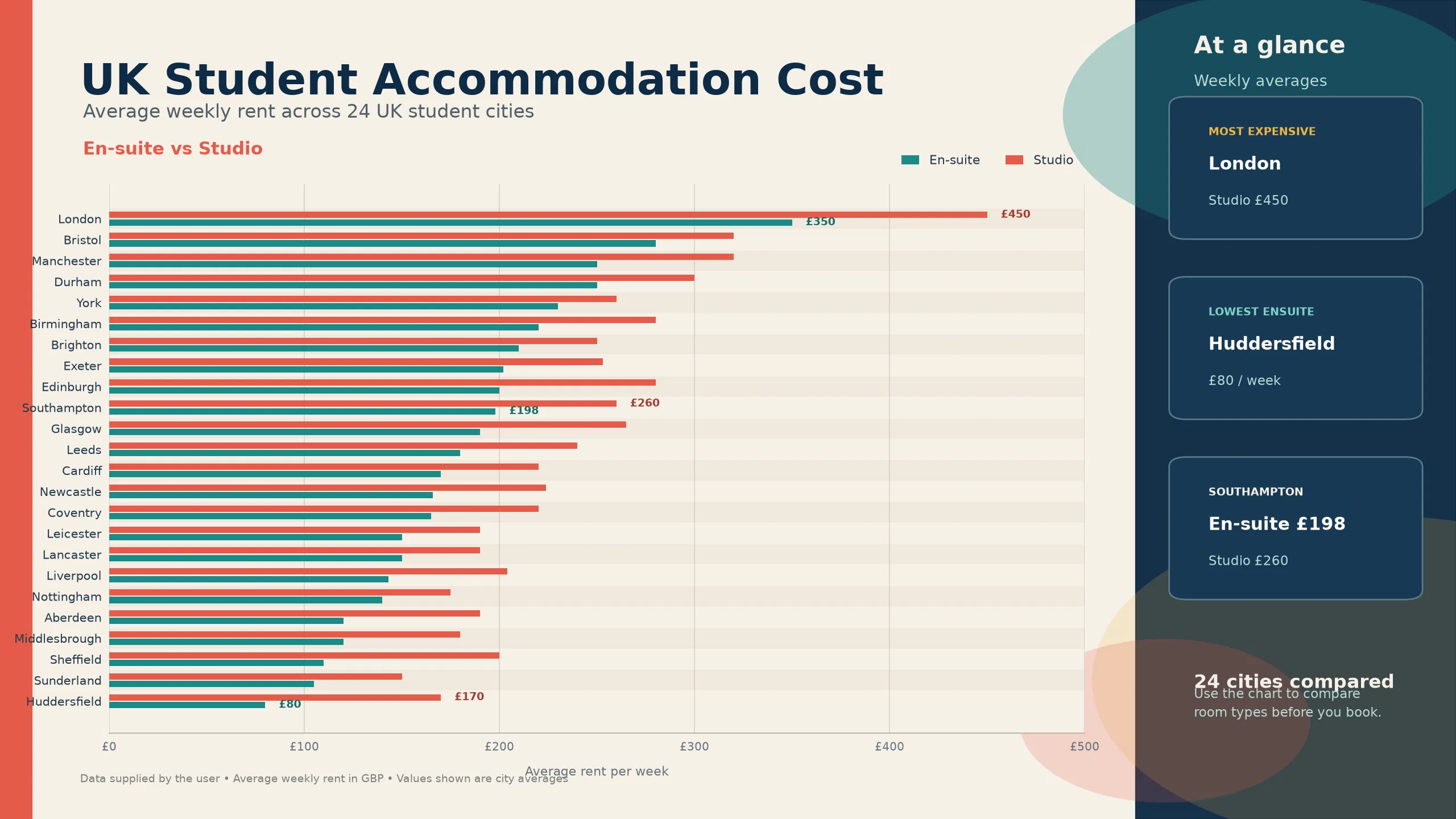
The UK student accommodation cost in 2027 varies considerably across university cities, with London, Manchester and Bristol generally having higher rents than cities such as Sheffield, Liverpool and Huddersfield. For students planning to study in the UK, understanding these differences is essential when choosing where to live and setting an accommodation budget.
How much does student accommodation cost in the UK? The answer depends not only on location but also on room type, property facilities and proximity to university campuses. En-suite rooms and private studios, for instance, typically have different rental prices, while accommodation in city centres may cost more than options in surrounding areas.
This guide compares average weekly rents for en-suite rooms and studios across 24 popular UK university cities, based on accommodation listings on uhomes.com. It also examines 2026 student accommodation market reports and official UK rental guidance to explain rental trends, compare affordable and expensive locations, and help students estimate their accommodation costs for the 2027 academic year.
UK Student Accommodation Market Trends 2026/27
Student Accommodation Rent Growth Is Slowing
UK student accommodation rental growth has slowed in the 2026/27 academic year. According to Knight Frank’s Student Accommodation Outlook: PBSA Rental Market, published in October 2026, its Student Property Rental Index recorded average rent growth of 1.5% across UK student accommodation room types. This was down from 2.3% in the previous academic year and significantly below the recent peak of 8.3%.
Rental trends also differ between accommodation providers. Knight Frank reported that rents for university-operated student accommodation increased by approximately 4.3%, while rents for private direct-let purpose-built student accommodation (PBSA) fell by around 0.7%. This highlights the growing difference in rental performance between university halls and privately operated student accommodation.
Cushman & Wakefield’s 2026 UK Student Accommodation Report also recorded rental growth of approximately 0.52% in the private student accommodation market for 2026/27. Although this figure uses a different market scope and methodology from Knight Frank’s index, both reports point towards more moderate rental growth.
Overall, UK student accommodation rents are no longer increasing at the rapid rates seen in previous years. Affordability, location, property quality and competition between accommodation providers are becoming increasingly important factors influencing rental prices.
London and Popular University Cities Remain Expensive
Despite slower overall rental growth, student accommodation costs remain relatively high in several of the UK’s most popular university cities. London continues to be one of the most expensive locations, driven by strong demand from domestic and international students, a large university population and competition for housing.
Bristol, Manchester, Edinburgh and Durham also tend to have higher student accommodation costs. Their established university communities and popularity among students contribute to sustained demand for rooms, particularly in areas close to campuses and city centres.
In comparison, Sheffield, Aberdeen and Leicester generally offer more affordable student accommodation options. For students looking to manage their living costs, these cities may provide a better balance between university choice and accommodation budgets.
Average UK Student Accommodation Cost in 24 Cities
The average UK student accommodation cost ranges from £80 to £350 per week for an en-suite room and £150 to £450 per week for a studio across the 24 cities covered in this comparison. London is the most expensive, with average rents of £350 per week for an en-suite and £450 per week for a studio. Bristol student accommodation also comes at a high cost, averaging £280 and £320 per week, respectively, while Manchester student accommodation averages £250 per week for an en-suite and £320 for a studio. Durham student housing is similarly expensive, with average weekly rents of £250 for an en-suite and £300 for a studio.
At the more affordable end, Huddersfield has the lowest average en-suite rent at just £80 per week, while Sunderland has the lowest average studio rent at £150 per week. Sheffield student accommodation is another budget-friendly option, with average rents of £110 per week for an en-suite and £200 per week for a studio. The table below compares average weekly rents for both room types across all 24 cities, based on uhomes.com accommodation listings.
| UK City | Major Universities | Average Ensuite Rent/Week | Average Studio Rent/Week |
|---|---|---|---|
| London | UCL, KCL, LSE, QMUL | £350 | £450 |
| Manchester | University of Manchester, Manchester Metropolitan University, University of Salford | £250 | £320 |
| Edinburgh | University of Edinburgh, Heriot Watt University, Edinburgh Napier University | £200 | £280 |
| Leeds | University of Leeds,Leeds Beckett University | £180 | £240 |
| Liverpool | University of Liverpool | £143 | £204 |
| Coventry | University of Warwick, Coventry University | £165 | £220 |
| Glasgow | University of Glasgow, University of Strathclyde, Glasgow School of Art | £190 | £265 |
| Durham | Durham University, Durham University Queen’s Campus | £250 | £300 |
| Leicester | De Montfort University, University of Leicester | £150 | £190 |
| Aberdeen | University of Aberdeen | £120 | £190 |
| Nottingham | University of Nottingham, Nottingham Trent University | £140 | £175 |
| Sheffield | University of Sheffield, Sheffield Hallam University | £110 | £200 |
| Newcastle | Newcastle University, Northumbria University | £166 | £224 |
| Exeter | University of Exeter | £202 | £253 |
| York | University of York | £230 | £260 |
| Southampton | University of Southampton, Winchester School of Art, Solent University | £198 | £260 |
| Birmingham | University of Birmingham, Birmingham City University, Aston University, Birmingham School of Jewellery | £220 | £280 |
| Cardiff | Cardiff University, Cardiff Metropolitan University, University of South Wales | £170 | £220 |
| Bristol | University of Bristol, University of the West of England | £280 | £320 |
| Brighton | University of Sussex, University of Brighton | £210 | £250 |
| Lancaster | Lancaster University | £150 | £190 |
| Huddersfield | University of Huddersfield | £80 | £170 |
| Sunderland | University of Sunderland | £105 | £150 |
| Middlesbrough | Teesside University | £120 | £180 |
Which UK Cities Have the Highest Student Accommodation Costs?
London: £350/week for Ensuite, £450/week for Studio
London remains the most expensive in the UK. Based on a 44-week contract, students can expect to pay approximately £15,400 for an Ensuite and £19,800 for a Studio. For a 51-week contract, these figures rise to £17,850 and £22,950, respectively.
High prices for student accommodation in London are primarily driven by the city’s overall expensive property market, relentless demand from students and professionals, and the unique concentration of world-class universities across the capital. Student properties near UCL, KCL and other central London universities often command premium rents due to their convenient locations. Students on tighter budgets can consider areas further from central London, including Barking, Croydon and Lewisham, where rents can be more affordable. Checking Underground and bus connections is essential when comparing these locations.
Bristol: £280/week for Ensuite, £320/week for Studio
With the University of Bristol and the University of the West of England, Bristol attracts a large student population across several university campuses. Its relatively high accommodation costs reflect strong student housing demand, competition for properties in popular neighbourhoods and a wider residential rental market with limited affordable options. Areas close to the University of Bristol, particularly Clifton, Redland and Cotham, are generally more expensive due to their proximity to campus and popularity among students. Students looking for affordable accommodation in Bristol can explore Easton, Fishponds, Horfield and Filton, where rents are generally lower than in popular student areas such as Clifton and Redland.
Manchester: £250/week for Ensuite, £320/week for Studio
Manchester’s high student accommodation costs reflect its position as one of the UK’s largest university cities. The University of Manchester, Manchester Metropolitan University and the University of Salford attract a large student population, sustaining demand for both private student halls and studios. Popular areas close to university campuses and the city centre often command higher rents due to their convenient locations and access to amenities.
Durham: £250/week for Ensuite, £300/week for Studio
Durham’s relatively high student accommodation costs are partly driven by its concentrated student population and limited housing supply. Durham University is the city’s main higher education institution, with students competing for accommodation near its colleges and university facilities. The city’s compact layout also means that well-located properties within convenient walking distance of the university are particularly sought after.
Which UK Cities Have the Least Expensive Student Accommodation?
Huddersfield, Sunderland, Sheffield and Aberdeen are ideal for students seeking the least expensive student accommodation in the UK.
Huddersfield: Lowest Average Ensuite Rent at £80/Week
Huddersfield has the lowest average Ensuite rent among the 24 UK cities in this comparison, at just £80 per week. The average Studio rent is £170 per week. One reason for Huddersfield’s affordability is its smaller-town housing market, where residential rents are generally lower than in larger university cities such as Leeds and Manchester. The University of Huddersfield is also the town’s main higher education institution, and students can choose from university-managed accommodation, private student halls and shared houses. This gives students different accommodation options without paying the rental premiums often associated with larger city centres.
Sunderland: Lowest Average Studio Rent at £150/Week
Sunderland has an average Ensuite rent of £105 per week and a Studio rent of £150 per week, making it one of the most affordable cities for both room types. Located in North East England, Sunderland benefits from a relatively low-cost residential property market compared with many parts of southern England. Lower local house prices also help keep private rental costs down, making student accommodation in Sunderland more affordable. The University of Sunderland offers another advantage for budget-conscious students, as they can compare university-managed halls with private accommodation across the city without facing the rental levels common in larger university markets.
Sheffield: Affordable Accommodation with Two Major Universities
Sheffield offers relatively affordable student accommodation despite being a major university city. The average weekly rent is £110 for an Ensuite and £200 for a Studio. Home to the University of Sheffield and Sheffield Hallam University, the city has an established student housing market with accommodation across different neighbourhoods and price ranges. Compared with larger and more expensive cities such as Manchester, Leeds and London, Sheffield has a lower overall residential rental market. Its range of shared student houses and purpose-built student accommodation also gives students more flexibility when choosing between private living space and lower-cost shared facilities.
Aberdeen: An Affordable Student City in Scotland
Aberdeen has an average Ensuite rent of £120 per week and a Studio rent of £190 per week, making it a relatively affordable option for students in Scotland. Its housing market has experienced softer rental conditions than some other major Scottish cities, partly reflecting changes in the local property market and demand. This helps explain why accommodation can be more affordable than in higher-cost student destinations such as Edinburgh. The University of Aberdeen is a major reason students choose the city, while its comparatively lower property prices and rental levels make it worth considering for those who want to study in Scotland without paying Edinburgh-level accommodation costs.
Liverpool, Nottingham and Leicester: Affordable Options for a Moderate Budget
Liverpool, Nottingham and Leicester are popular UK student cities with large university communities and established student accommodation markets. Despite attracting substantial student populations, all three offer relatively affordable rental options, with average weekly rents as follows:
| City | Average Ensuite Rent | Average Studio Rent |
|---|---|---|
| Liverpool | £143 | £204 |
| Nottingham | £140 | £175 |
| Leicester | £150 | £190 |
Each city offers different advantages for students on a budget. In Liverpool, areas such as Smithdown Road and Wavertree are popular for shared student houses, which can be cheaper than city-centre accommodation. Nottingham offers the lowest average Studio rent among the three cities at £175 per week, making it a good choice for students who prefer independent living. In Leicester, students at the University of Leicester and De Montfort University can compare accommodation across different neighbourhoods to find options that suit their budgets.
UK Student Accommodation Cost by Room Type
Studio, Ensuite and Shared House are three common types of student accommodation in the UK, each offering a different balance of privacy, space and cost. Ensuite rooms provide a private bedroom and bathroom with shared kitchen facilities, Studios offer self-contained living spaces, while Shared Houses allow students to rent a private bedroom and share communal areas with housemates. The best option depends on your budget, privacy preferences and lifestyle.
What is an En-suite Student Room?
An en-suite room features a private bedroom and bathroom, with the kitchen and communal areas shared with other students. It is ideal for students who want personal space, value bathroom privacy and enjoy socialising with flatmates. By sharing kitchen facilities, students can enjoy a more affordable option than a Studio without giving up their own bathroom.
What is a student studio?
A studio is a self-contained unit with a private bedroom, bathroom, kitchenette and living space, usually arranged in an open-plan layout. It is ideal for students who value privacy, prefer independent living or do not want to share kitchen facilities. Having everything in one private space offers greater independence and flexibility in daily life.
What is a Shared House?
A Shared House is a privately rented property where students have their own bedrooms but share facilities such as the kitchen, bathroom and living room. It suits students on a tighter budget who enjoy living with others and want more flexibility in their accommodation choices. Sharing a property with housemates can help reduce individual rental costs, although bills and tenancy responsibilities should be checked before signing a contract.
Studio vs Ensuite: How Much More Does a Studio Cost?
Studio rooms are more expensive than Ensuite rooms, with weekly rent differences ranging from £70 to £100 across the six cities shown below. London has the largest gap at £100 per week, meaning students choosing a Studio could pay an additional £4,400 over a 44-week tenancy. Sheffield and Huddersfield follow at £90 per week, while Manchester has the smallest difference at £70. Overall, choosing an Ensuite instead of a Studio could save students between £3,080 and £4,400 over 44 weeks, making it a more affordable option for those comfortable sharing kitchen facilities.
| City | Ensuite | Studio | Weekly Price Difference |
|---|---|---|---|
| London | £350 | £450 | £100 |
| Manchester | £250 | £320 | £70 |
| Edinburgh | £200 | £280 | £80 |
| Glasgow | £190 | £265 | £75 |
| Sheffield | £110 | £200 | £90 |
| Huddersfield | £80 | £170 | £90 |
How Much Should You Budget for Student Accommodation in the UK?
The actual cost of student accommodation in the UK depends on more than the advertised weekly rent. Students should compare the total tenancy cost, room type, contract length, included bills and additional charges to estimate their overall accommodation budget.
Compare the Total Rent Based on Your Tenancy Length
UK student accommodation contracts commonly last between 44 and 52 weeks, depending on the property and provider. A lower weekly rent does not necessarily mean cheaper accommodation, as a longer tenancy increases the total amount you pay.
You can calculate the total accommodation cost using this formula: Total Rent = Weekly Rent × Number of Contract Weeks The table below compares the total rent for 44-week and 51-week contracts.| Weekly Rent | 44 Weeks | 51 Weeks |
|---|---|---|
| £150 | £6,600 | £7,650 |
| £200 | £8,800 | £10,200 |
| £250 | £11,000 | £12,750 |
| £350 | £15,400 | £17,850 |
For example, a room costing £200 per week would cost £8,800 over 44 weeks but £10,200 over 51 weeks, a difference of £1,400.
A shorter contract may reduce accommodation costs if you only need a room during term time. However, students staying in the UK over summer should compare the cost of extending their tenancy with alternative accommodation options. Always check the tenancy start and end dates and the total number of payable weeks before booking.
Consider Utility Bills and Hidden Costs
When budgeting for student accommodation in the UK, remember that weekly rent isn’t the only expense. Utilities, transport, food and daily essentials can all affect your overall living costs.
Electricity, Gas, Water and Heating: These bills can add to your monthly expenses if they are not included in the rent. Most student accommodation listed on uhomes.com offers all-inclusive rent, covering utilities such as water, electricity, gas and heating, so students can manage their budgets more easily.
Internet: Wi-Fi is also included in the rent at many uhomes.com student accommodation properties. For private rentals, you may need to arrange and pay for broadband separately.
Transport: Budget for buses, trains and other regular journeys between your accommodation and university. Costs depend on the city, travel frequency and available student discounts.
Food and Groceries: Allow for supermarket shopping and meals out. Cooking at home can help reduce daily expenses.
Laundry and Daily Essentials: Some student residences charge extra for using washing machines and dryers. Toiletries, cleaning products and other household necessities should also be included in your budget.
Upfront Costs: Check whether your accommodation requires a security deposit, advance rent or any booking fees. You may also need to buy bedding, kitchen equipment and other essentials.
How Do UK Rental Rules Affect Student Accommodation Costs?
Rental rules can affect how much money students need to prepare before moving into their accommodation. For international students planning to study in the UK in 2027, the Renters’ Rights Act 2025 and other rental regulations are particularly relevant when comparing upfront payments, tenancy deposits and additional housing costs. However, the rules discussed below mainly apply to private rentals in England.
Changes to Rent in Advance Rules
The Renters’ Rights Act 2025 came into effect on 1 May 2026, changing how landlords can collect rent in advance for applicable assured periodic tenancies in England.
Under the new rules:
Landlords and letting agents cannot ask for, encourage or accept rent payments before both parties have signed the tenancy agreement.
After signing, if rent is paid monthly, landlords can generally request up to one month’s rent before the tenancy starts.
For tenancies with rent paid more frequently than monthly, landlords can generally request up to 28 days’ rent during the pre-tenancy period.
These changes help reduce the upfront financial burden on international students who previously might have been asked to pay six or twelve months’ rent in advance because they did not have a UK-based guarantor. However, the rules apply to specific tenancy types in England, not every form of student accommodation. University halls and some student accommodation arrangements may be subject to different rules, so always check the tenancy agreement and payment terms before booking.
Tenancy Deposit Limits and Upfront Costs
A tenancy deposit is usually paid before moving into privately rented accommodation to cover potential damage, unpaid rent or other costs permitted under the tenancy agreement. In England, the maximum deposit for a tenancy covered by the relevant rules is:
Five weeks’ rent if the annual rent is below £50,000.
Six weeks’ rent if the annual rent is £50,000 or more.
Landlords must also protect eligible tenancy deposits through a government-approved tenancy deposit protection scheme.
You may also be asked to pay a Holding Deposit to reserve a property while the landlord completes pre-tenancy checks. This is capped at one week’s rent in England. Unlike a tenancy deposit, it is generally refundable, although certain conditions may allow the landlord to retain it. It may also be put towards your first rent payment or tenancy deposit if agreed.
When calculating your initial accommodation budget, distinguish between the Holding Deposit, Tenancy Deposit and rent paid in advance. These are separate payments with different purposes, and you should confirm how each payment will be handled before transferring money.
Guarantor Requirements and Alternative Costs
Some private landlords and student accommodation providers require a UK-based Guarantor before accepting an international student’s booking. A guarantor agrees to cover rent or other specified tenancy obligations if the student fails to pay.
If you do not have a UK guarantor, you may need to consider alternative arrangements, which can affect your initial accommodation costs:
University Guarantor Schemes: Some universities offer guarantor support for eligible students. Check whether your university provides this service and whether any fees apply.
International Guarantors: Some landlords and accommodation providers accept guarantors based overseas, although eligibility and documentation requirements vary.
Third-Party Guarantor Services: Specialist providers may offer paid guarantor services for students who cannot provide a suitable guarantor. Fees and eligibility requirements vary by provider.
Alternative Payment Arrangements: Some accommodation providers offer different payment plans for international students. Check whether these involve additional conditions or costs.
Before booking, confirm whether a guarantor is required and whether an alternative is available. If you use a third-party guarantor service, include its fee in your initial accommodation budget.
Council Tax Exemption for Full-Time Students
Full-time students may qualify for Council Tax exemption, which can reduce their overall living costs. In England, a property occupied entirely by eligible full-time students is generally exempt from Council Tax. To qualify, a full-time university course normally needs to last at least one year and involve at least 21 hours of study per week.
However, if you share a privately rented property with non-students, the household may still have to pay Council Tax. Full-time students are generally disregarded when the council calculates the bill, but the amount payable depends on the other residents and the household’s circumstances.
After enrolling at university, request a Council Tax student certificate and submit it to the local council if required. If you are renting a room in a shared house, check who is responsible for Council Tax and whether it is included in the rent before signing the agreement.
How to Reduce Student Accommodation Costs in UK?
Students can reduce their UK student accommodation costs by comparing cities, room types, locations and tenancy terms before booking. The following tips can help you find affordable accommodation while keeping your overall living expenses under control.
Choose a More Affordable Student City: Accommodation prices vary significantly across the UK. London, Bristol and Manchester tend to have higher rents, while Huddersfield, Sunderland, Sheffield and Aberdeen offer more budget-friendly options. Liverpool, Nottingham and Leicester are also worth considering, as they combine large student populations with relatively affordable accommodation.
Compare Different Room Types: A private studio usually costs more than an ensuite room or a room in a shared house because it offers private kitchen and bathroom facilities. If you are comfortable sharing a kitchen or other communal spaces, choosing an ensuite or non-ensuite room can help reduce your weekly rent.
Consider Locations Outside the City Centre: Student accommodation in central areas is often more expensive. Consider neighbourhoods slightly further from the university or city centre, where weekly rents may be lower. However, compare the distance to campus and nearby transport links before booking to make sure the rent savings are not offset by longer and more expensive journeys.
Check Whether Bills Are Included: Always check whether rent covers electricity, water, gas, heating and Wi-Fi. Paying for utilities separately can increase your monthly accommodation expenses. Most student accommodation listed on uhomes.com offers all-inclusive rent, although the exact inclusions should be checked on each property page.
Compare Discounts on uhomes.com: Use uhomes.com to compare student accommodation prices, exclusive property offers and available promotions in different UK cities. Discounts may include cashback, early-bird offers, exclusive accommodation-provider deals, limited-time rent reductions and group booking rewards. The platform also offers a £50 referral reward for eligible bookings and a Price-Match Guarantee for the same property, room type and rental period. Offers and eligibility conditions vary, so check the property’s Special Offers section or ask a consultant about current deals.
Choose a Contract Length That Matches Your Study Plans: Student accommodation contracts commonly last 44 or 51 weeks. If you only need accommodation for the academic year, a 44-week contract may cost less overall than a 51-week contract. Compare the total rent rather than just the weekly price, and check whether you will need somewhere to stay during the summer break before choosing a shorter contract.
Calculate Hidden Transport Costs: A cheaper room outside the city centre may not be the most economical option if you need to pay for daily buses, trams, underground services or trains. Estimate your weekly commuting costs and travel time before booking. In some cases, paying slightly more for accommodation within walking or cycling distance of your university can reduce your overall living expenses.
Conclusion
The cost of student accommodation in the UK varies depending on the city, room type, location and tenancy length. While London and other popular university cities tend to have higher rents, students can find more affordable options in cities such as Huddersfield, Sunderland and Sheffield. To manage their budgets, students should compare weekly and total contract costs, check which bills are included, consider transport expenses and make use of available booking discounts. With a wide range of verified student accommodation across the UK, uhomes.com helps students compare prices, explore different room types and access exclusive offers, making it easier to find accommodation that suits their budget and study plans.
FAQs About UK Student Accommodation Costs
Student accommodation in the UK ranges from £80 to £350 for an ensuite room and £150 to £450 for a studio. Actual prices vary by city, university location, room facilities, tenancy length, availability and included bills.
Huddersfield, Sunderland, Sheffield and Aberdeen are among the most affordable UK cities for student accommodation, with ensuite rooms costing around £80–£120 per week and studios ranging from £150–£200 per week.
Yes. Most uhomes.com student student accommodation in UK is all bills-included rent, covering utilities such as water, electricity, gas and heating, with Wi-Fi also included at many properties.
Yes. Booking student accommodation early generally helps students save money by taking advantage of early-bird discounts and promotional offers. It also allows students to book before the peak rental period, when demand for popular properties increases. By booking ahead, students are more likely to access lower-priced rooms, a wider range of room types and more affordable accommodation options before availability becomes limited.
Yes. Besides rent, students may need to pay for utilities, internet, transport, laundry and a tenancy deposit, depending on the property. Some accommodation includes utility bills in the rent, so check what is covered before booking.