




Home for Global Students
4.9/5
GET APP

Student Accommodation in Japan:Your Ultimate Guide

By Sybil
student accommodation japan guide

Finding the right student accommodation in Japan is one of the most critical steps for international students. As of May 1, 2025, Japan hosted a record 408,069 international students, a 21.2% year-on-year increase according to the latest JASSO survey released in May 2026. The majority of these students concentrate in major study hubs such as Tokyo, Osaka, Kyoto, and Fukuoka, where demand for housing near campuses and train stations is particularly strong. Options range from university dormitories and private student halls to share houses and regular apartments.

However, navigating Japan’s rental market can feel overwhelming due to complex rules, language barriers, guarantor requirements, and high upfront costs like shikikin and reikin. This guide walks you through everything you need to know, from accommodation types, average rents and upfront costs to practical tips for securing a place. Whether you’re coming for language school, university, or vocational training, it will help you find suitable housing in Japan without costly surprises.

Overview of Japan

overview in JapanJapan has become a rapidly expanding study destination, hosting a record 408,069 international students as of May 1, 2025. Of these, 92,442 were undergraduate university students, 60,013 were graduate students, and 140,174 were enrolled at Japanese language institutes.

Accommodation demand therefore extends far beyond conventional university dormitories. Students on bachelor’s and master’s programmes often need housing for several years, while exchange students, language-school students and interns may prefer furnished accommodation with six-month, semester-length or other flexible contracts.

Housing costs vary considerably by location. JASSO’s 2023 survey puts average monthly housing expenditure for international students at ¥41,000 nationwide, compared with ¥57,000 in Tokyo, ¥40,000 in the Kinki region covering Osaka and Kyoto, and ¥29,000 in Kyushu, which includes Fukuoka.

For international students, the most important differences between cities are therefore not only university choice, but also rent, commuting distance, availability of furnished housing and the amount of money required before moving in.

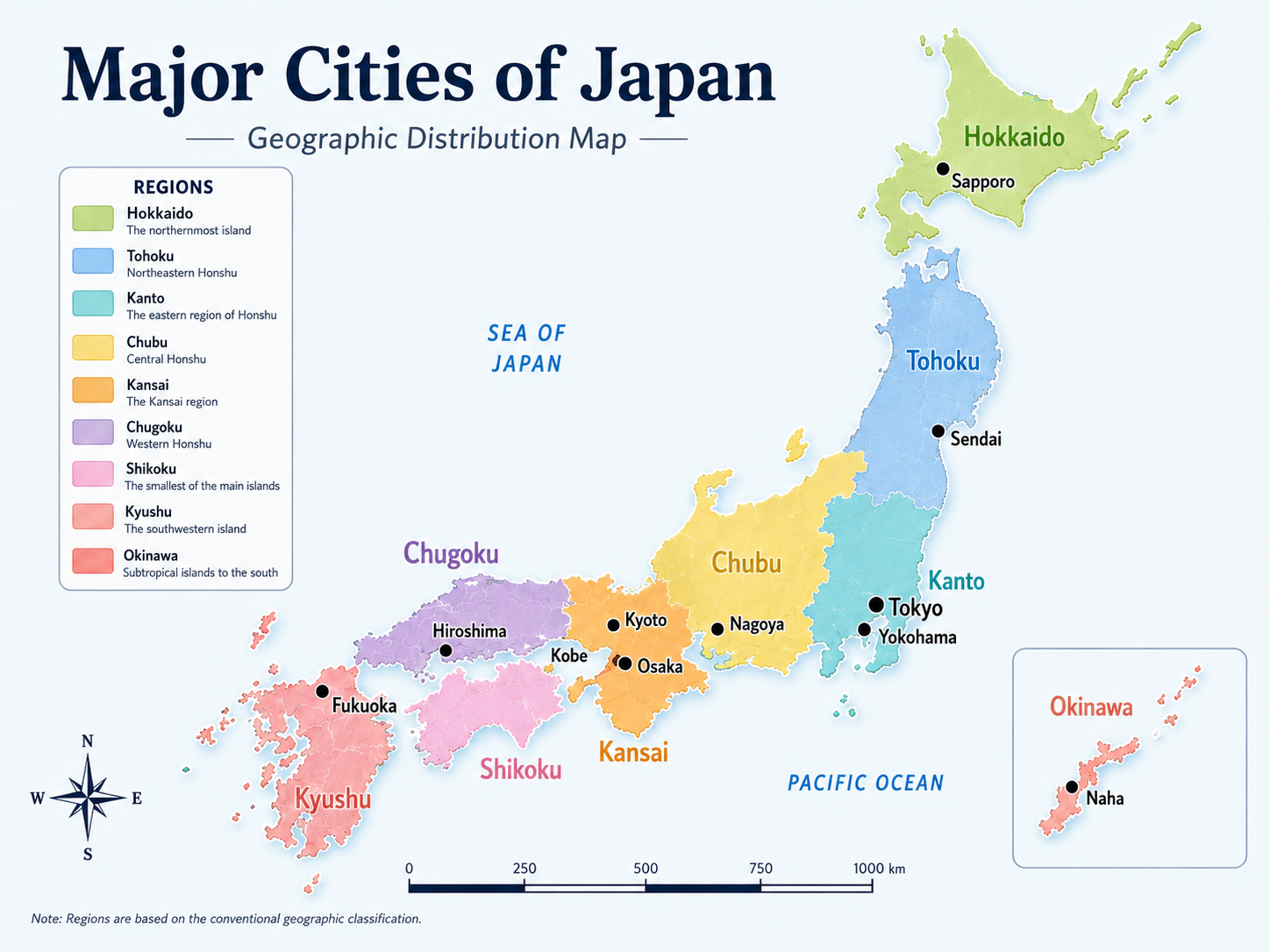
Japan’s most popular student cities include Tokyo, Osaka, Kyoto and Fukuoka, which together offer a strong combination of leading universities, international communities, public transport and relatively large student rental markets.

Tokyo, Japan

Tokyo offers largest and most varied student accommodation market in Japan, making it particularly attractive to international students attending universities, graduate schools and Japanese language schools. Major institutions include the University of Tokyo, Waseda University, Keio University, Sophia University and Hitotsubashi University. Tokyo’s extensive rail and subway network also allows students to live several stations away from campus rather than paying a premium for accommodation immediately beside their university.

Tokyo’s housing costs are higher than elsewhere in Japan. JASSO reports average international-student housing expenditure of ¥57,000 per month in Tokyo, while current private studio listings aimed at students can commonly fall around ¥77,000–¥95,000 per month in Tokyo’s 23 wards, depending on size and location.

  • Top universities in Tokyo:University of Tokyo, Waseda University, Keio University, Sophia University and Hitotsubashi University.
  • Best areas for students to live in Tokyo:Bunkyo/Hongo, Takadanobaba and Waseda, Nakano and Koenji, and Ikebukuro.
  • Average student rent in Tokyo:¥57,000/month, while private studios in the 23 wards are generally more expensive.
  • Types of student accommodation in Tokyo:university dormitories, private student halls, 1R/1K studios, serviced apartments and share houses.

tokyo japanOsaka, Japan

Osaka is one of Japan‘s major student cities and generally offers lower student rents than Tokyo. The wider Osaka area is home to Osaka University, Osaka Metropolitan University, Kansai University, Kindai University and several specialist and Japanese language institutions. Students can choose between central neighbourhoods and accommodation around suburban campuses in Suita, Toyonaka and other university districts.

Public transport makes cross-city commuting practical, but choosing accommodation on the correct railway or metro line is usually more important than simply measuring straight-line distance from campus.

  • Top universities in Osaka:Osaka University, Osaka Metropolitan University, Kansai University and Kindai University.
  • Best areas for students to live in Osaka:Ishibashi/Toyonaka and Suita, Tennoji , Umeda, and Namba or Chuo-ku.
  • Average student rent in Osaka:student dormitories and residences commonly range around ¥35,000–¥60,000/month, share-house rooms around ¥30,000–¥55,000, and private studios around ¥40,000–¥65,000+ on current student-oriented listings.
  • Types of student accommodation in Osaka:university dormitories, managed student residences, private studios, share houses and furnished apartments.

Kyoto, Japan

Kyoto is one of Japan’s strongest university cities and has a particularly visible student population around its major campuses. Kyoto University, Doshisha University, Ritsumeikan University and Kyoto Institute of Technology create substantial demand for apartments and student halls in areas such as Sakyo, Kamigyo and northern Kyoto.

Kyoto can be especially suitable for students who want a compact university-city environment rather than Tokyo’s larger metropolitan scale. Cycling is common for shorter journeys, while subway, railway and bus connections become more important when living farther from campus.

  • Top universities in Kyoto:Kyoto University, Doshisha University, Ritsumeikan University and Kyoto Institute of Technology.
  • Best areas for students to live in Kyoto:Sakyo-ku, Hyakumanben and Demachiyanagi, Imadegawa and Kamigyo, Saiin and Nishioji, and Fushimi.
  • Average student rent in Kyoto:Share-house rooms commonly around ¥40,000–¥75,000, while managed student halls with meal plans can reach approximately ¥60,000–¥100,000.
  • Types of student accommodation in Kyoto:university international houses, student halls, studios, share houses and traditional private apartments.

Fukuoka, Japan

Fukuoka is a comparatively affordable major study destination for international students in Japan, particularly those attending Kyushu University and other institutions across Fukuoka City. Housing around the Ito campus area can be substantially cheaper than comparable private accommodation in central Tokyo.

The city’s smaller scale also means students can often balance lower rents with access to rail, subway and bus routes rather than paying heavily for central accommodation.

  • Top universities in Fukuoka: Kyushu University, Fukuoka University, Seinan Gakuin University and Fukuoka Women’s University.
  • Best areas for students to live in Fukuoka: Nishi-ku and the Kyudai-Gakkentoshi area, Maidashi, Hakata, and Tenjin/Yakuin.
  • Average student rent in Fukuoka: starting from around ¥30,000–¥60,000+, depending on property type and location.
  • Types of student accommodation in Fukuoka: university dormitories, private student halls, studios, apartments and share houses.fukuoka japan

Types of Student Accommodation in Japan

The main types of student accommodation in Japan are private student residences, private rental apartments, university halls and share houses. Below are the details of each type.

Private Student Residences / Student Halls

Private student residences in Japan are often marketed as gakusei kaikan or student halls and may provide furnished private bedrooms, communal facilities, security systems and sometimes breakfast or dinner. They are particularly suitable for first-year international students because moving in is normally simpler than furnishing a conventional Japanese apartment. Some listings also remove individual upfront costs such as key money or deposits, but students should check each property rather than assuming these are automatically waived.

Private Student Rentals

Private student rentals in Japan give students the greatest independence but usually involve the most complicated application process. Common layouts include 1R studios, 1K apartments with a separate kitchenette, and larger 1DK or 1LDK apartments. Standard private rentals may be unfurnished, utilities may need to be arranged separately and the tenant may be required to use a guarantor or rental-guarantee company.

University Halls

University halls in Japan are usually among the most affordable student accommodation options, but availability can be limited and eligibility rules differ by institution. Some universities operate dedicated international houses, while others reserve places for exchange students or newly arrived overseas students.

For example, Kyoto University operates several international houses, while other universities may allocate accommodation through application windows or internal selection procedures. University accommodation can therefore be excellent value, but students should not rely on obtaining a place until an offer has been confirmed.

Share Houses and Guesthouses

Share houses in Japan provide a private bedroom with communal spaces such as kitchens, bathrooms or living rooms and are one of the most flexible options for international students. Share houses often have lower initial costs than conventional private apartments and are more likely to offer furniture and flexible lease terms. They can therefore work particularly well for language students, exchange students and anyone staying for less than a full academic programme.

Accommodation type Typical cost level Main advantages Main disadvantages Best for
Private student residence Medium Furnished, student-focused, easier move-in, security and sometimes meals More expensive than basic dorms; house rules may apply New international students
Private apartment Medium–High Privacy, independence and widest choice Deposit/key money may apply; utilities and furniture often separate Long-term students
University hall Low–Medium Usually affordable, close to campus, student community Limited places, eligibility rules and fixed application periods First-year and exchange students
Share house Low–Medium Lower upfront costs, furnished rooms, social environment, flexible terms Shared kitchen/bathroom and less privacy Budget and short-term renters

Top-rated Student Accommodations in Major Cities Across Japan

Recommended student accommodations in major cities across Japan include Share houses, university dorms, private apartments, and purpose-built student residences close to campuses or major train lines. They often keep rents reasonable, and offer clean, safe spaces with decent community support.

Best Student Accommodation in Tokyo

Some of the best student accommodations in Tokyo combine furnished rooms with good railway access and reduced upfront costs.

  • HAUN Kuramae starts from around ¥99,000/month on current uhomes.com listings. It is advertised as bills included, with no deposit, no landlord gift fee/key money and no service fee, making it particularly useful for international students who want clearer upfront costs.
  • Schloss Ichigaya starts from around ¥105,792/month and is a dedicated student accommodation option in Shinjuku with nearby subway access, supermarkets and student-oriented facilities.

Best Student Accommodation in Osaka

The best student accommodation in Osaka is concentrated around Osaka University and major transport corridors.

  • Student Hall Campus Terrace Ishibashi Handai-mae starts from around ¥58,500/month and includes meal-related options, furnished student-focused facilities and access to the Osaka University area.
  • Avenir Sumiyoshi starts from around ¥56,500/month and is currently advertised with no deposit, alongside rail, subway and supermarket access.

Best Student Accommodations in Kyoto

Top-tier student accommodation in Kyoto combines lower initial costs with access to university districts.

  • Cozy House (コージーハウス) starts from around ¥41,000/month and is currently listed with no deposit, no landlord gift fee/key money and no service fee, making it a particularly interesting option for students trying to minimise upfront expenditure.
  • Student Hall Fushimi Fukakusa Residence starts from around ¥59,500/month and includes a breakfast option, with nearby public transport and student-oriented services.

Best Student Accommodations in Fukuoka

The best student accommodation in Fukuoka are located around Kyushu University campuses and offer considerably lower rents than many Tokyo properties.

Average Student Rent in Japan

The average student rent in Japan is roughly ¥50,000–¥60,000 per month for a typical private studio or 1K apartment. The main factors that affect rent include city, distance from a railway station, commute to university, building age, apartment size, whether the property is furnished, whether bills or meals are included and whether upfront charges such as key money have been removed.

Below is a comparison of rents for single-occupancy rooms or studios in Japan’s major cities:

City Official average (JASSO / regional) Typical private rental Utilities if separate
Tokyo ¥57,000/month ¥65,000–¥90,000+ ¥8,000–¥15,000/month
Osaka ¥40,000/month ¥30,000–¥65,000+ ¥8,000–¥15,000/month
Kyoto ¥40,000/month ¥40,000–¥70,000+ ¥8,000–¥15,000/month
Fukuoka ¥29,000/month ¥30,000–¥60,000+ ¥8,000–¥15,000/month

How Much Are Upfront Costs for Student Accommodation in Japan?

The upfront costs for student accommodation in Japan can be much higher than the security deposit alone because private rentals may include a deposit, key money, agency fees, insurance, advance rent and a guarantor-company charge.

  • Security deposit / Shikikin: commonly 1–3 months’ rent. This is security held against unpaid rent, damage or eligible restoration costs and the remaining balance is returned after moving out.
  • Key money / Reikin: commonly 0–2 months’ rent. Unlike the deposit, key money is normally non-refundable.
  • Agency Fee: A commission paid to the real estate agent who arranges the rental. It is usually one month’s rent plus 10% consumption tax and is non-refundable.
  • Guarantor or guarantee-company fee: A fee charged by a third-party guarantor company, required for most foreign students. It is typically 50–100% of one month’s rent and is non-refundable.
  • Fire Insurance: Mandatory tenant insurance covering fire and related damage. It usually costs ¥15,000–¥25,000 for a two-year policy.
  • Lock Change Fee: A fee for replacing the door lock when a new tenant moves in, commonly ¥10,000–¥25,000.
  • Cleaning / Disinfection Fee: An optional or sometimes compulsory fee for professional cleaning or disinfection of the room, usually ranging from ¥10,000–¥30,000.

For traditional private apartments in Japan, the total upfront costs are usually equivalent to 4–6 months’ rent. In contrast, purpose-built student residences and dormitories often waive or significantly reduce key money and the security deposit, making the initial move-in costs much lower.

Cost of Living for Students in Japan

The cost of living for students in Japan averages approximately ¥105,000 per month nationally, covering rent, food, transport, entertainment, utility bills, and other items. Actual spending can be substantially higher in Tokyo or for students renting private studios.

  • Rent: ¥41,000/month
  • Food and groceries: ¥32,000/month 
  • Utility bills: ¥8,000–¥15,000/month
  • Transport: ¥4,000/month
  • Entertainment: ¥8,000/month 

When to Start Looking for Student Accommodation in Japan?

Students should start looking for student accommodation in Japan around two to three months before their intended move-in date. Starting earlier is particularly important for students who need furnished accommodation, English-language support or housing within a short commute of a specific campus.

Japan’s main university academic year begins in April, so demand becomes particularly competitive during February and March. September-entry students and exchange students can also create another period of stronger demand during late summer. Here is a practical timeline

  • December–January: Begin searching for an April move-in.
  • January–February: Compare properties, check guarantor requirements and prepare documents.
  • February–March: High-demand period; popular lower-cost options may become harder to secure.
  • June–July: Begin searching for September/autumn intake accommodation.
  • August: Finalise autumn bookings rather than waiting until arrival.

Where to Find Student Accommodation in Japan?

Students can find student accommodation in Japan through university housing services, specialist student accommodation platforms such as uhomes.com, Japanese rental portals, local estate agencies and direct accommodation providers.

University Accommodation Portals

University accommodation portals are usually the first place to check if you want low-cost university-managed housing in Japan. Universities may operate dormitories or international houses and sometimes provide lists of approved external housing.

The main advantage of living in residence halls in Japan is that students can get credibility and proximity to university support. However, the number of dorms is often limited, which means students may have little choice over building or room type.

Student Accommodation Rental Platforms

Japan boasts a lot of rental platforms for student accommodation, listing plenty of properties suitable for students. uhomes.com is a student accommodation platform covering Tokyo, Osaka, Kyoto, Fukuoka and other Japanese study destinations, with housing aimed specifically at students and international renters. For overseas students, one of the main priorities is being able to secure accommodation before arriving in Japan. uhomes.com allows students to search listings, view detailed photos and contract terms, and complete the booking process online, enabling them to confirm a room remotely before departure. The platform is dedicated to deeply understanding the core needs of international students: reducing the financial and practical barriers to renting. It offers accommodation with No Deposit, No Key Money, No Service Fee, furnished rooms, bills included or No Visa No Pay, where offered by the individual property. Multilingual assistance can also help students understand Japanese contracts and guarantor requirements before arrival.

Japanese Property Portals and Local Estate Agents

Japanese property portals and local estate agents provide the widest access to Japan’s conventional private rental market. Major domestic search channels include SUUMO, Sakura House and LIFULL HOME’S, while university co-ops and neighbourhood estate agencies can also be useful around individual campuses.

This route is particularly suitable for students who speak Japanese and plan to remain in Japan for several years. However, a listing appearing online does not necessarily mean the landlord will accept every international applicant, and the application may still require local screening, Japanese documentation or a guarantee company.

Direct Student Accommodation Operators

Direct student accommodation operators allow students to book with the company managing a specific residence. Providers of student halls and managed residences may offer meals, on-site management and furnished rooms.

Direct booking is useful when you already know exactly which residence you want. The disadvantage is that you are comparing only that operator’s inventory, making it harder to judge whether another building has a better commute, rent or move-in package.

Which Student Housing Channel Is Best?

Channel Main advantage Main limitation Best suited to
University housing portal University-backed information and often low rent Limited rooms and fixed deadlines First-year/exchange students
Student Accommodation Websites Multi-city comparison, student-specific listings, multilingual support and international-friendly filters Conditions vary by property International students booking before arrival
Japanese portals/local agents Very large mainstream rental market More Japanese-language and screening complexity Longer-term renters with Japanese ability
Direct accommodation operator Detailed information on one provider/building Limited comparison between providers Students already certain about a residence

How to Book Student Accommodation in Japan?

Booking student accommodation in Japan involves different processes for university accommodation and private off-campus rentals.

On-Campus University Accommodation Renting Process

The on-campus university accommodation renting process in Japan normally begins after admission or an exchange placement has been confirmed.

  • Check eligibility. Confirm whether the residence accepts undergraduate students, graduate students, exchange students or only newly arriving international students.
  • Check the application period. University housing deadlines may occur well before arrival in Japan.
  • Compare residences. Look at monthly rent, campus location, furnished items, shared facilities, meal arrangements and maximum residence period.
  • Submit the university housing application. Provide the requested admission/student information and preferred residence.
  • Wait for allocation. A housing application does not always guarantee a room because some universities receive more applications than available beds.
  • Accept the housing offer. Pay any required entrance, management or initial accommodation charges by the stated deadline.
  • Prepare for move-in. Confirm check-in dates, bedding, utilities, residence rules and documents required on arrival.

Off-Campus Accommodation Renting Process

The off-campus accommodation renting process in Japan normally takes around one to several weeks and includes property selection, tenant screening, guarantor arrangements and contract signing. MLIT guidance notes that a conventional rental application can commonly take around one to two weeks from application to move-in, although student and overseas applications may take longer depending on the property.

  • Set your total housing budget. Include rent, management fees, utilities and upfront charges rather than looking only at monthly rent.
  • Choose the correct commute. Search from your campus railway station outward and compare door-to-door journey time.
  • Check international-student eligibility. Confirm whether the landlord accepts international students and whether a Japanese guarantor or guarantee company is required.
  • Prepare documents. Common requirements can include your passport, admission or enrolment letter, visa/residence information, emergency contact and guarantor details.
  • Confirm all initial costs. Ask for a written breakdown showing shikikin, reikin, agency fee, guarantee fee, insurance, advance rent and management charges.
  • View the property or use a reliable virtual viewing. Check the room condition, furniture, storage, appliances and the actual route to the nearest station.
  • Submit the rental application. The landlord or management company may carry out tenant screening.
  • Arrange the guarantor. Use your university’s support system, an eligible individual guarantor or an approved guarantee company depending on the lease.
  • Read the Important Matters Explanation and lease. MLIT advises renters to understand the important contractual points before signing.
  • Sign and pay only after verifying the contract. Keep copies of payment records and the final rental agreement.
  • Arrange utilities if necessary. Private apartments may require separate electricity, gas, water and internet setup.
  • Document the room on move-in day. Photograph existing scratches, stains and damage so that they cannot later be confused with damage caused during your tenancy.

How to Avoid Common Student Rental Scams in Japan?

To avoid common student rental scams in Japan, students should verify the property, rental company, contract and payment instructions before transferring any money.

  • Verify who you are paying. The recipient name and payment details should correspond with the verified agent, landlord or accommodation provider.
  • Do not rely solely on social-media messages. Confirm the property through an established platform, university resource or legitimate real-estate company.
  • Ask for the complete fee breakdown. A low headline rent can still involve deposit, key money, brokerage, guarantor and insurance charges.
  • Never treat pressure as proof of genuine availability. Popular properties can rent quickly, but a demand for immediate payment without documents is a warning sign.
  • Read the Japanese lease carefully. MLIT provides multilingual rental guidance, but it also notes that Japanese-language documents may remain the legally operative documents.
  • Check cancellation and refund conditions before paying. This is particularly important when booking before receiving a final visa.
  • Keep written evidence. Save the listing, contract, inventory, payment receipts and communications.
  • Photograph the property immediately after moving in. Clear move-in evidence is particularly useful if there is later a dispute over restoration costs or the security deposit.

Japan’s Ministry of Land, Infrastructure, Transport and Tourism also publishes multilingual housing guidance specifically designed to help foreign residents understand rental rules and avoid problems.

What to Consider When Renting in Japan?

When renting student accommodation in Japan, students should consider factors such as the true upfront cost, university commute, guarantor requirements, lease conditions, furniture and move-out rules.

  • Commute to university: Check the actual route, number of transfers and walking time rather than straight-line distance.
  • Total upfront cost: Compare deposit, key money, agency fee, guarantor fee and advance rent.
  • Guarantor requirements: Confirm this before applying, especially if you have not yet arrived in Japan.
  • Lease length: Conventional apartments may suit long-term students better, while share houses and serviced student accommodation can be more suitable for semester stays.
  • Furniture: Standard Japanese private apartments may be unfurnished. Check specifically for a bed, desk, refrigerator and washing machine.
  • Utilities: Never assume “rent” includes electricity, gas, water or Wi-Fi.
  • Cancellation rules: Check the notice period and any early-termination charge.
  • Move-out costs: Understand cleaning and restoration clauses before signing.
  • Noise rules: Japanese residential buildings may have strict expectations regarding noise, particularly at night.
  • Garbage disposal: Waste sorting and collection schedules are local and can differ between municipalities. Japan’s official Study in Japan guidance specifically warns international students to follow local garbage-disposal rules.
  • Bicycle parking: Confirm whether the building has legal bicycle storage before purchasing a bike.
  • Distance to daily necessities: Supermarkets and railway stations generally matter more for daily student life than tourist attractions.

Transport in Japan & How Students Get Around

transport in japanTransport in Japan allows students to commute efficiently by train, subway, bus and bicycle, making it possible to consider cheaper accommodation outside the most expensive university neighbourhoods.

In Tokyo, rail and subway access should usually be one of the first filters used when choosing accommodation. In Osaka, combinations of Osaka Metro, JR and private railways connect central districts with university campuses across the wider metropolitan area. Kyoto students often combine trains, buses and bicycles, while Fukuoka’s subway and bus network connects major residential districts and university areas.

Eligible university students can also purchase student commuter passes (tsugaku teiki-ken) for qualifying routes between their registered home and university. Kyoto University, for example, confirms that eligible students can buy discounted commuter passes for the route between the station nearest their residence and their campus, while Osaka Metro also operates student commuter-pass arrangements.

This has an important housing implication: the cheapest student accommodation is not always the property closest to campus. A room several stations away on a direct route can provide better value than an expensive apartment within walking distance.


Conclusion

Finding student accommodation in Japan is easiest when international students compare the full cost of renting rather than monthly rent alone. University dormitories remain one of the most economical choices, while private student residences and share houses can simplify the transition for students who need furniture, shorter contracts or assistance with Japanese rental procedures. International students who need to arrange housing before arriving in Japan can compare student accommodation in Japan on uhomes.com, while university accommodation portals should also be checked early because lower-cost university rooms can fill quickly.

FAQ

The best universities in Japan include the University of Tokyo, Kyoto University and Osaka University, together with major private universities such as Waseda University and Keio University. The best choice for an individual student depends on subject, programme language, tuition and preferred city rather than rankings alone.

Yes, international students generally need a guarantor or an approved rental guarantee arrangement when renting a conventional apartment in Japan. Some universities can also provide or introduce guarantor-related support.

Yes, short-term student rentals are available in Japan, particularly through share houses, serviced apartments and some international student residences. They are useful for exchange students, language-school students, visiting researchers and students completing internships. You can find short-term student accommodation in Japan on uhomes.com and filter by lease term to find the ideal room for your schedule.

If your deposit is not returned in Japan, first send a written request to the landlord asking for the remaining deposit and a clear breakdown of deductions. Compare those charges with your lease, move-in inspection and photographs. If the disagreement cannot be resolved directly, students can seek advice from their university’s international office, local municipal housing consultation service or consumer affairs service before considering formal dispute resolution.

Yes, international students can find accommodation in Japan through an international-student-focused platform, university housing service or foreigner-friendly estate agency. They can make the searching process easier, particularly for students arranging accommodation before arriving in Japan.

Utility bills are not always included in student rent in Japan. Conventional private apartments normally require tenants to pay electricity, gas, water and sometimes internet separately, while student halls, serviced accommodation and share houses are more likely to bundle some or all utilities into the monthly charge.

uhomes.com | Student Accommodation,Flats,Houses,Apartments for Rent
What can I do for you?
ASK ME