





Student part-time jobs in Dublin can help you earn extra money while gaining local work experience. Hospitality, retail, on-campus and customer-service roles are among the most common options for students across the city.
This guide explains the best part-time jobs in Dublin for students, how much you can earn, where to find vacancies and how to get hired even with little or no experience.
Can international students work part-time in Dublin?
Yes, many international students can work part-time in Dublin, but the rules depend on your nationality and immigration permission. EU/EEA, Swiss and UK students generally have broader rights to work, while most non-EEA students need a valid Stamp 2 permission to take up part-time employment.
Who can work part-time in Dublin?
| If You Are… | Can You Work Part-Time? | How Many Hours? |
|---|---|---|
| EU/EEA/Swiss or UK Student | ✅ Yes | No student-hour limit |
| Non-EEA Student with Stamp 2 | ✅ Yes | 20 hrs/week during term time; 40 hrs/week during permitted holidays |
| Student with Stamp 2A | ❌ No | Part-time work is not permitted |
Stamp 2 and Stamp 2A are student immigration permissions in Ireland. Students on eligible full-time courses, including many bachelor’s, master’s, PhD and some English-language programmes, commonly receive Stamp 2, which allows part-time work within set hour limits. By contrast, Stamp 2A may apply to certain study situations, such as some semester-abroad or private-school programmes, and does not allow employment.
Can Stamp 2 students work 40 hours a week during all holidays?
Students with a valid Stamp 2 can work up to 20 hours per week during term time and up to 40 hours per week during the official holiday periods. These are June, July, August and September, and from 15 December to 15 January.
Immigration rules fix these dates, so a university reading week or an early end to exams does not automatically allow you to work 40 hours.
Best part-time jobs for students in Dublin
The best student part-time jobs in Dublin depend on your timetable, previous experience and what you want to gain from the job. Hospitality and retail are usually the easiest sectors to enter. On-campus jobs can fit more closely around lectures, while office and customer-service roles may offer experience that is more useful for your future career.
Hospitality and retail jobs
Hospitality and retail are among the most common part-time jobs for college students in Dublin, largely because cafés, restaurants, hotels, supermarkets and shops often need staff for evenings and weekends. Typical entry-level roles include barista, waitstaff, kitchen porter, sales assistant, cashier and stockroom assistant. Both Orla Student and PartTime.ie highlight these sectors as some of the most student-friendly options in Dublin.
| Role | Customer Contact | Typical Student-Friendly Shifts | Good Choice If… |
|---|---|---|---|
| Barista / Waitstaff | High | Evenings & weekends | You are confident speaking English |
| Kitchen Porter | Low | Evenings & weekends | You have little experience |
| Sales Assistant / Cashier | High | Evenings & weekends | You enjoy customer service |
| Stockroom / Replenishment | Low | Early mornings & evenings | You prefer less customer interaction |
If you are new to Ireland or not yet confident speaking English with customers, back-of-house roles such as kitchen porter, stockroom assistant or shelf replenishment can be easier places to start. If your spoken English is strong, front-of-house roles such as barista, waiter or sales assistant can help you build customer-service experience and confidence much faster.
Tips: Timing also matters. Hospitality and retail recruit throughout the year, but Dublin sees additional demand around the summer tourism season and the Christmas shopping period. At the same time, September can be particularly competitive, as thousands of students return to the city and start looking for part-time work.

On-campus jobs
On-campus jobs are often among the most convenient student part-time jobs in Dublin because you can work close to your lectures and avoid an extra commute. Depending on the university, roles may include library assistants, student ambassadors, campus assistants, event staff and administrative support.
However, on-campus opportunities vary significantly between universities. At Trinity College Dublin, for example, the Library hires Student Shelvers for around 10–12 hours per week throughout the academic year and Library Stewards for around 10–20 hours per week during pre-exam periods. Dublin City University (DCU) also hires a team of paid Student Ambassadors each year, with around 90% of the work taking place on campus, including campus tours, Open Days, conferences and other university events.
While not every Dublin university offers regular on-campus jobs, TU Dublin, for example, states that it does not currently provide regular on-campus employment for students and instead recommends looking for part-time opportunities in sectors such as retail, hospitality and customer service across the city.
Office, customer service and tech support
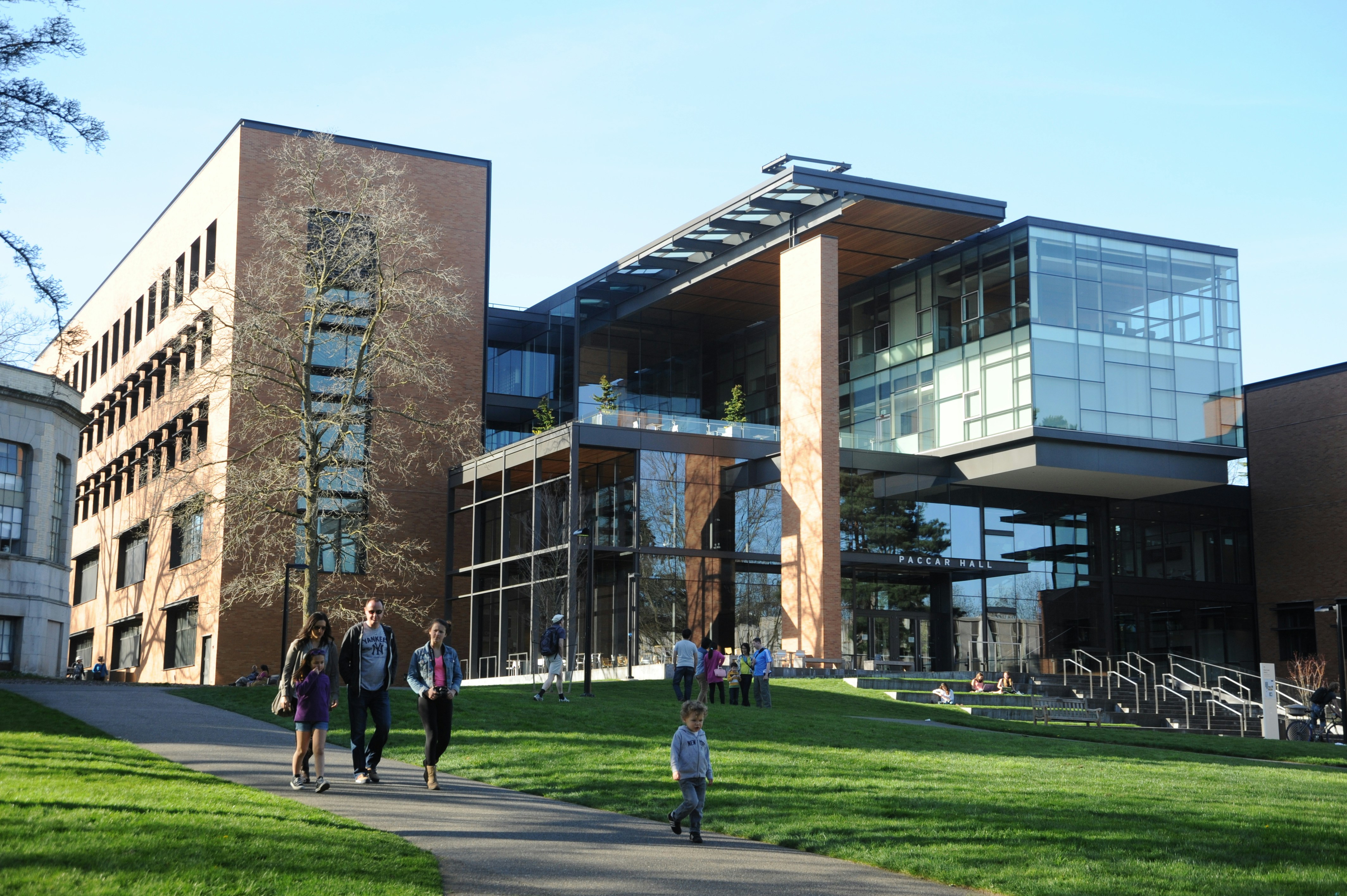
Office, customer service and tech-support jobs can give you experience that is useful for future internships and graduate roles. Common positions include administrative assistant, receptionist, customer service agent, helpdesk assistant and entry-level technical support.
| What to Know | Why It Matters |
|---|---|
| Good for your CV | You can build communication, digital and problem-solving skills that are useful for future internships and graduate jobs. |
| Languages can be an advantage | Some Dublin customer-support roles look for multilingual staff, so your first language may actually help you stand out. |
| Less flexible than retail | Office and support roles may follow fixed weekday or shift patterns, so check that they fit around your lectures. |
Important: The trade-off is flexibility. Some office and customer-support positions follow fixed weekday or shift patterns, so always check that the working hours fit your lectures before applying. A role described as “part-time” is not automatically suitable for a Stamp 2 student: for example, some current Dublin part-time customer-service jobs advertise 30 hours per week, which would exceed the 20-hour term-time limit for Stamp 2 students.

Part-time jobs in Dublin city centre for students
Dublin city centre puts several major student job areas within walking distance of each other. Grafton Street and Henry Street are strong for retail, while Temple Bar has more hospitality and tourism-related employers. Grafton Street and Henry Street are the city’s two main pedestrianised shopping streets, while Temple Bar has a particularly high concentration of pubs, restaurants and tourism-related businesses. For students studying at Trinity College Dublin or TU Dublin’s city-centre campuses, many of these job areas are also within walking distance of classes.
Grafton Street & St Stephen’s Green
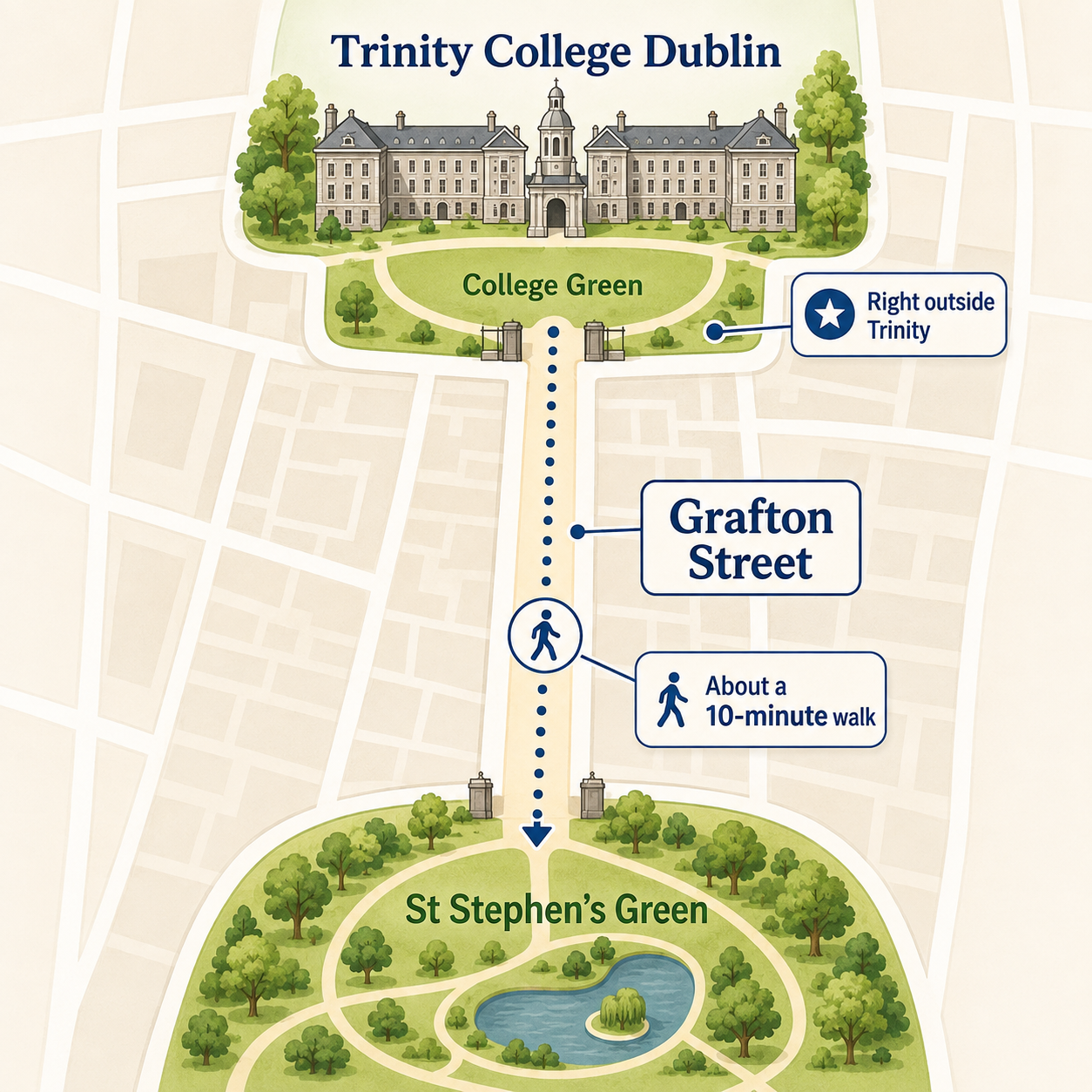
Grafton Street and St Stephen’s Green are especially useful for students looking for retail, café and customer-facing jobs. The area has a high concentration of shops, department stores, cafés and restaurants, so you can check several potential employers without travelling across Dublin. For Trinity College Dublin students, it is particularly convenient: Trinity is less than a ten-minute walk from Grafton Street and St Stephen’s Green.
One walk along the area lets you check several retail and hospitality employers without travelling across the city.
Henry Street & O’Connell Street
Henry Street and O’Connell Street are other strong areas for part-time jobs in Dublin city centre for students, particularly if you are looking for entry-level retail, food service, or customer service roles. The area includes major shopping centres, high-street retailers, cafés and restaurants.
Compared with Grafton Street, this area can be particularly useful if you want to target larger chain employers rather than smaller boutiques. For students with limited work experience, larger employers may also be worth checking because they often recruit for clearly defined roles such as sales assistant, cashier, stock assistant or food-service staff.
Temple Bar
Temple Bar is best suited to students looking for hospitality work. Pubs, restaurants, cafés and tourism-related venues create opportunities for waitstaff, bar staff, kitchen porters and other service roles, while evening and weekend shifts can fit around daytime lectures.
The main thing to check here is not just whether a job is part-time, but when the shift finishes. Hospitality work in Temple Bar can run later than retail jobs, so you should consider late-night transport and the journey back to your accommodation before accepting regular closing shifts.

Around city-centre university campuses
A job near campus does not have to be an on-campus job. Cafés, shops, restaurants and service businesses around city-centre universities can be just as convenient, especially if you want to work before or after lectures without adding a long commute.
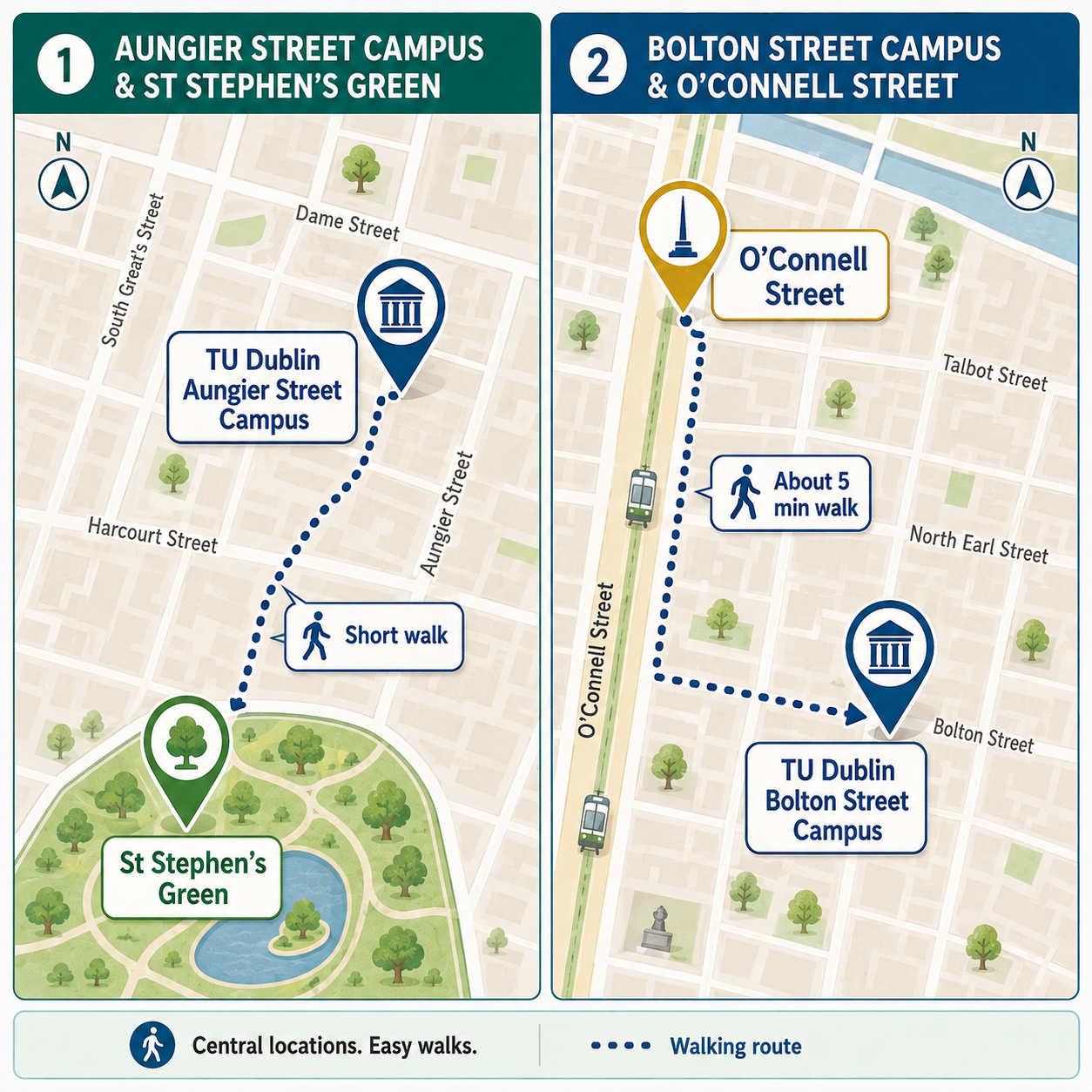
Trinity College Dublin sits in the heart of the city centre and is within walking distance of Grafton Street and St Stephen’s Green. TU Dublin’s Aungier Street campus is also a short walk from St Stephen’s Green, while its Bolton Street campus is only about five minutes from O’Connell Street.
For students, commute time is part of the job. A slightly lower-paying role ten minutes from campus may be more practical than a job that requires an extra hour of travel each day, especially during busy teaching weeks.
How much do student part-time jobs pay in Dublin?
Student part-time jobs in Dublin typically pay between €14.15 and €20.00 per hour. From 1 January 2026, the national minimum wage is €14.15 per hour for workers aged 20 and over. Lower statutory rates apply to younger workers: €12.74 for 19-year-olds, €11.32 for 18-year-olds and €9.91 for workers under 18.
| Job Type | 2026 Dublin Pay Snapshot | Source |
|---|---|---|
| Barista | €14.96/hour average | Indeed Dublin salary data |
| Retail Assistant | €14.65/hour | Current Primark Dublin vacancy |
| Customer Service | €14.50/hour | Current part-time Dublin vacancy |
| Reception / Administration | €14.50–€15.00/hour | Current Dublin vacancy |
| Higher-paying retail roles | €16.20–€17.90/hour | Current Aldi vacancy |
These figures show why there is no single “student wage” in Dublin. Many entry-level jobs sit close to the minimum wage, while experience, specialist skills and the employer can push hourly pay higher.
How much can you earn working 20 hours a week?
For many international students on Stamp 2, 20 hours is the maximum they can work during term time. So what does that actually mean in euros?
At the 2026 minimum wage of €14.15 per hour, a student aged 20 or over working the full 20 hours would earn about €283 per week, or roughly €1,226 per month before tax. At around Dublin’s current average barista rate of €14.96, the same 20 hours would produce about €299 per week or €1,297 per month.
| Hourly Pay | 20 Hours/Week | Average Monthly Gross Income | Pay Reference |
|---|---|---|---|
| €14.15 | €283 | ≈ €1,226 | 2026 National Minimum Wage (Age 20+) |
| €14.50 | €290 | ≈ €1,257 | Entry-level job example |
| €14.96 | €299 | ≈ €1,297 | Dublin barista average |
| €16.20 | €324 | ≈ €1,404 | Higher-paying retail example |
| €17.90 | €358 | ≈ €1,551 | Higher-paying retail example |
Every €1/hour makes a difference: at 20 hours a week, an extra €1 per hour is worth about €87 more per month before tax.
Which student part-time job is right for you?
Pay is only one factor when choosing a part-time job in Dublin. Working hours, location, commute time and the experience you can gain also matter. The comparison below brings these factors together, so you can see which job type best fits your timetable, skills and priorities.
Hospitality and retail are usually the easiest places to start if you want flexible shifts or have little experience. On-campus jobs can save commuting time, while office and tech roles may offer more useful experience for your future career. The best choice is the job that balances pay, hours and location without getting in the way of your studies.
| Job Type | Pay Snapshot | Flexibility | Best Places to Look | Best If You… |
|---|---|---|---|---|
| Hospitality | ≈ €14.15–€15+/hr | ⭐⭐⭐ High | Temple Bar, Grafton Street, St Stephen’s Green | Want evening/weekend shifts or have little experience |
| Retail | ≈ €14.15–€17.90/hr | ⭐⭐⭐ High | Grafton Street, Henry Street, O’Connell Street | Want entry-level work and regular customer contact |
| On-Campus Jobs | ≈ €14.15–€15.30/hr* | ⭐⭐ Medium–High | Your university campus | Want work close to lectures and less commuting |
| Office & Customer Service | ≈ €14.50–€16+/hr | ⭐⭐ Medium | Dublin city centre and office areas | Want experience that can strengthen your CV |
| Tech Support | Varies; skilled roles may pay more | ⭐ Low–Medium | Office-based or hybrid roles across Dublin | Have strong digital, IT or problem-solving skills |
Where to find part-time jobs in Dublin, Ireland, for students?
University portals are useful for student-focused roles, job websites offer the widest choice, and some cafés, restaurants and shops still accept CVs in person.
University career portals
Your university career portal should be one of the first places you check. These platforms often include part-time, campus and term-time jobs aimed directly at students, so you may spend less time filtering out unsuitable full-time roles.
Trinity College Dublin uses MyCareer, where students can search part-time and on-campus jobs and set alerts for new vacancies. UCD and TU Dublin use Careers Connect, while TU Dublin also provides a dedicated Part Time-Summer Work resource. DCU has a real-time Job Alerts Board for its students.
Do not only check these portals once at the start of term. New vacancies appear throughout the semester, so setting alerts can help you see suitable jobs before you remember to search again.
Student job websites
For a wider search, use job websites such as PartTime.ie, Indeed, Jobs.ie and IrishJobs. PartTime.ie focuses on flexible and part-time work, while larger platforms such as Indeed cover a much wider range of employers and job types. Trinity Careers Service also recommends Jobs.ie and IrishJobs.ie as places students can search for work.
The key is to search more specifically than just “part-time jobs Dublin”. Try terms such as “part time 20 hours Dublin”, “weekend jobs Dublin”, “retail assistant part time Dublin” or “barista part time Dublin”. This is especially useful for Stamp 2 students because some jobs labelled “part-time” still require 25 or 30 hours a week.

Walk in with your CV
Some Dublin cafés, bars, restaurants and shops still accept CVs in person. Trinity College Dublin also specifically advises students that visiting supermarkets, shops, cafés, bars and restaurants to ask about vacancies is common practice.
Instead of walking around Dublin at random, turn your search into a route. Use the city-centre map above and choose one area — for example Grafton Street and St Stephen’s Green, Henry Street, or Temple Bar — where you can visit several potential employers in one trip.
Try to visit cafés and restaurants outside their busiest meal times. Ask politely whether they are hiring and whether you can leave your CV. If a large chain tells you to apply online, note the company and complete the application later that day.
How to get a part-time job in Dublin with no experience?
To get a part-time job in Dublin with no experience, target entry-level sectors like hospitality, retail, and supermarkets that offer full training. For many entry-level retail, hospitality and customer-service roles, availability, communication and reliability matter too. For many entry-level retail, hospitality and customer-service roles, your availability, communication skills and reliability can matter just as much.
Make your CV easy to scan
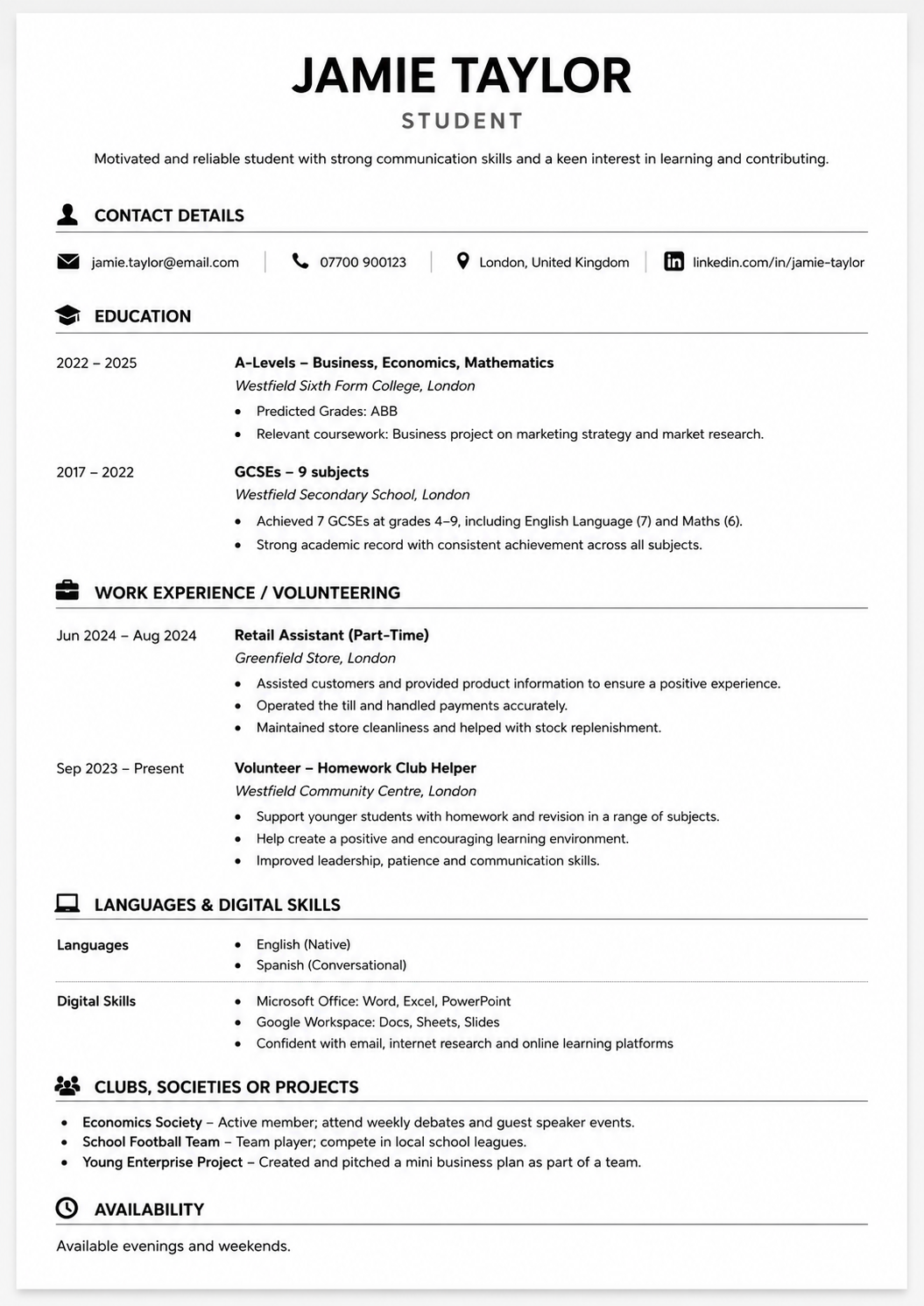
Keep your CV clear, short and relevant to the job. Trinity College Dublin recommends keeping a CV to no more than two A4 pages, using concise wording and tailoring it to the employer. UCD also recommends short bullet points, action verbs and avoiding large blocks of text.
If you have little formal work experience, include volunteering, university societies, group projects, languages and digital skills. These can still show teamwork, communication, organisation and responsibility.
Show skills, not just work experience
No experience does not mean no useful skills. Think about what you have already done at university, in school or outside the classroom. A group project can show teamwork, helping at a student society can show organisation, and speaking more than one language can be useful in Dublin’s customer-service market.
Trinity Careers specifically encourages students to include part-time work, volunteering, clubs and societies when showing transferable skills to employers.
Is a part-time job enough to cover student living costs in Dublin?
No, a part-time job is usually not enough to cover all student living costs in Dublin, but it can help pay for food, transport and part of your rent. If you are aged 20 or over and earn Ireland’s 2026 minimum wage of €14.15 per hour, working 20 hours a week would give you about €1,226 per month before tax.
Trinity College Dublin estimates international student living costs at around €1,661–€2,421 per month, depending mainly on accommodation and lifestyle.
At minimum wage, working the full 20 hours every week would therefore cover only about 51%–74% of Trinity’s estimated living costs, even before tax.
Where does your student budget go in Dublin?
Student living costs in Dublin cover much more than rent. For a broader breakdown, see our guide to the cost of living in Dublin. The latest detailed survey shows that a one-adult household spent an average of €71.30 per week on food and €44.06 on fuel and light. Dublin students can also keep public transport costs lower with a Student or Young Adult Leap Card, with Zone 1 travel capped at €12 per week or €48 per month.
| Cost | Official Benchmark | Approx. Monthly Cost |
|---|---|---|
| Food | €71.30/week | ≈ €309/month |
| Fuel & Light | €44.06/week | ≈ €191/month |
| Clothing & Footwear | €14.80/week | ≈ €64/month |
| Public Transport | Student Zone 1 cap €12/week | Up to €48/month |
| Private Rent in Dublin | €2,232/month average new tenancy | €2,232/month* |
Accommodation is one of the biggest parts of a student budget in Dublin. Trinity’s current estimates range from about €7,227 per year for Trinity Hall to €13,200–€16,000 for PBSA, while other city-centre accommodation is estimated at around €9,000–€13,000 per year.
Current student accommodation in Dublin on uhomes.com starts from around €155 per week, while average prices vary widely by room type. Shared rooms average about €252/week, en-suites around €299/week, and studios around €445/week. Many properties on uhomes.com also include utility bills such as water, electricity and heating, which makes monthly spending easier to predict. Some residences offer extra perks such as free laundry, social events or other included services, helping you reduce everyday costs further.
Conclusion
Student part-time jobs in Dublin can be a useful way to earn extra money, gain local experience and build skills while studying. Retail, hospitality, on-campus and customer-service roles are all common options, but the best job depends on your timetable, work permission, experience and how far you need to travel.
For international students, part-time income should be treated as support rather than your full living budget. Check the hours carefully, compare pay with commuting time, and plan accommodation costs early. A job that fits around your classes and reduces everyday costs is often more valuable than simply choosing the highest hourly rate.
FAQ
Student part-time jobs in Dublin typically pay around €14.15–€16 per hour, although some roles pay more. Ireland’s 2026 minimum wage is €14.15/hour for workers aged 20+; current Dublin examples include Primark retail assistants at €14.65/hour, while Indeed reports an average Dublin barista wage of about €14.96/hour.
International students with Stamp 2 can work up to 20 hours per week during term time and 40 hours per week during permitted holidays. The 40-hour periods are June to September and 15 December to 15 January. EU/EEA/Swiss and UK students are not subject to this Stamp 2 student-hours limit.
Stamp 2 students can have more than one part-time job in Dublin, but their total working hours must stay within the Stamp 2 limit. During term time, that means your combined hours across all jobs should not exceed 20 hours per week. Revenue also allows employees to have multiple jobs and split tax credits between them.
Students do pay tax on part-time jobs in Ireland under the same PAYE system as other employees. Being a student does not automatically make your wages tax-free; the amount you actually pay depends on your earnings and tax credits.
You do not need a PPS Number simply to apply for a part-time job in Dublin, but you will need one for normal tax and payroll registration when you start working. If it is your first job in Ireland, register it with Revenue as soon as possible; otherwise, you may be charged Emergency Tax.
Stamp 2 students cannot normally do freelance or self-employed work in Ireland. Stamp 2 permits casual employment but explicitly states that students must not engage in business or trade, so be careful with freelance tutoring, gig work or other roles where you would be working as self-employed.
The best time to look for a part-time job in Dublin is before the September rush and then regularly throughout the semester. Trinity warns that September is particularly competitive because thousands of students return to Dublin at the same time. Seasonal employers also recruit early: for example, Primark was advertising September-to-January Dublin roles in August 2026.
Tips cannot be used to make up your minimum contractual wage in Dublin. Employers must pay your normal wage separately, while electronic tips and gratuities must be distributed fairly to workers under Irish law.