


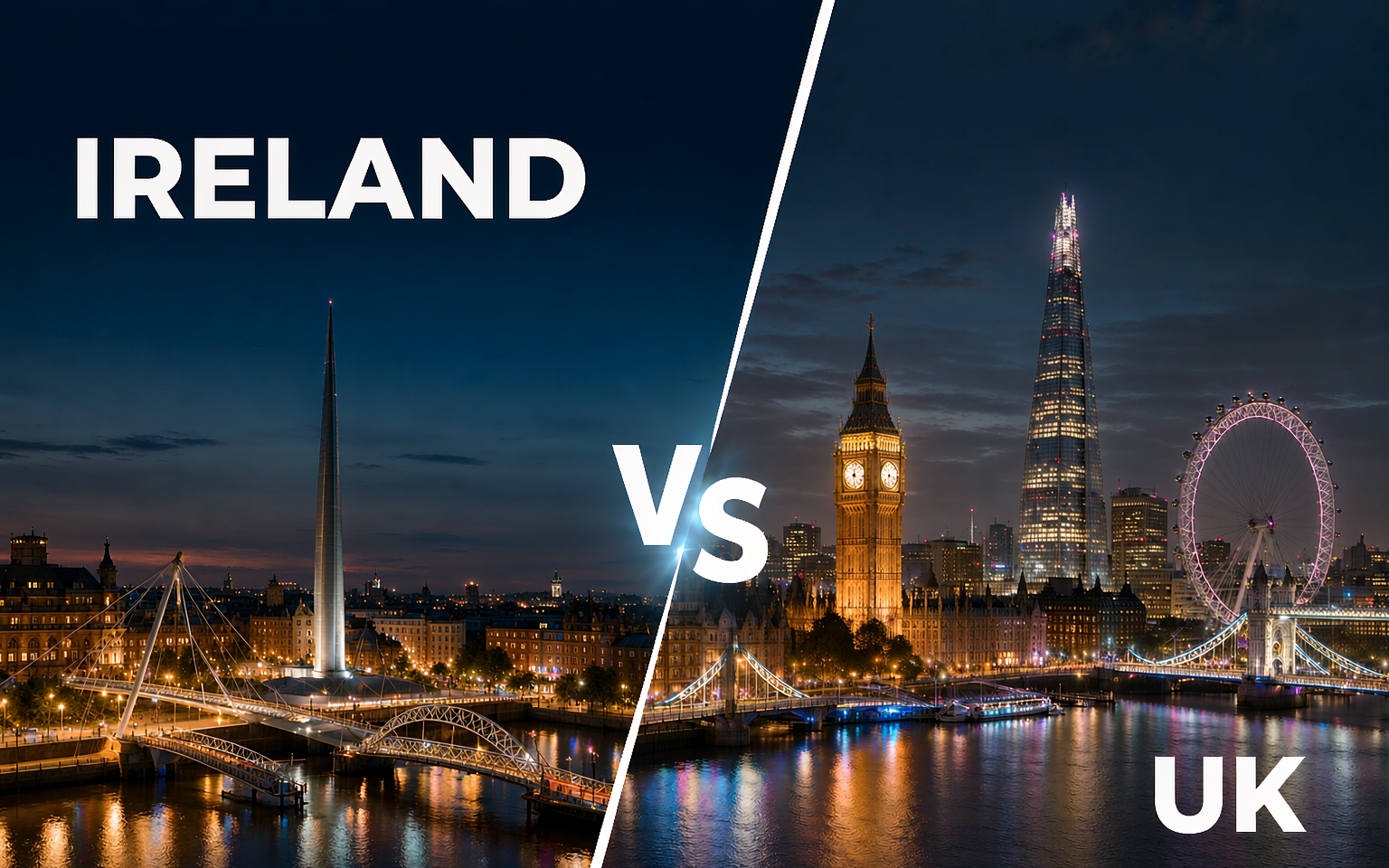
Ireland vs UK is a common comparison for people planning to live, study, or work abroad. Although the two countries share close historical and cultural ties, they differ in living costs, population, career opportunities, education, infrastructure, utilities, telecommunications, safety, climate, healthcare and lifestyle. This guide compares these key areas to help you understand the differences between Ireland and the UK and choose the country that best suits your needs.
Ireland vs UK: An Overview
The UK and Ireland are adjacent nations that have long had close historical, cultural and economic ties, however, they differ in respect to their political system, population size, currency and international status. The UK is comprised of England, Scotland, Wales and Northern Ireland; whereas Ireland is an independent nation and is a part of the European Union. In the following table you will find the main differences in the comparison of Ireland vs UK.
| Category | United Kingdom (UK) | Republic of Ireland |
|---|---|---|
| Capital | London | Dublin |
| Political System | Constitutional monarchy and parliamentary democracy | Parliamentary republic |
| Land Area | 243,610 km² | 70,280 km² |
| Population | 69.5 million | 5.5 million |
| Currency | Pound sterling (£) | Euro (€) |
| Main and Official Languages | English is the main language; Welsh, Scottish Gaelic and Irish are also recognised or used regionally | Irish and English are official languages |
| European Union Status | Not an EU member; left the EU in 2020 | EU member and part of the Eurozone |
| Economy and Employment | Larger, more diversified economy, with major sectors including finance, technology, healthcare, manufacturing and creative industries | Strong presence of multinational companies, particularly in technology, pharmaceuticals, medical devices and financial services |
| Cost of Living | Varies widely by region; London is particularly expensive | Generally higher than the UK average, although Dublin can be less expensive than London |
| Healthcare System | NHS across Great Britain; Northern Ireland operates its own Health and Social Care system | Public and private healthcare managed through a mixed system |
| Transport | Extensive rail and urban transport networks, particularly in major cities | Established transport links between major cities, with more limited public transport in some rural areas |
| Climate and Landscape | Varied landscapes and regional climates, from the Scottish Highlands to southern England | Atlantic-influenced climate, green countryside and a rugged western coastline |
| Common Travel Area (CTA) | British citizens have reciprocal residence and work rights in Ireland under the CTA | Irish citizens have reciprocal residence and work rights in the UK under the CTA |
Ireland differs from the United Kingdom economically because of its distinct economic profile, while maintaining close connections with the UK through trade, travel and historical ties. However, the two countries share many similarities as destinations for living, working and studying. When comparing Ireland vs UK, the most important differences include employment opportunities, housing costs, access to healthcare and the availability of public transportation. These factors can help international students and professionals evaluate Ireland vs UK which is better for their individual needs.
Ireland vs UK: Cost of Living
Ireland is generally 3% to 15% more expensive to live in than the United Kingdom overall. Cost of living in Ireland is estimated at around €1,997 per month, while cost of living in the UK is around £1,652 per month. Ireland has higher accommodation, public transport and gym membership costs, whereas the UK has higher basic utility expenses. A city-centre one-bedroom apartment costs around €1,575 per month in Ireland, compared with £1,189 in the UK. A monthly public transport pass averages €94 in Ireland and £87 in the UK, while an inexpensive restaurant meal costs around €19 in Ireland and £19 in the UK. Actual expenses vary by city and lifestyle.
Average Cost of Living in Ireland vs UK
| Cost Category | Ireland | United Kingdom |
|---|---|---|
| Accommodation Costs | Around €1,575/month for a city-centre one-bedroom apartment | Around £1,189/month for a city-centre one-bedroom apartment |
| Public Transportation | Around €94/month for a transport pass | Around £87/month for a transport pass |
| Restaurants & Dining | Around €19 for an inexpensive restaurant meal | Around £19 for an inexpensive restaurant meal |
| Utilities & Internet | Around €212/month for basic utilities, plus €48/month for broadband | Around £280/month for basic utilities, plus £37/month for broadband |
| Fitness & Leisure | Around €49/month for a gym membership | Around £40/month for a gym membership |
Actual expenses vary by city, accommodation type and lifestyle. These estimates exclude other costs such as groceries, healthcare and personal spending, so they should be treated as a starting point for international students planning their budgets.
Housing Costs
Student accommodation prices vary across Ireland and the UK. Based on student accommodation prices listed on uhomes.com, weekly rents start at €136 in Dublin, €165 in Cork and €165 in Galway. Students looking for student accommodation in Ireland can compare options across these cities. In the UK, weekly rents start at £130 in London, £140 in Manchester and £128 in Edinburgh. Students can also explore student accommodation in UK to compare housing options. Actual costs vary by room type, property and rental arrangement.
| Ireland | UK |
|---|---|
| Dublin: From €136/week | London: From £130/week |
| Cork: From €165/week | Manchester: From £140/week |
| Galway: From €165/week | Edinburgh: From £128/week |
Bills are another important consideration when comparing student accommodation in Ireland and the UK. Most student accommodation in London listed on uhomes.com is all-inclusive, meaning utility and internet costs are covered by the rent at these properties. Many properties in Dublin also offer all-inclusive rental options, helping students manage their budgets without calculating every household bill separately. Students can explore student accommodation in Dublin, student accommodation in Cork to compare options across Ireland. Before booking, check which bills are included, as coverage varies by property. Comparing the total cost of accommodation, rather than rent alone, can help you make a more informed decision.
For students planning to study in the UK, uhomes.com offers a wide selection of student accommodation in London, from private studios to en-suite rooms in shared student residences. If you are looking for alternatives to the capital, student accommodation in Manchester and student accommodation in Edinburgh are also worth exploring. Each city offers different housing options to suit a range of budgets, study locations and living preferences. When comparing properties, consider the weekly rent, room type, distance to your university and whether utilities, heating and Wi-Fi are included. Choosing accommodation with bills included can make budgeting easier and help you estimate your total living expenses before moving to the UK.
Ireland vs UK: Population and Demographics
The United Kingdom has a population of approximately 69.5–70.1 million people across 243,610 km², while the Republic of Ireland has around 5.4–5.5 million people across 70,280 km². Although the UK is much larger in both population and land area, Ireland has a younger population and a higher annual population growth rate. In the Ireland vs UK comparison, the two countries also differ in population density, urbanisation, fertility rates, and ethnic composition.
Population and Size
The UK has approximately 69.5 million residents, compared with around 5.48 million in the Republic of Ireland. The UK covers about 243,610 km², making it roughly 3.5 times larger in land area and more than 12 times larger in population than Ireland. Population density is also higher in the UK, at approximately 285 people per km², compared with around 78 people per km² in Ireland.
Age and Population Growth
Ireland has a younger population and a faster annual population growth rate than the United Kingdom. The median age in Ireland is approximately 37.8 years, compared with 40.6 years in the UK. Ireland’s annual population growth rate is also higher, at around 0.97%, compared with 0.48% in the UK. These demographic differences are useful to consider when comparing Ireland vs United Kingdom, particularly for those assessing long-term living prospects, workforce trends and opportunities for international students.
Life Expectancy and Fertility
Both countries have high life expectancy, generally exceeding 80 years. Life expectancy is approximately 81.5 years in Ireland and 81.3 years in the UK. Ireland’s total fertility rate is around 1.93 children per woman, compared with 1.86 in the UK, indicating a slightly higher fertility rate in Ireland.
Urbanisation and Major Cities
The UK has a more urbanised population than Ireland. Approximately 84.2% of the UK’s population lives in urban areas, compared with 63.9% in Ireland. London, Manchester, Birmingham and Glasgow are among the UK’s major urban centres, while Dublin is Ireland’s largest city and its main population hub. Ireland’s lower urbanisation rate reflects a greater proportion of people living outside major urban areas. When comparing UK vs Ireland, these differences in population distribution can help explain variations in access to employment, education, transport and other urban services.
Ethnic Composition
Both countries have diverse populations, although their demographic profiles differ. Approximately 87.2% of the United Kingdom’s total population is White, while around 82.2% of Ireland’s population identifies as Irish. Additionally, about 9.5% of Ireland’s population belongs to other White ethnic groups.
Generally, the United Kingdom has a much larger population, a greater land area and a higher level of urbanisation than the Republic of Ireland. Ireland has a younger population and a higher annual population growth rate. Both countries have high life expectancy and diverse communities, but they differ in population density, age structure and settlement patterns. When comparing Ireland vs UK which is better, these demographic differences can help readers understand the living environments and community characteristics of each country.
Ireland vs UK: Economy and Career Opportunities
The UK has a larger and more diversified economy, with strong employment opportunities in finance, technology, healthcare, engineering and creative industries. Ireland has a smaller economy but excels in technology, pharmaceuticals, biotechnology and financial services, supported by major multinational companies. When comparing Ireland vs UK salary levels, median annual earnings are approximately €46,305 in Ireland, while median gross annual earnings for full-time employees in the UK are around £39,039. Career prospects and earning potential vary by industry, experience and location.
Economic Overview
The UK economy spans financial services, technology, manufacturing, healthcare, education and creative industries. London is a major global business centre, while Manchester, Birmingham and Edinburgh support regional employment and investment. Ireland’s economy is strongly influenced by multinational companies, particularly in technology, pharmaceuticals and medical devices. Because multinational activities can significantly affect its GDP, Ireland also uses modified gross national income (GNI*) to assess underlying domestic economic activity. These differences are important when comparing Ireland vs UK salary levels and career prospects, as earning potential and job availability vary across industries and locations.

Job Opportunities in Ireland
Ireland offers strong career opportunities in technology, pharmaceuticals, biotechnology, medical devices and financial services. Major employers include Google, Meta, Apple, Microsoft, Pfizer and Johnson & Johnson, with Dublin serving as an important base for international technology and business operations. Cork and Galway also have established pharmaceutical and medical technology industries.
Median annual earnings across all sectors in Ireland are approximately €46,305. The Information and Communication sector records median annual earnings of around €83,329, while Financial, Insurance and Real Estate records approximately €62,031. These figures highlight the earning potential of specialised industries, although individual salaries vary by role and experience.
Job Opportunities in the UK
The UK offers a broader employment market across finance, fintech, technology, healthcare, engineering, manufacturing and creative industries. Major employers include HSBC, Barclays, AstraZeneca, GSK, Rolls-Royce and the NHS. London is particularly important for finance, legal services and international business, while Manchester has a strong presence in digital and professional services. Birmingham offers opportunities in engineering and manufacturing, and Edinburgh is known for financial services and technology.
Median gross annual earnings for full-time employees in the UK are approximately £39,039. Salaries vary significantly by occupation and region, with specialised professional roles often offering higher pay. The UK’s larger economy provides access to a wider range of employers and career paths, while Ireland can be particularly attractive to professionals targeting multinational technology and pharmaceutical companies.
On balance, the UK offers a broader job market and more diverse career paths, while Ireland stands out in technology and pharmaceuticals. The right choice hinges on your industry, salary expectations and living costs, which are key factors to consider when comparing Ireland vs UK salary levels and career opportunities.
Ireland vs UK: Education Systems
Ireland and the UK both offer internationally recognised education and highly ranked universities, but they differ in school curricula, degree length and tuition costs. Ireland has strong programmes in technology, pharmaceuticals and business, while the UK offers a wider range of universities and specialist degrees.
Education System in Ireland
Ireland’s education system includes primary, secondary and higher education.
- Primary and Secondary Education: Primary school typically lasts eight years. Secondary education consists of the Junior Cycle and Senior Cycle, with students usually completing the Leaving Certificate before university. Transition Year is an optional programme between the two cycles.
- Top Universities and Rankings: Trinity College Dublin ranks 75th and University College Dublin ranks 100th in the QS World University Rankings 2027. Trinity is known for humanities, law, business and health sciences, while UCD has strengths in business, engineering and life sciences.
- Degree Duration: Bachelor’s degrees generally take three to four years, while master’s programmes typically last one to two years.
- Tuition Fees for International Students: Annual undergraduate tuition varies by subject:
- Business: €10,300–€29,000
- Engineering and Science: €14,500–€28,500
- Medicine and Health Sciences: €50,135–€62,500
Education System in the UK
The UK’s education system differs across England, Scotland, Wales and Northern Ireland, as each nation manages its own education policies.
- Primary and Secondary Education: In England, students generally progress from primary school to secondary school and take GCSE examinations at around age 16, followed by A-levels or vocational qualifications. Scotland uses the Curriculum for Excellence and qualifications such as National 5s and Highers. Wales and Northern Ireland have their own curricula and assessment arrangements.
- Top Universities and Rankings: In the QS World University Rankings 2027:
- Academic Strengths: Imperial specialises in engineering, medicine and technology. Oxford and Cambridge offer broad strengths in science, humanities and social sciences, while UCL is recognised for medicine, architecture and education.
- Degree Duration: Bachelor’s degrees usually take three years in England, Wales and Northern Ireland, and four years in Scotland. Taught master’s programmes generally take one year.
- Tuition Fees for International Students: Fees vary by university and subject. In England, the standard tuition fee cap for eligible home students is £9,535 for full-time undergraduate courses. International students generally pay higher fees set by individual universities, so they should check course-specific tuition fees and scholarships.
In general, Ireland is worth considering for students interested in technology, pharmaceuticals and business, while the UK offers a wider range of universities and specialist subjects. When deciding UK or Ireland which is better for international students, comparing course content, tuition fees, university rankings and career opportunities can help students make an informed decision.
Ireland vs UK: Infrastructure and Transportation
Public Transport and Commuting
- Railway Networks: The UK connects major cities through extensive intercity and commuter rail services. Ireland has a smaller network, with trains connecting Dublin to cities such as Cork, Galway and Limerick.
- Urban Public Transport: London has the Underground, Elizabeth line and Overground, while cities such as Manchester and Nottingham operate tram systems. Dublin relies on buses, DART commuter rail and the two-line Luas tram network. MetroLink is planned but is not yet operational.
- Commuting Costs: In Dublin, an adult using a TFI Leap Card pays €2 for an eligible 90-minute journey within Zone 1, with a daily cap of €6 and weekly cap of €24. In London, buses and trams cost £1.75 per journey, with a daily cap of £5.25 and weekly cap of £24.70. A single Tube journey in Zone 1 costs £3.10 at peak times or £3.00 off-peak. London bus and tram fares are scheduled to rise on 1 November 2026.
- Rural Connectivity: The UK generally offers more rail connections between major cities. Ireland has intercity trains, coaches and local rural bus services, but a car can be more practical in areas with limited public transport.
Roads, Rural Connectivity and Essential Infrastructure
- Roads and Motorways: Both countries have extensive road networks. Ireland’s standard car toll is €2.30 on the M1 and €1.80 at each toll plaza on the M3 Clonee–Kells motorway.
- Rural Driving: Irish rural roads can be narrow and winding, often bordered by hedges or stone walls. The UK also has narrow country lanes, and driving may be necessary in areas with limited public transport.
- Road Rules: The Republic of Ireland uses kilometres per hour and generally bilingual Irish-English signs. Great Britain and Northern Ireland use miles per hour, with signs predominantly in English.
- Walking and Cycling: The UK has an established public footpath and rights-of-way network, while Ireland offers walking trails and greenways. Access varies by region.
- Essential Infrastructure and Investment: Both countries maintain water, wastewater and electricity networks that require ongoing upgrades. Ireland’s National Development Plan commits €275.4 billion to public capital investment from 2026 to 2035, while the UK’s 10-year infrastructure strategy is backed by at least £725 billion. These totals cover different investment categories and are not directly comparable as transport budgets.
Overall, the UK generally offers more public transport options, particularly in major cities, while Ireland provides modern road connections between key destinations. For those asking Ireland vs UK which is better, comparing local fares, rail access, road conditions and the infrastructure available in your intended place of residence can help you make an informed decision.
Ireland vs UK: Energy and Utility Systems
Ireland and the UK share the same standard 230V/50Hz electricity supply and Type G plug, but differ in energy sources, household tariffs and heating systems. Both are expanding renewable energy, particularly wind power, while natural gas remains an important electricity source. Energy imports, grid investment and heating needs all influence household utility costs. When comparing Ireland vs United Kingdom in terms of living expenses, these differences can help explain variations in monthly electricity and heating bills.
Electricity Prices and Household Utility Costs
- Ireland: Electricity is generated mainly from natural gas, wind and imported power. Household bills vary by supplier, tariff and consumption, with wholesale energy prices and grid investment also affecting costs.
- Great Britain: Ofgem’s energy price cap limits unit rates and standing charges on eligible default tariffs in England, Scotland and Wales. A typical dual-fuel household paying by direct debit has an annual price cap of £1,723. Actual bills vary with energy use.
- Northern Ireland: Northern Ireland has a separate retail energy market and regulator. Its tariffs differ from those in Great Britain and the Republic of Ireland, so residents should compare local supplier prices.
Energy Sources, Renewables and Energy Security
- Electricity Generation: In Ireland, natural gas accounted for 47% of electricity generation, while wind contributed 40%. In Great Britain, renewables and nuclear power together accounted for 73.3% of electricity generation.
- Renewable Energy: Both countries are expanding wind and solar power. Ireland relies heavily on wind, while the UK benefits from extensive offshore wind farms and a broader mix of low-carbon electricity sources.
- Energy Imports and Grid Connections: Ireland imports 78.2% of its total energy requirement, and imports supply 82.3% of its natural gas. Electricity interconnectors connect the island of Ireland with Great Britain, allowing power to flow between markets.
- Electricity Markets: Ireland and Northern Ireland share a wholesale electricity market but have separate retail arrangements. Great Britain has its own market, with Ofgem regulating eligible default tariffs in England, Scotland and Wales.
Heating Systems and Household Utilities
- Heating Fuel Choices: Natural gas and electricity are widely used for heating in Ireland and Great Britain. In Northern Ireland, around 63% of households use heating oil as their primary central heating fuel.
- Impact on Household Budgets: Electricity and gas prices, heating fuel, home insulation and energy consumption all affect utility bills. Comparing a property’s heating system and estimated annual energy use gives a clearer picture of costs than unit prices alone.
- Future Energy Infrastructure: Both countries are investing in renewable generation and grid upgrades. Ireland faces additional pressure from rising electricity demand, including data centres, while new generation capacity and interconnectors can help improve supply flexibility.
Broadly speaking, both countries are moving towards cleaner electricity, but differ in energy imports, retail regulation and heating choices. When comparing the United Kingdom vs Ireland, consider electricity and gas tariffs, home insulation and regional heating systems to better estimate household utility costs.
Ireland vs UK: Telecommunications
Ireland and the United Kingdom have distinct telecommunications markets, regulatory frameworks, and infrastructure timelines, though they share close cross-border ties. These differences are worth considering when comparing Ireland vs UK in terms of mobile coverage, broadband availability and telecommunications costs.
Mobile Networks and 5G Coverage
- Ireland: Major operators include Eir, Vodafone Ireland and Three Ireland. 4G and 5G services are available, but coverage varies between urban and rural areas.
- UK: Major operators include EE, Vodafone, O2 and Three UK. 5G coverage continues to expand, although signal strength varies by provider and location.
- Regulation: ComReg regulates telecommunications in Ireland, while Ofcom oversees the UK market.
Broadband and Infrastructure
- Ireland: The National Broadband Plan supports fibre rollout in underserved rural areas. Around 86% of premises have access to fibre-to-the-premises broadband, while 91% can access gigabit broadband.
- UK: Full-fibre broadband is available to around 78% of residential premises nationwide. Northern Ireland has particularly strong coverage, reaching approximately 95%.
- Mobile and Broadband Plans: Both countries offer prepaid and monthly mobile plans, alongside various broadband packages. Compare data allowances, contract costs and local coverage before choosing a provider.
- Network Modernisation: Both countries are moving away from traditional copper telephone networks towards digital services. Older landline-dependent equipment may require an alternative connection.
Overall, both countries offer expanding 5G and high-speed broadband services, although coverage varies by location. When considering Ireland vs United Kingdom, comparing mobile signal strength, fibre availability and monthly service costs can help you assess connectivity in your intended area.
Ireland vs UK: Safety and Security
Ireland and the UK are generally considered safe places to live and visit, although crime levels and personal safety vary by location. Ireland ranked 2nd in the Global Peace Index, compared with 30th for the UK. However, national rankings do not reflect every aspect of everyday safety, and conditions can differ between cities and neighbourhoods.
Crime Rates and Personal Safety
- Overall Crime: The UK records more crimes in total, partly because of its larger population. Per-capita rates and individual crime categories provide a more meaningful comparison.
- Violent Crime: Intentional homicide rates are relatively low in both countries. The figures provided are approximately 0.96 per 100,000 people in Ireland and 1.17 in the UK, although rates can vary by reporting period and statistical source.
- Urban Safety: Dublin, London and Belfast all experience opportunistic crimes such as pickpocketing and phone theft, particularly in busy shopping districts, transport hubs and tourist areas. Risks vary considerably by neighbourhood.
- Everyday Precautions: Stay aware of your surroundings, keep valuables secure and check local crime information when choosing accommodation or planning travel.
Natural Hazards and Environmental Risks
Both countries experience strong winds, heavy rainfall and flooding, which can disrupt transport and damage property. Flood risk varies by neighbourhood, especially near rivers, coastlines and areas with poor drainage. Ireland and the UK can also experience cold spells and occasional heatwaves. Check local weather warnings and flood-risk information when choosing where to live.
As a general rule, Ireland ranks higher than the UK in international peace assessments, but safety in either country is shaped by the specific location and circumstances. When comparing Ireland vs UK which is better, consider local crime patterns, neighbourhood conditions, transport routes and exposure to flooding or severe weather to make a more informed decision about where to live.
Ireland vs UK: Weather, Climate and Geography
Ireland generally has a wetter, more consistently Atlantic-influenced climate, while the UK experiences greater regional variation, with southern England often warmer and sunnier than Ireland and northern Scotland. Both countries have mild winters, cool summers and changeable weather due to their maritime climates. When comparing Ireland vs UK, these climate differences can influence daily life and outdoor activities. Their landscapes also differ in scale, with the UK offering a wider range of mountains, lowlands and urban regions, while Ireland is known for its green countryside, rugged western coastline and rolling hills. For those considering united kingdom vs ireland as a place to live, both countries offer distinctive natural environments and outdoor experiences.
Climate and Weather
- Temperature and Seasons: Both countries have relatively mild winters and cool summers. Western Ireland and western Britain are strongly influenced by Atlantic weather, while eastern England tends to experience warmer, drier summers and colder winter spells.
- Rainfall: Ireland receives approximately 1,205 mm of rainfall and around 182 rainy days annually, compared with about 953 mm and 156 rainy days in the UK. Rainfall varies significantly by region, with western and mountainous areas generally wetter.
- Sunshine: Annual sunshine averages approximately 1,351 hours in Ireland and 1,387 hours across the UK. Southern England is generally sunnier, while western Ireland and northern Scotland tend to receive less sunshine.
- Weather Risks: Both countries experience Atlantic windstorms, heavy rain and localised flooding. Flood exposure is higher in some coastal areas, river valleys and locations with drainage problems, so local risk information is worth checking before choosing a place to live.
Geography and Natural Landscapes
- Land Area and Location: The UK covers a larger area and includes England, Scotland, Wales and Northern Ireland. The island of Ireland contains the Republic of Ireland and Northern Ireland, which is part of the UK.
- Terrain: Ireland features rolling green countryside, central lowlands and rugged coastal landscapes, particularly along the west. The UK has more varied terrain, including the Scottish Highlands, Welsh mountains, English lowlands and extensive urban areas.
- Coastline and Rural Environment: Both countries have dramatic coastlines, walking trails and rural communities. Ireland is particularly known for its Atlantic cliffs and green landscapes, while the UK offers a broader range of scenery across its regions.
Generally, Ireland tends to be wetter and more consistently influenced by Atlantic weather, while the UK offers greater variation in climate and geography. When comparing Ireland vs UK, consider regional rainfall, sunshine, seasonal temperatures and local flood exposure, especially if you plan to live outside a major city.
Ireland vs UK: Healthcare Systems
The UK mainly provides tax-funded healthcare through the National Health Service (NHS), where GP consultations and most public hospital treatment are free at the point of use for eligible residents. Ireland operates a mixed public and private healthcare system through the Health Service Executive (HSE), and many patients pay for GP visits unless they qualify for a medical card or GP visit card. The two countries also differ in prescription charges, waiting times and the role of private health insurance.
Healthcare Systems in Ireland and the UK
- United Kingdom: The NHS provides publicly funded healthcare across England, Scotland and Wales, while Northern Ireland operates its own Health and Social Care (HSC) system. GP consultations are generally free for eligible patients, although some services and treatments may incur charges.
- Ireland: The HSE manages public healthcare, alongside private hospitals, clinics and health insurance providers. Access to free or subsidised services is determined by eligibility, with medical cards covering GP visits and many other services.
GP Visits and Prescription Costs
- GP Visits: In Ireland, a private GP consultation typically costs around €50–€60. Medical card and GP visit card holders can access GP services without paying consultation fees, and children under eight are eligible for free GP care. In the UK, GP consultations are generally free through the NHS for eligible patients.
- Prescription Charges: Prescriptions are free in Scotland, Wales and Northern Ireland. In England, many patients pay a standard charge per prescription item, unless exempt. In Ireland, the Drugs Payment Scheme limits the monthly cost of approved prescribed medicines to €80 per family.
- Out-of-Pocket Expenses: Ireland’s mixed system can result in higher direct costs for GP visits and some services. In the UK, patients may still pay for prescriptions in England, dental treatment, eye care and certain other services.
Waiting Times and Private Health Insurance
- Waiting Times: Both countries face pressure on public healthcare services, including delays for some specialist appointments and hospital procedures. Waiting times vary by treatment, hospital and region.
- Private Health Insurance: Private insurance is available in both countries and can provide additional treatment options or access to private facilities. In Ireland, it plays a particularly significant role in the mixed healthcare system, while in the UK some people use private care to seek alternatives to NHS waiting lists.
In general, the UK generally offers more comprehensive free access to GP consultations, while Ireland combines public healthcare with a larger role for direct payments and private insurance. When comparing UK vs Ireland, consider GP fees, prescription costs, eligibility for public healthcare and potential waiting times.
Ireland vs UK: Culture, Languages and Lifestyle
Ireland and the UK share close historical, geographical and linguistic ties, but differ in national identity, traditions and everyday lifestyles. Ireland is an independent republic and an EU member that uses the euro, while the UK is a constitutional monarchy comprising England, Scotland, Wales and Northern Ireland and uses the pound sterling. Ireland is often associated with traditional music, community gatherings and a strong connection to rural landscapes, while the UK offers a broader mix of regional cultures, large metropolitan centres and entertainment options.
Cultural Diversity, Traditions and Religion
- Languages: Ireland’s official languages are Irish (Gaeilge) and English, although English is more widely used in everyday communication. English is the UK’s dominant language, alongside regional and minority languages such as Welsh, Scottish Gaelic, Scots and Irish.
- Religion and Diversity: Christianity has influenced the history and traditions of both countries, but their populations have become more religiously diverse and include people with no religious affiliation. The UK has a larger and more diverse population, particularly in major cities such as London, Birmingham and Manchester.
- Social Customs: Irish social life is often associated with informal conversation, hospitality and community gatherings. British social customs vary across regions but are commonly associated with politeness, personal space and queuing etiquette.
- Traditions and Sports: Both countries have strong pub cultures, live music and popular sports such as football and rugby. Ireland also has distinctive Gaelic games, including Gaelic football and hurling, organised through the Gaelic Athletic Association (GAA).
Food and Dining Culture
- Traditional Food: Irish dishes include Irish stew, soda bread and colcannon. British food traditions include fish and chips, Sunday roast, Yorkshire pudding and regional specialities such as Scottish haggis and Welsh rarebit.
- Everyday Dining: Pubs play an important role in both countries, serving food and drinks as well as providing places to socialise. Tea, café culture and casual dining are also common.
- International Cuisine: Both countries offer diverse international food options, especially in larger cities. London’s dining scene is particularly extensive, while Dublin, Birmingham, Manchester and other cities also have restaurants serving cuisines from around the world.
Attractions, Entertainment and Outdoor Activities
- Museums and Landmarks: Ireland offers attractions such as Dublin’s museums, historic castles and archaeological sites. The UK has major cultural destinations including London’s museums, Edinburgh Castle, Cardiff Castle and historic sites across England, Scotland and Wales.
- Music and Nightlife: Live folk music and traditional pub sessions are important parts of Ireland’s cultural identity. The UK offers a broad entertainment scene, from West End theatre and large music venues to local pubs, clubs and festivals.
- Festivals and Events: St Patrick’s Day is a major cultural celebration in Ireland and is also widely observed in the UK. Both countries host music festivals, sporting events, seasonal markets and local cultural celebrations.
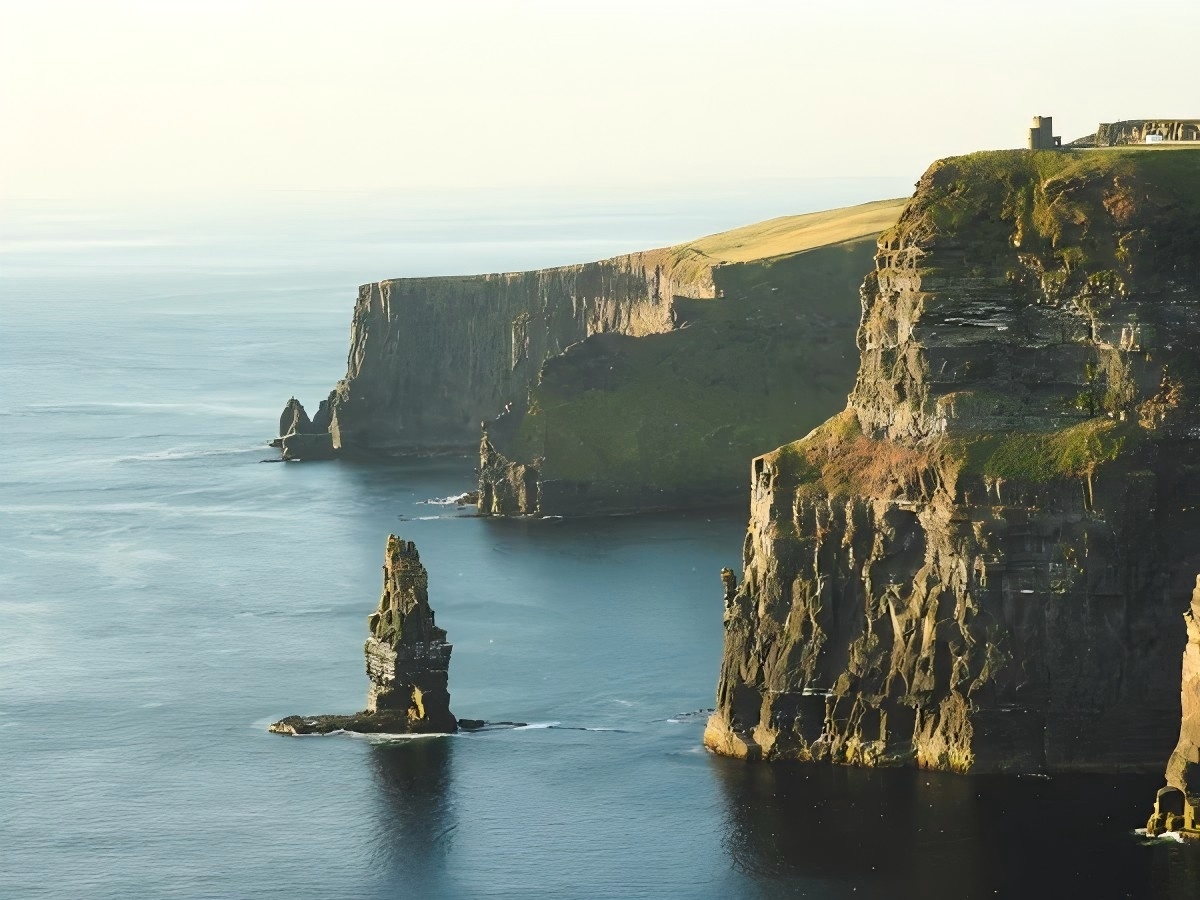
- Outdoor Activities: Ireland is known for the Cliffs of Moher, the Wild Atlantic Way and its green countryside. The UK offers a wide range of outdoor destinations, including the Scottish Highlands, the Lake District, Welsh national parks and coastal walking routes.
Overall, Ireland offers a strong sense of national identity, traditional music and access to rural landscapes, while the UK provides a wider variety of regional cultures, major cities and entertainment options. When comparing Ireland vs UK, consider language, social customs, food preferences and the cultural activities available where you plan to live.
Ireland vs UK: Environment and Natural Resources
Ireland and the UK share Atlantic-influenced climates and similar environmental challenges, but differ in woodland coverage, land use and natural landscapes. Ireland is known for its grasslands, peatlands and rugged coastline, while the UK has slightly greater woodland coverage and a wider variety of regional landscapes. Both countries face challenges related to water pollution, biodiversity loss and climate change.
Forest Cover and Biodiversity
- Ireland: Forests cover approximately 11.6% of the land area, while agriculture occupies around two-thirds. Many protected habitats face conservation challenges due to agricultural activity, pollution and invasive species.
- United Kingdom: Woodland covers approximately 13% of the land area. Despite its diverse landscapes and protected areas, the UK continues to face biodiversity loss and habitat degradation.
- Peatlands and Green Spaces: Both countries have important peatlands that store carbon and support wildlife. National parks, nature reserves and coastal trails also provide opportunities for walking, cycling and other outdoor activities. Ireland is known for the Cliffs of Moher, while the UK offers destinations such as the Lake District and Scottish Highlands.
Water Quality and Agricultural Runoff
- Ireland: Around 52% of surface waters achieve good or high ecological status. Fertilisers, livestock waste and wastewater continue to affect rivers and lakes, although groundwater generally performs better.
- United Kingdom: Water quality varies by region. In England, approximately 14.3% of assessed surface waters achieve good ecological status, with agricultural runoff and sewage discharges among the main pressures.
- Daily Life: Water quality affects drinking-water resources, wildlife and recreational activities such as swimming and fishing. Local water conditions and flood risks are worth checking when choosing where to live.
Climate and Emissions
- Climate Targets: Ireland aims to achieve climate neutrality by 2050, while the UK has legally binding climate targets under its Climate Change Act. Both are expanding renewable energy and working to reduce emissions.
- Agriculture and Emissions: Livestock farming makes agriculture a major source of greenhouse gas emissions in Ireland. Agricultural emissions and runoff also remain concerns in parts of the UK, including Northern Ireland.
- Natural Hazards: Both countries experience Atlantic storms, heavy rainfall and flooding. Local risks vary, particularly in coastal areas and river valleys, so checking flood maps and weather warnings can help when choosing a place to live.
For the most part, Ireland is characterised by grasslands, peatlands and Atlantic coastal scenery, while the UK offers slightly greater woodland coverage and varied regional landscapes. When comparing Ireland vs United Kingdom, consider biodiversity, water quality, access to green spaces and local flood risks, as these factors can affect quality of life and outdoor recreation.
Conclusion
Ireland vs UK offers different advantages for living, studying and working. The UK stands out for its larger job market, wider university choice and more extensive public transport, while Ireland is particularly attractive for careers in technology, pharmaceuticals and financial services. Ireland generally has high living costs, especially in Dublin. The UK has a larger population and economy, and both countries offer established healthcare systems and mild, rainy climates. The UK has a broader transport network, while Ireland relies more on buses outside major cities. Overall, the UK is better suited to those seeking diverse career and education opportunities, while Ireland is a strong choice for professionals in technology and pharmaceuticals. Comparing city-level salaries, housing costs and job prospects can help you make a more informed decision.
FAQ
Yes. Ireland generally has a higher cost of living than the UK, particularly when rent is included. However, expenses vary by city, accommodation type and lifestyle.
Not in every category. Dublin has high housing costs, while London can be more expensive for certain types of accommodation, transport and everyday expenses. Comparing specific expenses provides a more accurate picture.
Median annual earnings are approximately €46,305 in Ireland and £39,039 for full-time employees in the UK. Since these figures use different currencies, they should be converted before comparing purchasing power. Salaries also vary by industry, experience and location.
The UK has a larger and more diversified job market, with opportunities in finance, technology, healthcare, engineering and creative industries. Ireland is particularly strong in technology, pharmaceuticals, biotechnology and financial services. The better choice depends on your career goals and industry.
The UK is generally more affordable for students than Ireland, particularly when comparing living costs outside London with those in Dublin. However, expenses vary by city and university. Compare tuition fees, rent, food, transport and utilities in your chosen location before making a decision.
Ireland has a mixed public and private healthcare system, and patients may pay for GP visits and other services. The UK provides publicly funded healthcare through the NHS, although arrangements differ across England, Scotland, Wales and Northern Ireland. British citizens moving to Ireland can access certain healthcare services under the Common Travel Area, but healthcare is not entirely free and charges hinge on eligibility and the service received.
Both countries have established education systems and internationally recognised universities. The UK offers a wider selection of higher education institutions and courses, while Ireland has strong programmes in fields such as technology and pharmaceuticals. Tuition fees, admission requirements and course structures vary by institution.
Housing affordability, salaries, healthcare, education, transport, safety, climate and community life all influence quality of life. The UK offers a larger economy and broader transport networks, while Ireland attracts professionals in several international industries and offers a different pace of life.
Both countries have areas with relatively low crime and locations with higher crime rates. Results vary depending on the offence, reporting practices and geographical area. Comparing specific cities and neighbourhoods is more useful than relying solely on national averages.
Both countries have temperate climates, with generally mild temperatures and frequent rainfall. Weather can influence commuting, outdoor recreation and seasonal routines, although conditions vary by region.
The UK has a more extensive overall rail and urban transport network, particularly in major cities such as London. Ireland offers buses, rail services and urban transport in key areas, but buses are more important outside major cities. Convenience depends on where you live.
Ireland is known for traditional Irish music, Gaelic sports, storytelling and pub culture. The UK has diverse regional traditions across England, Scotland, Wales and Northern Ireland. Both countries offer traditional dishes, international cuisines, pubs and varied restaurant scenes.
Ireland is attractive to people pursuing careers in technology and pharmaceuticals, while the UK offers a larger job market, more university options and broader transport networks. The better choice depends on housing costs, career prospects and personal lifestyle preferences.
Ireland offers coastal scenery, countryside, walking routes and traditional community activities. The UK has national parks, coastal paths, organised sports and a wide range of urban cultural events. Available activities depend on the region and proximity to outdoor attractions.
No. British citizens generally do not need a visa or residence permit to live, work or study in Ireland under the Common Travel Area arrangements. Different immigration rules may apply to family members who are not British or Irish citizens.
No, relief from import charges may be available when transferring your normal residence and bringing eligible personal belongings, subject to specific conditions. Customs formalities may still apply, so check the requirements with Irish Revenue before moving.
Moving time depends on the collection and delivery locations, ferry or road arrangements, shipment size and customs procedures. Request a timeframe from a removal company based on your specific route and moving requirements.
Depending on your circumstances, you may need identification, an inventory of household belongings, evidence of your change of residence and customs paperwork. Confirm the exact requirements with your removal company and Irish Revenue before shipping.
Groceries, utilities and dining out are generally more affordable in the UK overall, although prices vary by location, provider and consumption. Dublin and London can both be expensive, so comparing individual expenses in your intended city is important.
Mortgage rates vary by lender, loan type, deposit and borrower profile. Neither country is consistently cheaper for every borrower, so compare current mortgage offers and associated fees in Ireland and the UK before making a decision.